
Lieferung heute & morgen

Qualitätsgarantie

Willkommens-Angebote freischalten: KOSTENLOSE Lieferung | Bis zu 80 % RABATT | Kostenlose 30-Tage-JoyPlus-Testphase
App herunterladen
An outdoor light with motion sensor switches on automatically when someone approaches the entrance, garage or garden path. This makes it easier to find your way in the dark and can replace a manual switch. However, not every model is suitable for every location.
High lumen ratings alone say little about how a light will perform in practice. A motion sensor can also react too late if it is installed incorrectly, or trigger constantly by mistake. Before buying, you should check three common pitfalls:
The IP code describes protection against solid foreign objects and water. A light with IP44 is protected against splashing water from different directions. This may be sufficient for a partially covered patio or a sheltered entrance area.
For more exposed areas, waterproof outdoor lighting with IP65 is often more practical. IP65 indicates complete protection against dust and protection against water jets. However, this does not mean that the light may be immersed in water or treated with a pressure washer.
You should also check:
For a small entrance, 300 lumens may be sufficient, while a courtyard or wide driveway requires brighter illumination. An outdoor floodlight with motion sensor offering 1,700 to 3,000 lumens is more suitable for providing orientation across larger areas.
Colour temperature is measured in kelvins:
With several light heads, it is usually easier to direct the beam towards a house wall, courtyard or garden. An LED floodlight with a wide beam angle can cover a larger area, but requires a suitable mounting height.
A motion sensor responds to heat movement, while a light sensor takes the ambient brightness into account. Combining the two prevents the outdoor sensor light from switching on unnecessarily during the day.
Look out for:
A battery-powered light with a USB connection is flexible, but requires regular charging. A solar outdoor light works without a fixed power cable, although in winter it depends more heavily on available daylight. For a permanently bright outdoor security light, a mains connection may be the more predictable solution.
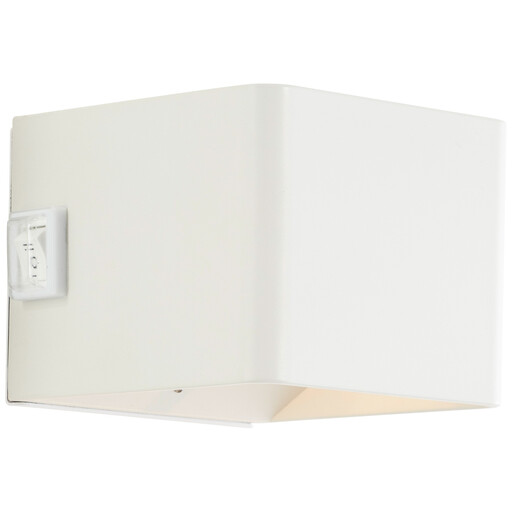
Why this product suits this profile: This portable outdoor LED wall light is ideal for smaller entrance areas, patios or garden locations without a fixed power connection.
The integrated battery and USB cable eliminate the need for complex wiring. The IP44 rating also makes it clear that a sheltered mounting location is advisable.
300 lumens, 3,000 kelvins, integrated battery, USB connection, magnetic mounting and motion sensor.
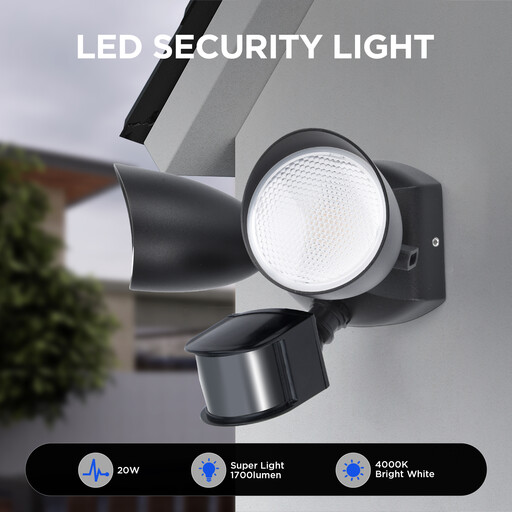
Why this product suits this profile: This mains-powered outdoor floodlight with motion sensor is designed for entrances, courtyards, patios and garden areas where a constant power supply is preferred.
The 20-watt output and stated luminous flux provide a clearly defined basis for planning. Two light heads help with precise positioning.
20 watts, 1,700 lumens, 4,000 kelvins, integrated LED and twin-head design for outdoor walls.

Why this product suits this profile: This solar outdoor light is aimed at garden and home owners who want to illuminate larger areas such as driveways, courtyards or garages without a mains connection.
The three light heads and stated 270° beam range help with planning coverage. IP65 protection and a 1,800-mAh battery are concrete specifications for outdoor use.
302 LEDs, 3,000 lumens, three operating modes, 180° sensor angle, stated range of 60 feet and solar power.

Why this product suits this profile: This outdoor light with camera combines automatic lighting with surveillance, making it suitable for users who also want to monitor their driveway, courtyard or entrance via an app.
The features are clearly specified: dual camera, motion activation, Wi-Fi and local storage option. Before installation, check the power supply, Wi-Fi range and data protection requirements.
2,000 lumens, 360° pan and tilt function, 24/7 recording, dual-band Wi-Fi 6 and compatibility with HomeBase 3.
We have put together a complete, regularly updated list of products that fully meet these strict selection criteria and the safety regulations applicable in the EU.
The sensor should detect the expected movement area as front-on as possible or at a slight angle. Many models are installed at a height of around two to three metres, but the specific manufacturer’s instructions take priority. Avoid pointing the sensor directly at busy roads, moving branches or heat sources. Before working on a permanently connected light, the circuit must be switched off; electrical connections should be handled by a qualified professional.
Service life depends on the LED module, power supply, heat dissipation, switching cycles and weather exposure. With permanently integrated LEDs, replacing the bulb is often not intended. That is why housing quality, IP rating and the manufacturer’s specifications are more important than generalised service-life claims. With battery and solar lights, you should also take battery ageing into account.
A mains-powered light only uses its rated power while it is actively lit. At 20 watts and ten minutes of daily operation, the calculated consumption is around 1.2 kilowatt-hours per year; actual figures depend on the sensor controls and usage. A solar outdoor light does not require direct mains electricity, but it may shine for less time or at a lower brightness when sunlight is limited.