
Lieferung heute & morgen

Qualitätsgarantie

Willkommens-Angebote freischalten: KOSTENLOSE Lieferung | Bis zu 80 % RABATT | Kostenlose 30-Tage-JoyPlus-Testphase
App herunterladen
Whether for your front entrance, balcony, patio or garden path, outdoor lighting in Germany needs to do more than simply look decorative. It is exposed to the weather, temperature fluctuations and, occasionally, splashing water. At the same time, the requirements for an outdoor wall light at an entrance are very different from those for outdoor string lights or decorative Christmas lighting.
If you make your decision based solely on brightness, the number of LEDs or a low price, you will often overlook important details. The following criteria will help you compare outdoor lights objectively and choose the right option for your own outdoor area.
The IP44 rating is often found on LED outdoor lighting and decorative garden lighting. It means that the product is protected against solid foreign objects measuring 1 mm or more, as well as splashing water from different directions. However, IP44 does not mean that a light can be submerged in water or left permanently exposed to heavy rain.
When installing an outdoor wall light, you should therefore also consider its position. Conditions beneath a canopy are different from those on a completely exposed façade. Connections, power supplies and battery compartments must be installed with suitable protection in accordance with the manufacturer's instructions.
The number of LEDs alone does not indicate the light output. For functional lighting, the most important factors are luminous flux in lumens, light distribution and colour temperature. A 15-metre length of outdoor string lights may contain many LEDs while still providing mainly decorative accents.
For paths, entrances and larger patios, the lumen rating is more useful. For example, an LED outdoor wall light with 950 lumens is suitable for a very different purpose from a small battery-powered decorative light.
Warm white light of around 3000 Kelvin often creates a subtle, welcoming atmosphere around entrances, on patios or in gardens. Cool white light of around 6500 Kelvin, on the other hand, appears noticeably brighter and more like daylight. This can be useful for large-scale decoration or a particular event, but may feel less suitable in a cosy seating area.
Product names such as “Firework”, “Meteor” or “Starburst” primarily describe the design. When making your decision, you should also consider the cable length, power supply, IP rating and installation method.
An IP44 outdoor light may be suitable for covered outdoor areas, provided that the surroundings meet the manufacturer's specifications. For permanently exposed locations, buyers should check whether a higher IP rating is required. A light with a mains connection should only be installed at a suitable outdoor socket or by a qualified professional.
Battery-powered models offer greater flexibility but require regular battery replacement. The battery compartment should be positioned so that water cannot collect inside it. Batteries should not be left in a product that will not be used for an extended period.
The following specifications are particularly useful when making your choice:
Metal, plastic, glass and matt finishes differ in weight, appearance and cleaning requirements. The EGLO Mazzini, for example, has a metal and plastic housing with an anthracite finish and a white diffuser. It is designed to be cleaned with a damp cloth; abrasive cleaning products should be avoided.
With integrated LED modules, you should also check whether the light source can be replaced. According to the product information, the LED module in the Mazzini model is not replaceable. This may be relevant when planning for long-term use.
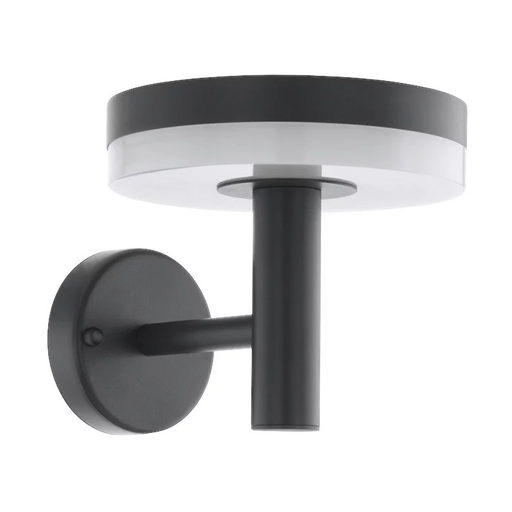
Why this product suits this profile: This integrated LED outdoor wall light is designed for entrances, patios, gardens and paths, and does not require a separate bulb.
The specifications state 950 lumens, 11 W and 3000 K. This makes it easier to assess the light objectively rather than relying solely on promotional brightness claims.
950 lm luminous flux, warm white light at 3000 K, 11 W LED module and anthracite metal and plastic construction.
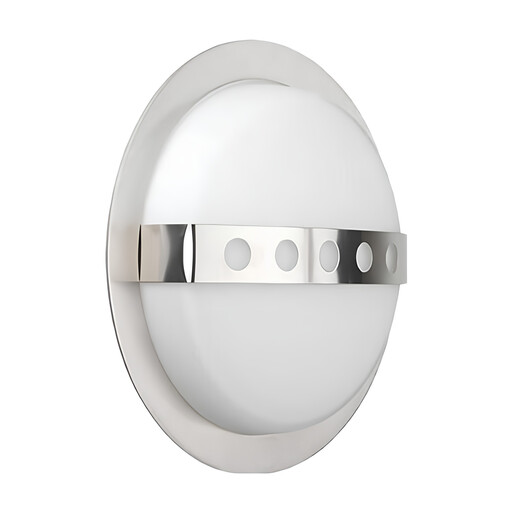
Why this product suits this profile: This classic outdoor wall light, with matt nickel and satin-finish glass, is suitable for permanently installed wall lighting.
The IP44 rating is stated explicitly. This allows buyers to assess its suitability for splashing water without confusing IP44 with protection against immersion.
2050 lm, 230-volt connection, IP44, matt nickel, satin-finish glass and dimensions of 32.5 × 9.2 cm.
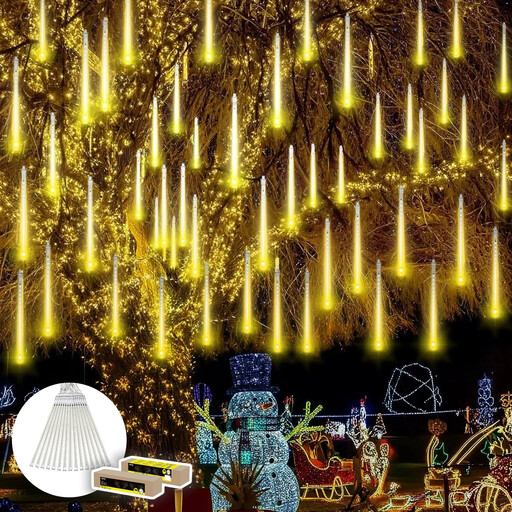
Why this product suits this profile: With 15 hanging elements, this meteor shower light chain is designed for large-scale decoration on trees, façades or covered patios.
The product data specifies the coverage, number of LEDs, spacing between the hanging points and IP rating. This lets you check in advance whether the decoration will suit the available area.
720 LEDs at 3000 K, 15 hanging points, 10 × 0.5 m coverage area, 9 W adapter and IP44.
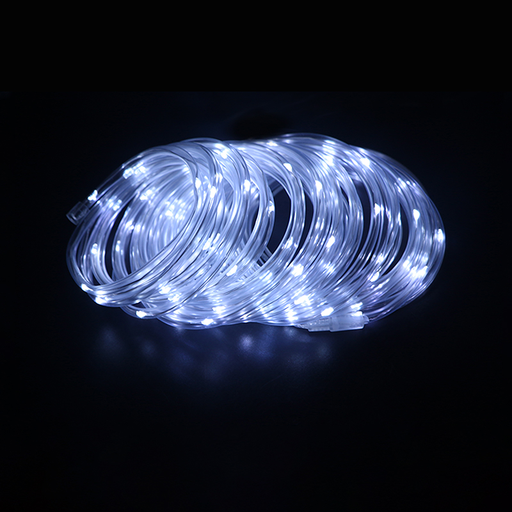
Why this product suits this profile: This battery-powered string light is suitable for balcony, garden, party and Christmas decorations when there is no power socket nearby.
The total length of 15.3 metres, the 10 cm LED spacing and the three AA batteries required are clearly specified. This makes installation planning easier.
150 LEDs at 6500 K, 15.3 m length, eight lighting functions, memory function and IP44 protection.
We have put together a complete, regularly updated list of products that fully meet these strict selection criteria and the safety regulations applicable in the EU.
This depends on the installation location. IP44 protects against splashing water and can be used in suitable, partially sheltered outdoor areas. A higher IP rating may be required for completely exposed or particularly damp locations. Local conditions and the manufacturer's specifications are the deciding factors.
For seating areas and calm patio lighting, warm white LED lighting of around 3000 K is often chosen. Cool white light of around 6500 K resembles daylight and can be used for large-scale decorations or specific events. There is no one-size-fits-all choice; the right option depends on how you intend to use it and the lighting effect you want to create.
For a rough calculation, you need the wattage, daily operating time and electricity price. An 11 W light uses 0.011 kWh after one hour of operation. With battery-powered models, regular battery purchases replace electricity costs. Timers, a memory function and switching the lights on only when needed can reduce operating time.