
Lieferung heute & morgen

Qualitätsgarantie

Willkommens-Angebote freischalten: KOSTENLOSE Lieferung | Bis zu 80 % RABATT | Kostenlose 30-Tage-JoyPlus-Testphase
App herunterladen
Outdoor lighting can make paths and entrances clearly visible, make spending time on the patio more enjoyable or create a decorative atmosphere for celebrations. However, choosing the right product involves more than just the lumen rating, design and an attractive price. The key factors are where the light will be used, how it is powered, its protection against the weather and how it is controlled.
Wattage mainly describes energy consumption, not the amount of light produced. The lumen value is what determines brightness. A modern LED light can produce a high light output while using comparatively little power. You should therefore consider the ratio of watts to lumens, as well as the intended application.
A different light output is suitable for a front entrance than for a decorative string of lights. An LED floodlight for outdoor use generally requires significantly more lumens than a small warm-white outdoor light for a balcony or patio.
Terms such as weather-resistant or waterproof should not be the only reason for choosing a product. Look for a specific IP rating. The first digit describes protection against solid foreign objects, while the second indicates protection against water. Different requirements apply depending on the installation location:
If there is no clear, verifiable marking, you should check the product information more carefully before buying.
An outdoor light with a motion sensor can only switch on reliably when the detection angle, range and installation height are suitable for the property. Passing cars, animals or moving branches can trigger the sensor unnecessarily. With an outdoor light fitted with a light sensor, it is also important to check whether it is activated only in the dark or whether additional settings are available.
Solar lights are flexible to install, but require sufficient direct sunlight. A solar and battery-powered string of lights is therefore mainly suitable for decorative purposes and should not automatically be regarded as permanent security lighting.
Light colour is measured in Kelvin. Warm-white light at around 2,700 to 3,300 Kelvin usually creates a subtle, welcoming effect and is suitable for seating areas, balconies and decorative lighting. Neutral-white light of around 4,000 Kelvin can illuminate contours and surfaces in a more functional way. Warm-white outdoor lighting is therefore often a good choice for patios and gardens, while neutral-white light can be practical for functional lights at an entrance or garage.
In addition to lumens and Kelvin, the beam angle is also important. A wide beam can illuminate a driveway or seating area. An adjustable or split beam makes it possible to cover several areas more precisely.
Metal housings can provide a robust construction for permanently installed wall lights and floodlights. Nevertheless, you should check whether the screws, seals and mounting materials are suitable for the location. If you live in rented accommodation, you should also consider drilling, cable routing and whether your landlord’s permission is required.
An LED outdoor wall light should be positioned so that it does not dazzle neighbours or shine directly into windows. For motion sensors, mounting the light on a stable surface helps prevent unnecessary activation caused by vibrations.
Mains-powered lights are suitable for lighting that is available continuously, but require an appropriate connection point. Work on fixed electrical installations in Germany should be carried out by a suitably qualified professional.
Battery-powered products are easier to use flexibly. Before buying, check the battery type, how accessible the battery compartment is and the expected operating time. For Christmas lights intended for indoor and outdoor use, the cables, power supply and controls should be explicitly designed for the relevant environment.
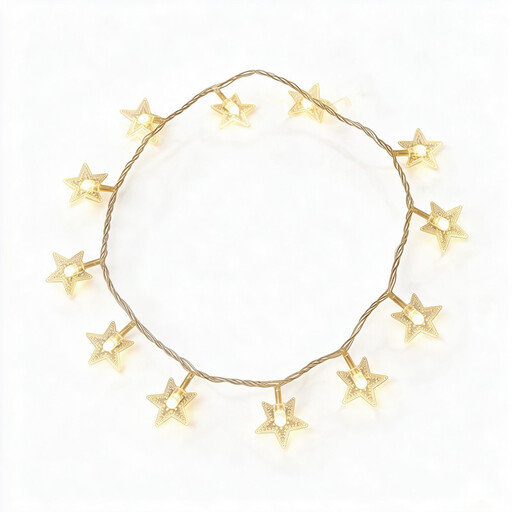
Why this product suits this profile: This battery-powered string of lights can be attached to a tree, railing, table decoration or balcony without needing a socket. With 20 star-shaped LEDs and a length of 9.8 feet, approximately 2.99 metres, it is designed for smaller decorative areas.
The power supply is clearly described as battery-operated. This means you do not need to find an outdoor socket. However, it should not be relied on as a replacement for a functional light where essential security lighting is required.
20 warm-white LEDs, battery operation and stated suitability for indoor and outdoor use support flexible decorative lighting.
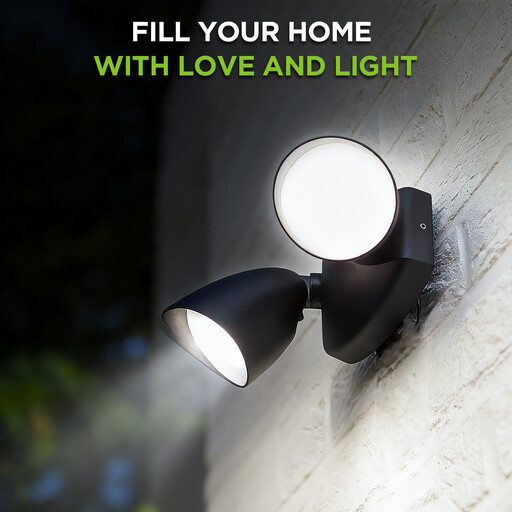
Why this product suits this profile: This functional light is specified as delivering 1,800 lumens at 20 watts, with two light heads and a colour temperature of 4,000 Kelvin. It is suitable for buyers who prefer directed illumination of a courtyard, garden or patio.
The light output, power consumption and colour temperature are all clearly specified. This makes it easier to assess the product compared with general advertising claims about brightness. The product title also indicates a waterproof outdoor housing; check the installation instructions and IP rating before installation.
1,800 lumens, 20 watts, two adjustable heads and an all-metal housing according to the product description.
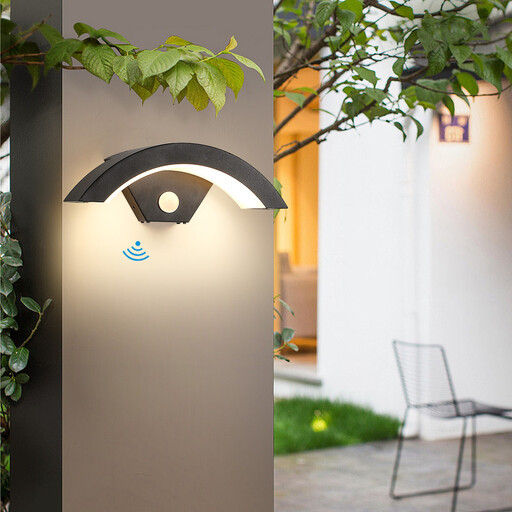
Why this product suits this profile: According to the product description, this LED outdoor wall light combines a light sensor with a motion sensor. It is designed for entrances, paths, balconies, patios, garage driveways and stairways.
The light sensor and motion sensor are explicitly listed. This allows buyers to check more precisely whether the automatic switching is suitable for the installation location, rather than relying solely on general claims about sensor functionality.
24 watts, warm-white light at 3,000 Kelvin, an aluminium housing and high weather resistance according to the description.
We have put together a complete, regularly updated list of products that fully meet these strict selection criteria and the safety regulations applicable in the EU.
An LED outdoor wall light or an outdoor light with a motion sensor is often suitable for front entrances. An appropriate IP rating, glare-free positioning and a sensor location that reliably detects people approaching the entrance are important. In a dark entrance area, combining a wall light with decorative lighting can be a practical option.
Consumption depends on the power rating in watts and the daily operating time. A 20-watt light uses 0.02 kilowatt-hours when operated for one hour. Sensors can reduce the operating time if they are set up correctly. Battery-powered string lights do not consume mains electricity directly, but they do require regular battery replacement.
Service life depends, among other things, on operating hours, temperature, moisture, installation and the quality of the power supply. With LED products, buyers should check the service life stated by the manufacturer, warranty terms and whether the power supply or light source can be replaced. Regularly checking seals, cables and fixings can help identify damage at an early stage.