
Lieferung heute & morgen

Qualitätsgarantie

Willkommens-Angebote freischalten: KOSTENLOSE Lieferung | Bis zu 80 % RABATT | Kostenlose 30-Tage-JoyPlus-Testphase
App herunterladen
The right outdoor lighting should reliably illuminate paths, entrances and seating areas while blending harmoniously into its surroundings. However, design and brightness are not the only considerations when buying. Unclear protection ratings, unsuitable power supplies or incorrectly assessed installation conditions can often lead to unnecessary follow-up costs.
This buying guide explains what homeowners, tenants and garden owners in Germany should look out for. You will then find a selection of LED outdoor lights, outdoor wall lights, solar lights and lights with motion sensors for different situations.
The IP44 rating means protection against solid foreign objects above a certain size and against splashing water from various directions. IP44 outdoor lighting is therefore suitable for many sheltered outdoor areas, but not automatically for prolonged heavy rain, standing water or pressure washing.
For an outdoor wall light installed beneath a canopy, IP44 may be sufficient. On a completely exposed façade or in a dip where water can collect, buyers should check the installation position and the protection rating specified by the manufacturer particularly carefully. The term ‘waterproof outdoor lamp’ alone is not technical proof of waterproofing.
Power consumption in watts describes electricity usage, not the amount of light directly. For comparing LED outdoor wall lights and outdoor spotlights, luminous flux in lumens is more informative. Colour temperature in kelvin also affects the lighting effect:
A very bright light is not automatically the right choice. Too much light can disturb neighbours, cause glare or use more energy than necessary.
Hard-wired outdoor lights require a suitable electrical installation. In Germany, work on fixed electrical systems should be left to an appropriately qualified professional. Before buying, also check the cable length, connection type, mounting surface and the space available for the junction box.
Battery- or USB-powered lights are more flexible, but need to be recharged regularly. Solar lights in the garden need to be positioned where they receive sufficient sunlight. Trees, walls and canopies can extend charging times and reduce operating time.
For covered entrance areas or sheltered patios, IP44 outdoor lighting may be suitable. Locations directly exposed to the elements require the manufacturer’s specifications to be checked carefully. The light must be securely mounted, and seals must not be damaged during installation.
The mounting surface is also important: a heavy metal light requires a strong, load-bearing fixing. In rented properties, portable battery-powered or magnetic models can be a practical alternative, provided they are securely attached.
Pay attention to the combination of lumens, beam angle and light colour. An outdoor spotlight with an adjustable head can be aimed precisely at a driveway or area of the garden. A diffuse outdoor wall light, on the other hand, distributes light more softly and is better suited to doors, walls or seating areas.
For lights with integrated LEDs, you should also check whether the LED module can be replaced. On some lights, it is permanently integrated. Although this reduces the effort involved in changing the light source, a later fault may mean that the entire light has to be replaced.
An outdoor light with a motion sensor switches on automatically when movement is detected. Before buying, consider the detection range, stay-on time and possible false triggers caused by pets, passing vehicles or moving plants.
A dusk sensor can prevent the light from being activated during daylight. With solar lights, automatic activation when it gets dark is often already part of the design.
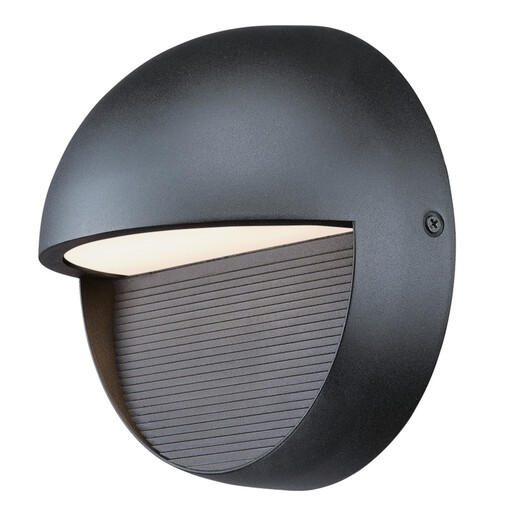
Why this product suits the profile: This compact, round outdoor wall light combines an integrated 10-watt LED module with an IP44 protection rating, making it suitable for sheltered entrances, patios or garden walls.
The protection rating is clearly specified. The manufacturer also states that the light is compatible with an external LED dimmer; the dimmer is not included.
Frosted opal glass, textured black finish, 220–240 V at 50 Hz and compact dimensions of approximately 16 cm.
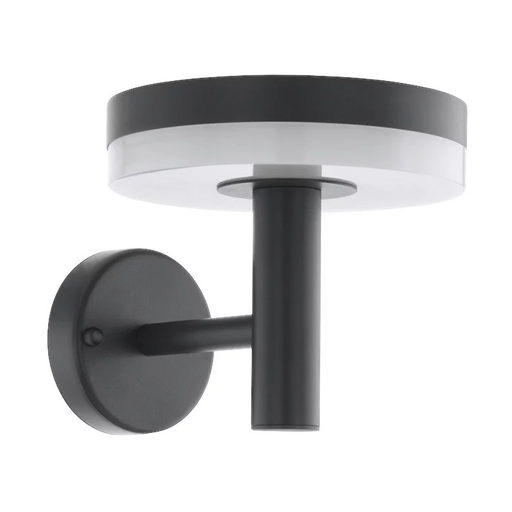
Why this product suits the profile: This light offers 950 lumens, warm white light at 3,000 kelvin and a permanently integrated LED module for entrances, patios and paths.
Luminous flux and colour temperature are clearly specified. This makes it easier to compare the light with the intended installation location.
Anthracite-coloured metal and plastic construction, warm white 3,000-kelvin illumination and 950 lumens.
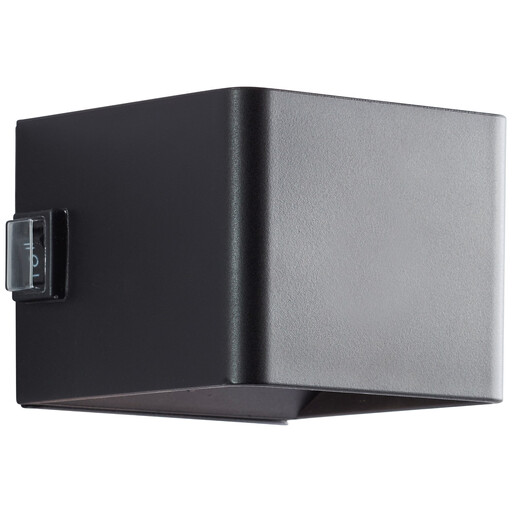
Why this product suits the profile: This battery-powered light can be used without a fixed power connection and offers 300 lumens, 3,000 kelvin, USB charging, a magnet and a motion sensor.
The portable power supply reduces installation work. However, the IP44 rating should not be confused with protection against immersion.
Battery, USB connection, magnetic mounting, rocker switch and integrated motion sensor with a power consumption of 4 watts.
We have put together a complete, regularly updated list of products that fully meet these strict selection criteria and the safety regulations applicable in the EU.
That depends on where it is installed. IP44 protects against splashing water and may be suitable for many sheltered outdoor areas. For exposed façades, ground lights or areas regularly affected by heavy rain, the manufacturer’s specific information and the installation conditions should be checked.
Lower luminous flux is often sufficient for decorative garden lighting. Paths, entrances and garages generally require more targeted illumination. In addition to lumens, the beam angle, installation height and distance from the area are also important. More lumens are not always better if they create glare.
Solar lights draw their energy from daylight and do not require a mains connection. However, actual operating time depends on sunlight, the time of year, battery capacity and shade. For consistently predictable lighting at entrances or garages, a hard-wired LED light or a rechargeable battery-powered outdoor light may be more suitable.