
Lieferung heute & morgen

Qualitätsgarantie

Willkommens-Angebote freischalten: KOSTENLOSE Lieferung | Bis zu 80 % RABATT | Kostenlose 30-Tage-JoyPlus-Testphase
App herunterladen
The right outdoor lighting can make paths easier to see, brighten up your entrance or create an atmospheric setting in your garden and patio. In practice, however, unclear IP ratings, incorrectly judged light levels and unsuitable mounting methods often lead to disappointing purchases. When choosing outdoor lights in particular, it is therefore worth looking at the technical specifications rather than relying solely on product images and marketing claims.
An IP44 outdoor light is protected against solid foreign objects measuring 1 millimetre or more, as well as splashing water from various directions. This does not mean it is suitable for prolonged heavy rain, standing water or complete immersion. For more exposed areas, a light with IP65 may be the better choice. Even a lamp advertised as “waterproof outdoor lighting” should be checked against its specific IP rating.
A solar garden light needs sufficient direct sunlight, or at least bright daylight, during the day. Under trees, on a north-facing wall or next to tall hedges, the operating time can be significantly shorter than under ideal conditions. The stated charging and operating times should therefore be understood as the manufacturer's figures under suitable conditions, not as a guaranteed value for every garden.
Warm white light at around 2,700 to 3,000 Kelvin is often ideal for seating areas, patios and decorative façades. Neutral white light at around 4,000 Kelvin provides clearer illumination for paths or work areas. Cool daylight white at approximately 5,000 Kelvin can be suitable for garages and security areas, but may look rather stark in a small balcony space. Alongside the colour temperature, buyers should also consider the luminous flux in lumens. Wattage alone does not indicate how bright an LED outdoor light actually is.
Before choosing an outdoor lamp, you should establish whether it will be installed under a porch, on an exposed façade, in a flower bed or directly beside a path. For an outdoor wall light at a sheltered entrance, IP44 may be sufficient, provided it is installed correctly. For locations more exposed to the weather, higher IP ratings should be considered.
The materials and build quality are also important:
Solar lights do not require a permanent power connection, but they depend on daylight. Mains-powered outdoor wall lights generally provide a consistent power supply, but a fixed connection must be installed professionally. Work on 220–240-volt systems should be carried out by a qualified electrician.
For an outdoor lamp with a motion sensor, the detection angle, range and timer duration are crucial. Garden spotlights should have an adjustable light head. For paths, several lower-powered path lights can create more even illumination than one very bright point of light.
With integrated LEDs, check whether the LED module can be replaced. With some models, the entire light must be replaced if a fault occurs. A dimmable outdoor light also requires a compatible LED dimmer; an existing dimmer switch is not automatically suitable.
RGB garden lighting and CCT functions allow you to create coloured light or adjust the colour temperature. With smart models, check compatibility with the app, Wi-Fi or voice assistants before buying. Additional features can make operation more convenient, but are not necessary for every application.
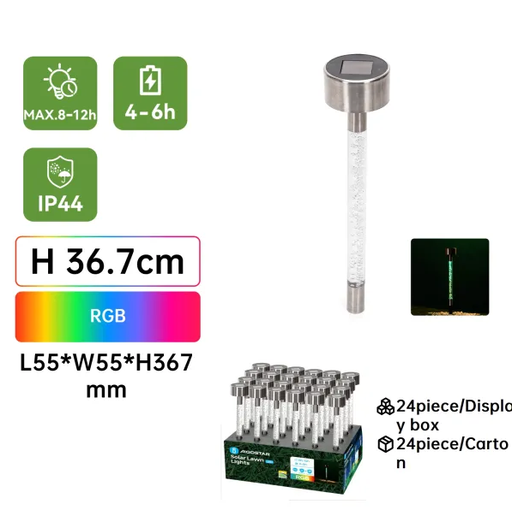
Why this product suits this profile: This solar garden light is ideal for flower beds, lawns and paths without a direct power connection. RGB lighting and its height of 36.7 cm add decorative accents.
The product details clearly state the IP44 rating, charging time and operating time. This makes it easier to plan the location realistically; however, the light is not designed for immersion.
Integrated rechargeable battery, amorphous silicon solar panel, RGB function and a stated lighting duration of 8–12 hours under suitable charging conditions.
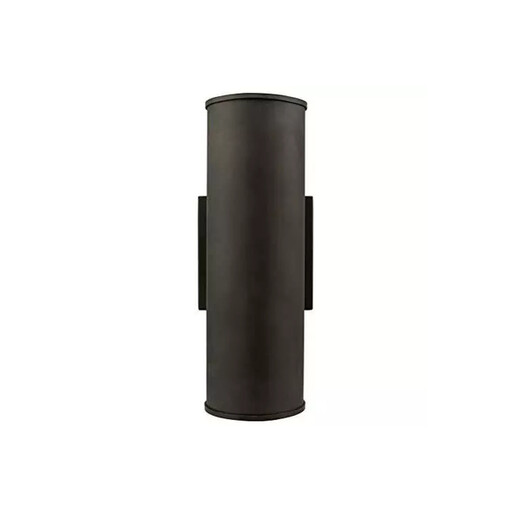
Why this product suits this profile: This LED outdoor light is aimed at homeowners looking for fixed lighting for an entrance, patio or garage, backed by clear technical specifications.
The choice is based on more than just the design: IP44, 3000 Kelvin, 870 lumens and two integrated 8-watt LEDs are all clearly specified.
Upward and downward lighting, warm white light and mounting hardware included. The light is designed for 220–240 volts.
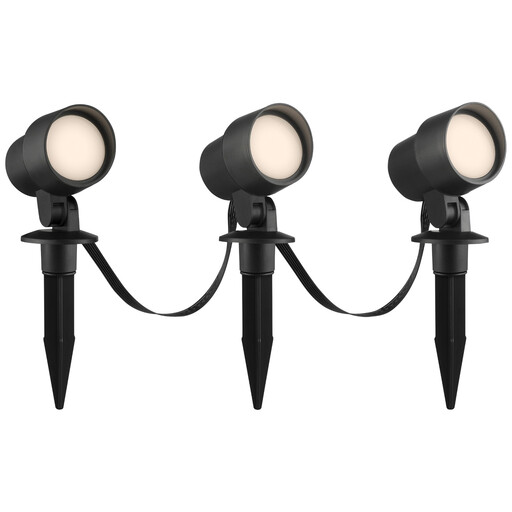
Why this product suits this profile: This set is ideal for users who want to illuminate flower beds, paths or patios flexibly and adjust the light colour and colours via an app.
The three lights allow for more even positioning than a single spotlight. However, IP44 is designed only for protection against splashing water, so installation should be suitably sheltered.
Dimming function, RGB and CCT selection, plus Tuya Smart compatibility. The lights are supplied as a set with ground spikes.
We have put together a complete, regularly updated list of products that fully meet these strict selection criteria and the safety regulations applicable in the EU.
This depends on the installation location. IP44 protects against splashing water and is suitable for many sheltered outdoor areas. For open, heavily exposed locations, buyers should consider a higher rating such as IP65. Regardless of its IP rating, the light must not be immersed in water.
Consumption depends on the wattage and the number of hours it operates each day. A 10-watt light running for five hours a day uses 0.05 kilowatt hours per day in theory. Solar lights do not use mains electricity while operating, but they do depend on the charging conditions.
The manufacturer states the lifespan in operating hours. It depends, among other things, on heat, switching cycles, moisture and the power supply. With integrated LEDs, check before buying whether the module can be replaced. Regular cleaning and professional installation can help maintain the intended operating conditions.