
Lieferung heute & morgen

Qualitätsgarantie

Willkommens-Angebote freischalten: KOSTENLOSE Lieferung | Bis zu 80 % RABATT | Kostenlose 30-Tage-JoyPlus-Testphase
App herunterladen
The right outdoor lighting can illuminate paths, light up entrances, or create a pleasant ambience on your patio or balcony. However, technical specifications and product images don't always lead to the right purchasing decision. All too often, lights are bought that end up being too dim for their intended location, aren't sufficiently protected against moisture, or have a battery that doesn't last long enough in everyday use.
This buying guide highlights which specifications for LED outdoor lights, solar garden lights and outdoor wall lights are truly relevant.
A rating such as IP44 means protection against solid objects larger than 1 mm and against splashing water from any direction. It does not mean protection against high-pressure water, continuous submersion, or standing water. For exposed locations, buyers should therefore check carefully which protection rating the manufacturer specifies.
IP66 offers a higher level of protection against dust and powerful water jets. Even so, electrical connections must still be professionally secured against moisture. With ground lights, it's also important that no water can collect at the installation site.
The wattage primarily describes energy consumption. For brightness, the luminous flux in lumens is what matters. A decorative solar light with a low lumen count may be sufficient for flower beds or accent lighting, but it won't replace an outdoor LED floodlight.
Colour temperature also affects how you use the light:
A stated lighting duration usually applies under suitable conditions. Solar garden lights need a location with as much direct sunlight as possible. Shade from house walls, trees or overhangs reduces charging performance.
With battery-powered outdoor lights, the charging time, battery type and intended use all need to match. A light with six hours of battery life may be enough for an evening on the table, but it isn't automatically suitable for permanent security lighting.
For covered balconies or sheltered patios, IP44 outdoor lights may be suitable, provided they aren't permanently exposed to rain or splashing water. For freestanding lights and exposed wall areas, a higher protection rating is often advisable. The installation instructions and manufacturer's specifications are what you should follow.
For decorative purposes, low to medium lumen values are often sufficient. Entrances, steps and driveways, on the other hand, need more targeted illumination. With outdoor wall lights that have a motion sensor, it also matters at what angle the sensor detects movement and whether the light has an adjustable detection range.
Solar lights don't need a fixed power cable, but they depend on daylight. USB outdoor lights can be placed flexibly but need to be recharged regularly. Hardwired lights should only be connected to suitable outlets and, if necessary, installed by a qualified person. For products without a supplied plug, the connection type should be checked particularly carefully before purchase.
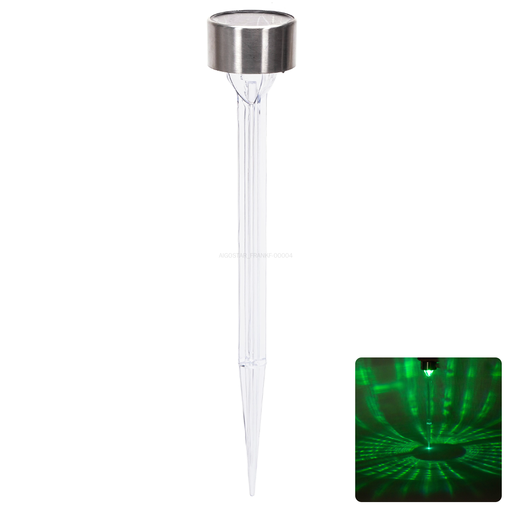
Why this product fits the profile: This solar ground light is simply pushed into soft soil or grass and requires no mains connection. That makes it ideal for adding initial accents along paths, in flower beds or on smaller plots.
The technical specifications state a charging time of around 4 to 6 hours, a lighting duration of 8 to 12 hours under suitable conditions, and an IP44 protection rating. This makes it easier to assess its limitations.
RGB light, integrated solar panel and ground spike installation; dimensions of 55 × 55 × 320 mm.
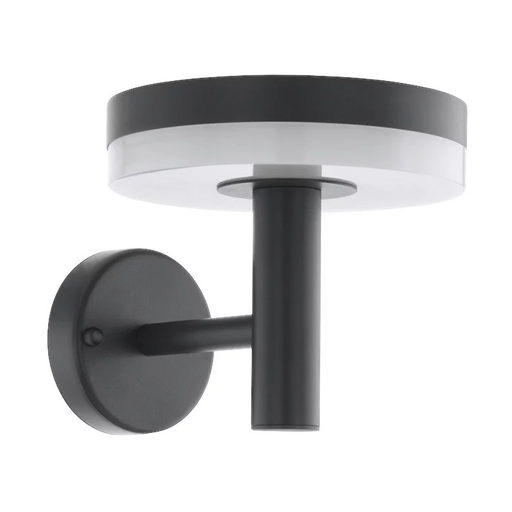
Why this product fits the profile: This hardwired outdoor wall light is designed for entrances, patios, gardens and pathways. The anthracite housing with a white diffuser blends in with a variety of facades.
The selection is based on concrete specifications rather than vague brightness claims: 11 W power consumption, 950 lm luminous flux and 3,000 K colour temperature are all clearly stated.
Integrated LED module, 950 lm and warm white light at 3,000 K; dimensions of 24.5 × 18 × 24.5 cm.
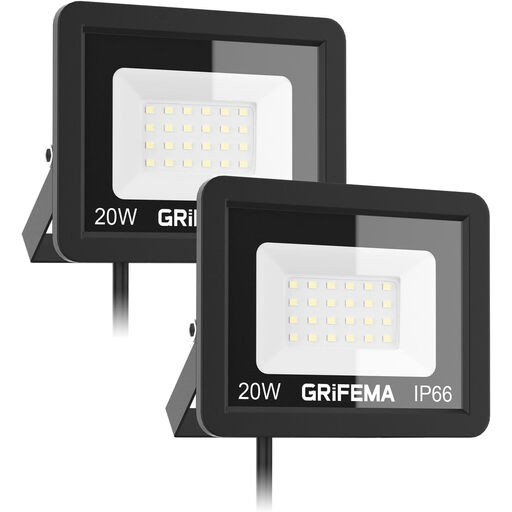
Why this product fits the profile: This two-pack is aimed at users who want to illuminate gardens, garages, courtyards or work areas over a large area with bright light.
The IP66 protection rating is explicitly stated and is higher than the splash-water protection of IP44. For installation, the power supply and connections must still be weatherproofed.
Two floodlights at 20 W each, combined 2,200 lm, 6,500 K and an adjustable 180° bracket.
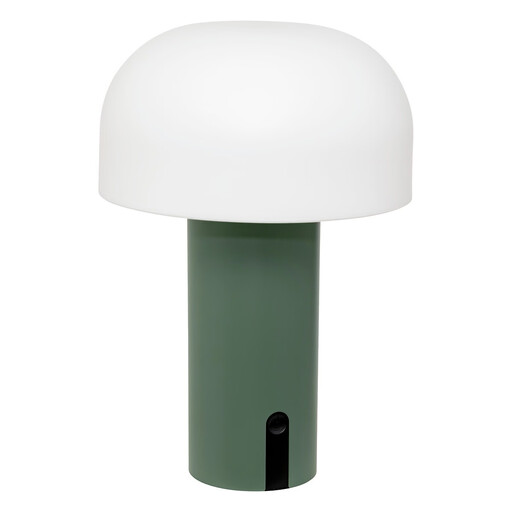
Why this product fits the profile: This compact LED table lamp can be used on a balcony, patio or garden table without any fixed installation, and simply stored away after use.
Battery life and charging time are clearly stated: up to 6 hours of operation with around 5 to 6 hours of charging time. The IP44 protection rating limits its use to suitable outdoor areas.
90 lm, warm white LED light at 3,000 K, USB-C cable and touch-sensitive switch; compact height of 22 cm.
We've put together a full, regularly updated list of products that fully meet these strict selection criteria and the safety regulations in force in the EU.
Solar garden lights and rechargeable battery-powered outdoor lights don't need a fixed power cable. Solar lights depend on direct sunlight. USB lights can be charged regardless of the weather, but need to be connected to a power source regularly.
IP44 can be suitable for covered balconies, patios and sheltered entrance areas. The light should not be standing in water or exposed to persistent heavy rain. For more exposed installation locations, a higher protection rating such as IP66 should be considered.
The cost depends on the wattage, usage time and electricity tariff. A light with 11 W uses around 0.11 kWh when operated for ten hours. Solar lights don't consume any mains electricity during operation, but they do require batteries that may need replacing later, depending on the design and usage.