
Lieferung heute & morgen

Qualitätsgarantie

Willkommens-Angebote freischalten: KOSTENLOSE Lieferung | Bis zu 80 % RABATT | Kostenlose 30-Tage-JoyPlus-Testphase
App herunterladen
Whether you’re lighting your front door, balcony, patio, garden path or garage, outdoor lights need to suit their location, power supply and exposure to the weather. Good looks alone aren’t enough. Unclear IP ratings, unsuitable light colours and poorly planned mounting positions can all lead to the wrong purchase.
This buying guide from the Joybuy Product Recommendation Officer explains the key technical details and explores which outdoor lighting could suit different needs in Germany.
The luminous flux, measured in lumens (lm), tells you how much visible light a fitting produces. It doesn’t, on its own, show how evenly it will light a path, wall or patio. The beam angle, mounting height and direction also affect the result.
A bright LED outdoor light might be too powerful for a small balcony, while a decorative solar light may not provide enough guidance around a dark courtyard.
Check the IP rating. The first digit indicates protection against solid objects and dust; the second indicates protection against water. IP44, for example, means protection against solid objects 1 mm or larger and splashing water from any direction. Other ratings may be more suitable for areas that are more exposed.
An IP44 light shouldn’t be installed somewhere it will be exposed to a direct jet of water or standing water for long periods. Always follow the installation instructions and ensure the fitting is properly sealed.
A solar garden light needs plenty of direct sunlight to charge its battery. Trees, walls and canopies can reduce the panel’s charging capacity. The stated run time therefore depends on the weather, location, battery condition and time of year.
Solar lights are particularly useful for guidance and ambience. For consistent courtyard lighting or illumination around an entrance, a mains-powered outdoor light is often a more dependable choice.
Colour temperature is measured in kelvins (K):
For an outdoor wall light by the front door, glare and beam direction matter just as much as light colour. Adjustable heads can direct the beam more precisely towards a driveway, door or path.
Before buying, check:
For a weather-resistant garden light, it’s also worth checking whether the bulb can be replaced. Integrated LED modules don’t need a separate bulb, but depending on their design, the module may not be replaceable on its own if it fails.
An outdoor light with a motion sensor switches on only when it detects movement. Its range, detection angle, on-time and sensitivity should suit the location. Automatic activation is useful for paths and garage driveways. For patio lighting, a model that can stay on or be dimmed may be more convenient.

Why this product suits this profile: This solar path light doesn’t need a mains connection and can be placed in soft ground. It’s a practical choice for your first garden lighting project or for illuminating the edges of flowerbeds.
The specifications state a charging time of 4 to 6 hours, a run time of 8 to 12 hours and an IP44 rating. However, a spot with direct sunlight is still essential.
Wireless installation, NiMH battery, polycrystalline solar panel and a colour temperature of 6.500 K.
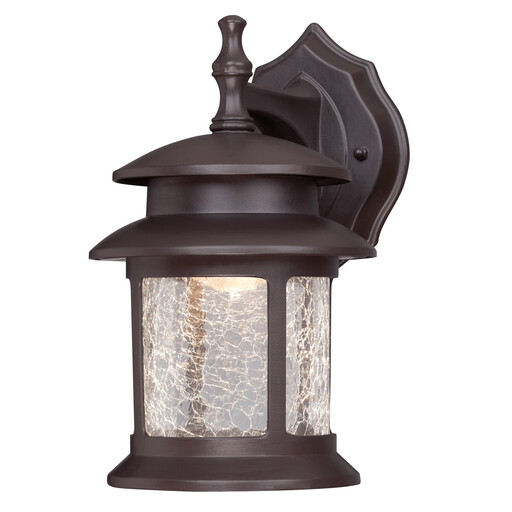
Why this product suits this profile: This aluminium light with clear-glass styling is designed for entrances, patios and exterior walls. It provides warm white light at 3.000 K.
Its IP44 rating is clearly stated, and the installation guidance calls for proper fitting and suitable sealing.
9 W integrated LED, 1.000 lm luminous flux from the light source, dimmable with a compatible LED dimmer and a stated average lifespan of 35.000 hours.
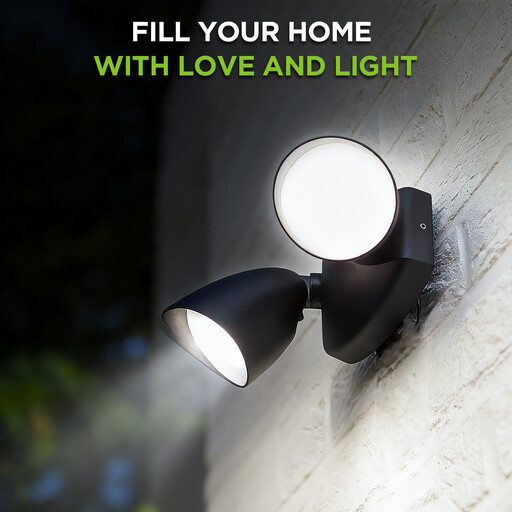
Why this product suits this profile: With two light heads and 1.800 lm, this model can illuminate larger areas such as courtyards, garages, gardens or driveways, with the flexibility to direct the beams where needed.
The dual-head design spreads light across two adjustable areas rather than producing just one narrow beam.
20 W power, a colour temperature of 4.000 K and an all-metal construction, according to the product specifications.
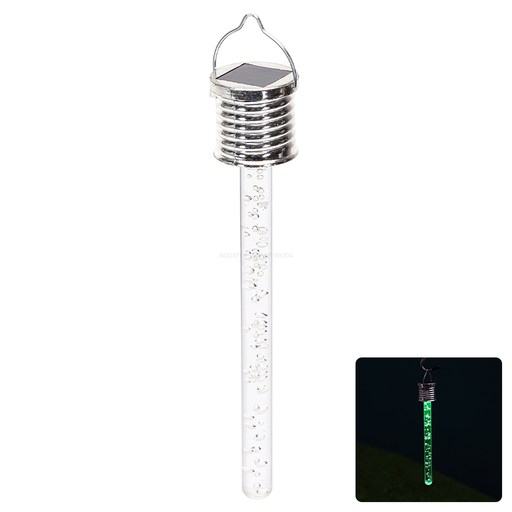
Why this product suits this profile: This compact solar light with RGB lighting is designed for flowerbeds, lawns, paths and small outdoor areas where decorative accents matter more than bright general illumination.
The specifications state an IP44 rating, a charging time of 4 to 6 hours and a run time of 8 to 12 hours. This makes it clear that the light is a decorative solar option.
RGB colour-changing light, automatic switch-on at dusk, 0,006 W power and a stated lifespan of 15.000 hours.
We’ve put together a complete, regularly updated list of products that meet these strict selection criteria and fully comply with the safety regulations in force in the EU.
Path lights, bollard lights and solar lights with ground stakes are all options for paths. Look for even light distribution, secure installation and an IP rating suited to the location. For longer paths, spacing several lights evenly may work better than relying on one bright light.
Consumption depends on the light’s power and how long it’s on. A 10 W light switched on for five hours a day uses 50 Wh per day. Motion sensors, timers and dusk sensors can reduce how long it operates. Solar lights don’t use mains electricity while running, but their light output depends on sunlight and the battery’s charge level.
Lifespan is often given in hours, for example 15.000 or 35.000 hours. This is a manufacturer’s estimate and depends, among other things, on temperature, moisture, switching cycles and correct installation. If the light has an integrated LED, check before buying whether the module can be replaced.