
Lieferung heute & morgen

Qualitätsgarantie

Willkommens-Angebote freischalten: KOSTENLOSE Lieferung | Bis zu 80 % RABATT | Kostenlose 30-Tage-JoyPlus-Testphase
App herunterladen
A well-chosen outdoor motion sensor light enhances pathway safety, deters unwanted visitors, and provides convenience when you arrive home after dark. However, the market is flooded with products whose promises fail to hold up after the first winter. Before you make a decision, it's crucial to understand the common pitfalls that often lead to disappointment and unnecessary expense.
As your Joybuy Product Recommendation Officer, I'm here to help you separate marketing hype from reality. Here are the most common problems and what you should look out for.
The 3 Most Common Pitfalls When Buying Outdoor Lights:
solar light with motion sensor. An undersized solar panel or a weak battery means the light won't collect enough energy on cloudy days to stay operational all night. The result: your property is left in the dark precisely when you need the light most.To avoid a bad purchase, you should focus on objective, technical specifications rather than marketing promises. These three criteria are crucial for the longevity and performance of your outdoor lighting.
The IP (Ingress Protection) rating indicates how well an electrical device is protected against the entry of foreign objects (first digit) and water (second digit). For outdoor use, the following ratings are relevant:
outdoor security light.The choice of power supply depends on your installation location and your needs.
A good motion sensor is the heart of the light. Two specifications are crucial here:
garden light with a motion sensor along a path, 5–8 metres is often enough. For a large yard or driveway, the range should be at least 10–12 metres.Instead of making a one-size-fits-all recommendation, we have selected products tailored to specific needs and use cases.

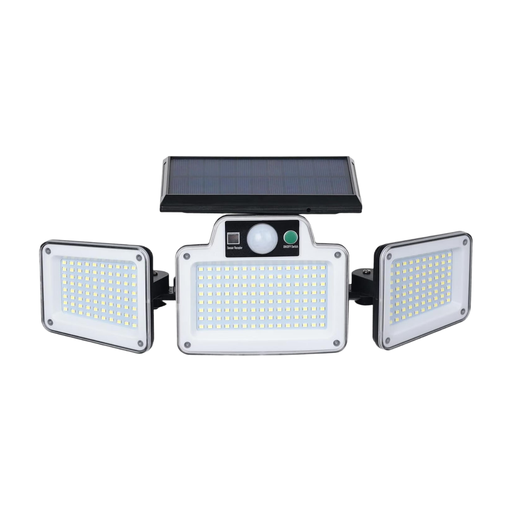
Why it's a great fit: Ideal for homeowners who need powerful and flexible lighting for driveways, yards, or large gardens. The three adjustable heads allow for wide and targeted illumination.
The high output of 3000 lumens and 302 LEDs provides intense illumination, avoiding the "lumen hype" trap. Furthermore, the IP65 certification ensures high weather resistance.
According to the manufacturer, the sensor offers a long range of up to 18 metres and a wide 180° detection angle, enabling early motion detection on large properties.
Why it's a great fit: Perfect for gardens or tricky areas where the light needs to be mounted in the shade, but the solar panel can be placed in the sun. Ideal for sustainable lighting of paths and flowerbeds.
The separate solar panel with a long cable (approx. 4.7 m) solves the problem of weak solar performance. You can place the panel in the sunniest spot, regardless of where the light itself is mounted.
Three different lighting modes, adjustable via remote control, offer flexibility—from pure motion detection to a permanent dim light at night.

Why it's a great fit: The perfect solution for renters or anyone looking for a hassle-free, non-permanent lighting solution for a balcony, patio, or shed. No drilling, no wires.
This model bypasses the installation hurdles of mains-powered lights. Thanks to its integrated battery and magnetic mount, it can be flexibly attached to metal surfaces and removed as needed.
Portability is its biggest asset. The battery is easily recharged via a USB cable. The IP44 rating is sufficient for use in splash-proof areas like covered balconies.
We have compiled a complete, up-to-date list of products that fully meet these strict selection criteria and safety standards.
A mounting height of about 2 to 2.5 metres is ideal in most cases. At this height, the light is protected from easy tampering, and the motion sensor can cover an optimal area without being constantly triggered by small animals like cats or hedgehogs.
Yes, modern solar lights are designed to operate in winter. However, their efficiency heavily depends on the quality of the solar panel and the battery capacity. On short, heavily overcast days, the runtime may be reduced. Models with a large, efficient panel and a power-saving mode (e.g., a dim continuous light that brightens when motion is detected) are better suited for winter use.
Most outdoor lights use a PIR (Passive Infrared) sensor, which reacts to the body heat of people and larger animals. It is energy-efficient and reliable. An RF (Radio Frequency) sensor, on the other hand, emits microwaves and reacts to any movement, even through thin walls or glass. RF sensors are more sensitive but can also cause more false triggers (e.g., from falling leaves). For most home applications, a PIR sensor is the more practical choice.