
Lieferung heute & morgen

Qualitätsgarantie

Willkommens-Angebote freischalten: KOSTENLOSE Lieferung | Bis zu 80 % RABATT | Kostenlose 30-Tage-JoyPlus-Testphase
App herunterladen
Outdoor solar lights are a practical way to illuminate garden paths, lawns, flower beds or patios without needing a fixed power supply. However, not every model is right for every location. The key factors are not eye-catching product images or a wide range of colour modes, but charging conditions, IP rating, materials, battery capacity and installation type.
Claims such as ‘up to 8–12 hours’ assume suitable charging conditions. In the shade, in cloudy weather or during short winter days, the stored energy may be lower. A dirty solar panel can also reduce charging performance. That’s why you should always consider lighting time alongside charging time, battery type and panel size.
The IP rating describes a product’s level of protection. IP44 protects against solid objects and water splashes, but isn’t designed for immersion in water. So a solar light with an IP44 rating shouldn’t be placed in a spot that stays wet. Models with IP65 offer greater protection against dust and water jets, but should still be used in accordance with the manufacturer’s instructions.
RGB solar lights and colour-changing solar lights are best suited to decorative accents. For steps, entrances or well-used paths, brightness, light distribution and a stable position matter more than a wide range of colours. Small solar ground lights and lights with ground stakes often provide more of a guiding glow or ambient light than even illumination across larger areas.
Solar lights with ground stakes are handy for lawns and flower beds, as you can push them into soft ground without using tools. Solar ground lights or models designed for fixed installation are better suited to hard patio surfaces. Before buying, check that the stake is long enough and that the ground will hold it securely.
The solar panel needs as many hours of direct daylight as possible. Trees, walls, awnings and tall shrubs can significantly affect charging performance. An automatic dusk-to-dawn function is useful if you want the light to switch on by itself when it gets dark and turn off again at daybreak.
For outdoor solar lights for flower beds and paths, check that the manufacturer specifies they’re suitable for outdoor use and provides a clear IP rating. The Aigostar models featured here, for example, have IP44 protection, a temperature range of -10 °C to 50 °C and automatic on/off operation. Even so, the lights shouldn’t be left standing in water.
Warm white light at 2700 Kelvin creates a subtle effect and works well on patios, in seating areas and among flower beds. RGB lighting is an option for decorative displays, garden parties or seasonal accents. Battery type, capacity and charging time also affect how practical a light is for everyday use. Several products in this selection have a stated charging time of around 4–6 hours and a lighting time of 8–12 hours in suitable conditions.
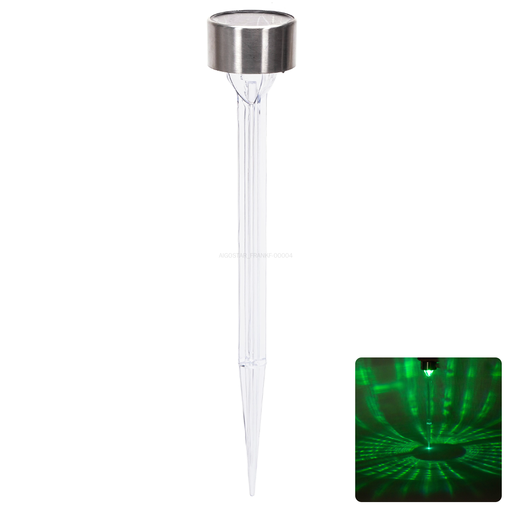
Why it’s a good fit: This compact light with a ground stake can be placed beside garden paths, on lawns or among flower beds without needing a power supply. RGB lighting adds a decorative touch to outdoor spaces.
The technical specifications include charging time, lighting time, battery details and an IP44 rating. This makes it easier to assess whether the light is suitable than relying on the colour display alone.
RGB lighting, ground stake, automatic dusk function and a stated lighting time of 8–12 hours in suitable conditions.
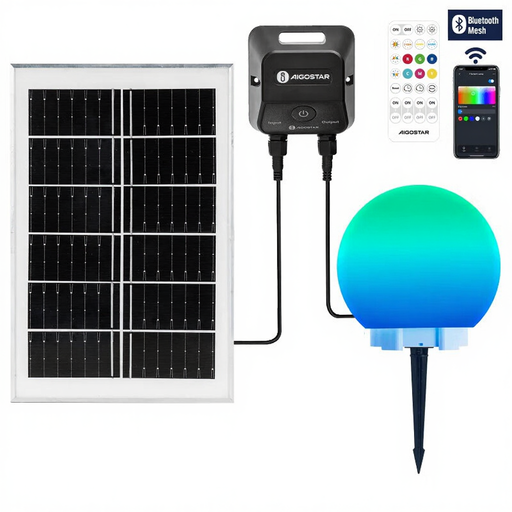
Why it’s a good fit: The combination of Bluetooth Mesh, the AigoSmart app and RGB+CCT lighting will appeal if you want to control several lights and adjust the colour temperature between 2700 and 6500 Kelvin.
You’re not limited to a fixed colour-changing mode. According to the product details, app features include schedules, grouping and brightness adjustment.
RGB+CCT lighting from 2700–6500 Kelvin, Bluetooth Mesh connectivity and stated IP54/IP44 ratings.
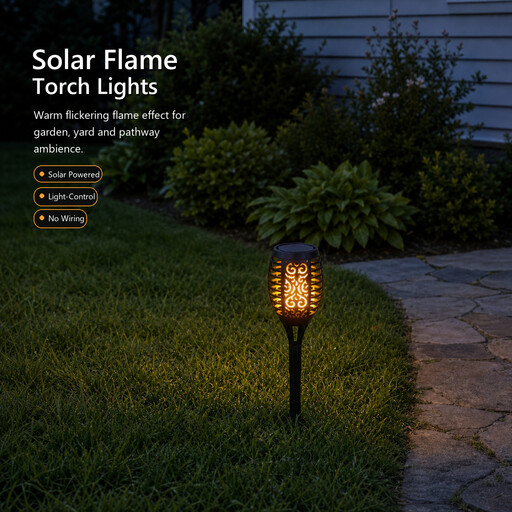
Why it’s a good fit: This set of four is designed for longer paths, larger flower beds or evenly spacing several points of light. At a stated height of 51 cm, the lights are more visible outdoors.
The product details specify 12 LEDs, automatic on/off operation and an IP65 rating. Even so, check that the location isn’t prone to standing water before installation.
Four lights per set, 51 cm tall, 12 LEDs and a stated IP65 rating.
LED solar lights don’t need a direct mains connection while in use. This means they have low running costs at home, although the battery is still a wear-and-tear component. To help them work consistently, clean the solar panels regularly with a soft cloth. If you’re not using the lights for an extended period, follow the manufacturer’s storage instructions.
Also check the stated lifespan of the LED unit. Several Aigostar models are listed as lasting up to 15,000 hours. This refers to the LED lifespan and shouldn’t automatically be taken as the lifespan of the battery or the complete light.
We’ve put together a complete, regularly updated list of products that meet these strict selection criteria and fully comply with the safety regulations in force in the EU.
The panel should face upwards and get as much direct daylight as possible. Avoid shade from trees, buildings or parasols. Lights with ground stakes should be placed in firm, soft ground; the stake may be damaged if the ground is very hard.
Lifespan depends on the LED, battery, weather conditions and care. A stated LED lifespan of, for example, 15,000 hours doesn’t automatically tell you how long the battery will last. A shorter lighting time may indicate that the battery is ageing or isn’t charging sufficiently.
They don’t need a mains connection during normal operation. The main costs are the initial purchase, replacement batteries if needed and, where applicable, disposal of electronic components. When choosing a light, it’s worth checking whether the battery can be replaced and whether the manufacturer provides clear information.