
Lieferung heute & morgen

Qualitätsgarantie

Willkommens-Angebote freischalten: KOSTENLOSE Lieferung | Bis zu 80 % RABATT | Kostenlose 30-Tage-JoyPlus-Testphase
App herunterladen
An outdoor solar light with a motion sensor promises a simple and cost-effective solution for more security and comfort around your home and garden. Installation is straightforward, requiring no expert knowledge or electrical connection. However, the market is flooded with products whose real-world performance often falls short of their marketing claims. Before you make a decision, it's crucial to understand the most common pitfalls that can lead to disappointment and unnecessary expense.
This guide will help you separate the wheat from the chaff by highlighting what truly matters when making your selection. We'll focus on the three most common problems:
To avoid a bad purchase, you should focus on a few core technical specifications. These determine the functionality and longevity of your off-grid outdoor lighting.
The brightness of a light is measured in lumens (lm). Don't rely on vague descriptions; look for concrete values.
The light colour, measured in Kelvin (K), influences the atmosphere. Values around 3000 K produce a warm, inviting white light. Values between 4000 K and 6500 K create a neutral to daylight white light, which is often preferred for security lighting.
The IP rating indicates how well a light is protected against the ingress of foreign objects and water. For a weatherproof outdoor solar wall light, the following ratings are relevant:
A good motion sensor is crucial for functionality. Pay attention to the detection angle (often 120° to 180°) and the range of the sensor. An LED solar floodlight with a motion sensor should have a range of at least 5-8 metres to detect movement early. The battery capacity, specified in milliampere-hours (mAh), determines how long the light can operate on a full charge. A higher capacity is particularly advantageous in months with less sunlight.
Instead of a one-size-fits-all recommendation, we have identified models tailored to specific needs and use cases.

Why it's a good fit: Ideal for users who need a hassle-free and flexible light source for a balcony, garden shed, or camping. Since it doesn't require permanent installation, it can be used wherever temporary light is needed.
This model isn't purely solar-powered; it's charged via USB. This bypasses the problem of insufficient charging on dark days and guarantees reliable performance when you need it.
The magnetic mount and integrated battery offer maximum portability. The 300 lm brightness and warm white light are sufficient for most temporary applications.

Why it's a good fit: For homeowners whose priority is maximum illumination of driveways, gardens, and dark corners for deterrence. The high brightness and wide detection area provide a high level of security.
With 3000 lumens, it avoids the lumen trap and delivers genuinely bright light. The IP65 certification ensures it can withstand heavy rain and adverse weather conditions, significantly increasing its lifespan.
Three adjustable heads allow for flexible illumination up to 270°. The sensor detects motion across a wide 180° angle and at a great distance, enabling seamless coverage.
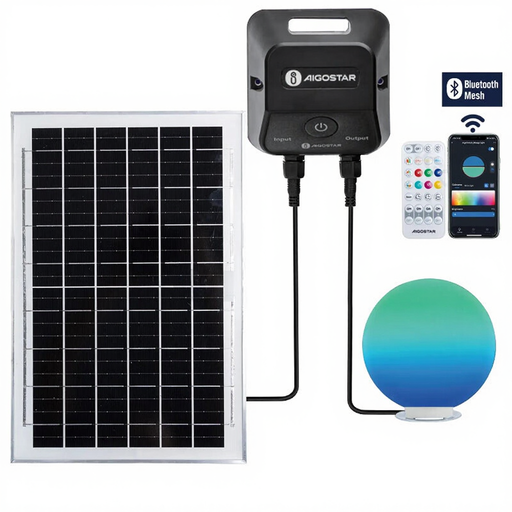
Why it's a good fit: For users who want more than just a functional solar garden light. This model combines illumination with smart controls and ambient effects, ideal for creating atmospheric scenes in the garden or on the patio.
The IP65 rating ensures the longevity of the complex electronics. The 8000mAh battery is generously sized to reliably power the smart functions and colourful light effects through the night.
Control via Bluetooth Mesh allows for networking over 200 devices. The RGBCCT function gives you complete control over light colour and colour temperature (2700K-6500K) for custom lighting scenes.
We've curated a current selection of products that meet these selection criteria.
The runtime in winter depends heavily on the daily sun exposure, the battery's capacity, and the solar panel's efficiency. On short, overcast days, the runtime can be reduced to just a few hours. Models with large batteries (e.g., over 2000 mAh) and efficient panels have an advantage here. Many lights also feature a dim mode, which conserves energy and extends the runtime.
No, that's one of the biggest advantages of a solar light. Since no connection to the mains electricity is required, you can perform the installation yourself. Typically, it only involves fastening a few screws to mount the light on a wall, fence, or post.
The IP (Ingress Protection) rating is an international standard that classifies the degree of protection a housing provides against the ingress of foreign objects (first digit) and water (second digit). For an outdoor solar light, the second digit is crucial: IPx4 (e.g., IP44) means protection against splashing water, while IPx5 (e.g., IP65) offers protection against jets of water and thus has higher weather resistance.