
Lieferung heute & morgen

Qualitätsgarantie

Willkommens-Angebote freischalten: KOSTENLOSE Lieferung | Bis zu 80 % RABATT | Kostenlose 30-Tage-JoyPlus-Testphase
App herunterladen
As a Joybuy Product Recommendation Officer, my role is to provide you with a clear and objective guide to the outdoor lighting market. Outdoor solar lights offer an attractive way to illuminate gardens, balconies, and patios without additional electricity costs or complex wiring. Whether you want to create an inviting ambiance or enhance the security of your property, the selection of models is vast. This article introduces different types of solar lights and explains which features are most relevant to your needs.
To make an informed decision, several technical features are important. These will help you find the right outdoor solar light for your specific location.
For lights used outdoors year-round, resistance to weathering is crucial. The IP (Ingress Protection) rating indicates how well a device is protected against the ingress of foreign objects and water. For outdoor use, a rating such as IP65 waterproof is recommended. The first digit (6) means the light is dust-tight. The second digit (5) certifies protection against water jets from any angle. This ensures reliable operation in rain and snow.
Lighting requirements vary depending on the purpose.
Outdoor solar string lights or solar garden torches with a warm white light colour (approx. 2700 to 3300 Kelvin) create a cosy and inviting atmosphere. The brightness, measured in lumens (lm), is often secondary in this case.solar floodlight with motion sensor should have a high brightness to clearly illuminate paths, driveways, or entryways. Values of 500 lumens or more are common here. The light colour can be neutral white to make details more visible.Off-grid LED garden lighting relies on the solar energy stored in its battery. The runtime is directly dependent on the battery's capacity (measured in milliampere-hours, mAh) and the efficiency of the solar panel. A larger, more powerful panel can absorb more energy even on overcast days and charge the battery faster. Pay attention to the manufacturer's specified runtime after a full charge to ensure the light still functions in the early morning hours.
Based on functionality and application, we have compiled a selection of products that cater to different needs—from decorative accent lighting to functional security lighting.
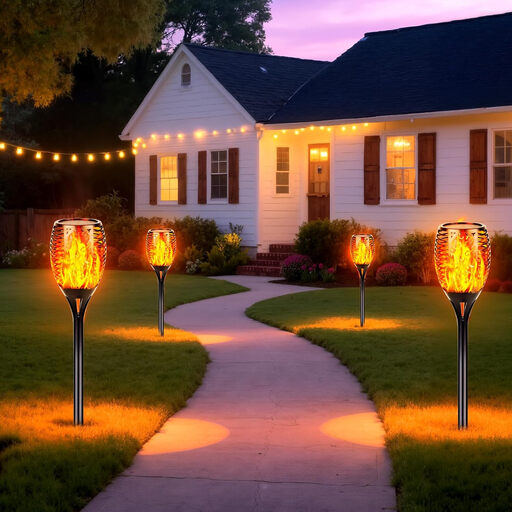
Why It Stands Out These garden torches use 96 LEDs to create a realistic, dancing flame effect. They automatically turn on at dusk and off at dawn, making operation very convenient.
Pros
Who Is It For? Ideal for users who want to enhance garden paths, flowerbeds, or patio areas with decorative and atmospheric lighting. These solar garden torches are a great choice for parties or relaxed evenings outdoors.

Why It Stands Out This set consists of two 12-metre string lights, each with 120 LEDs. The flexible copper wire can be easily wrapped around railings, plants, or other objects. Eight different lighting modes offer creative freedom.
Pros
Who Is It For? An excellent solution for decorating a garden, balcony, or patio. These outdoor solar string lights are perfect for adorning fences, pergolas, or even outdoor Christmas trees to create a festive or romantic atmosphere.
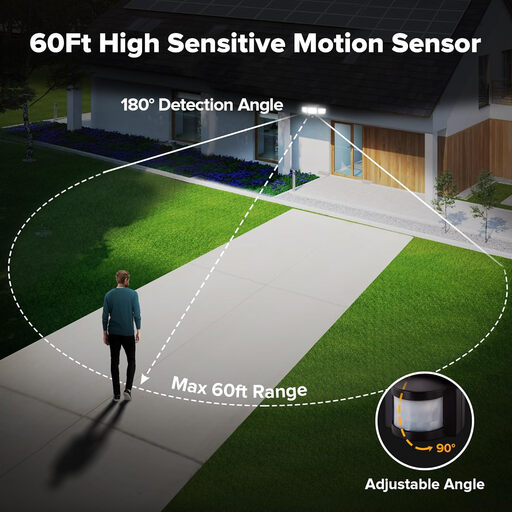
Why It Stands Out This solar floodlight with motion sensor is designed for functionality and security. With a light output of 3000 lumens and 302 LEDs, it provides intense illumination. The three adjustable heads allow for a wide illumination angle of 270 degrees.
Pros
Who Is It For? For homeowners seeking reliable and powerful security lighting without a mains connection. The floodlight is ideal for monitoring properties, garages, and entrance areas.
Our selection covers common use cases. However, if you are looking for more specific models, different designs, or additional features, you will find a wider range of products in our main category.
Discover more Solar Lights here.
The lifespan of a solar light is determined by several components. The LEDs themselves are very durable, often lasting 50,000 hours or more. The critical component is the battery, whose capacity can degrade after about 2 to 4 years, depending on quality and usage. However, in many models, the battery can be replaced. The quality of the housing material also affects longevity.
Yes, solar lights do work in winter, but with some limitations. The shorter days and lower intensity of solar radiation mean the battery may not fully charge. This results in a shorter runtime at night. To optimise performance, the solar panel should be placed in a location with maximum sun exposure, ideally with a south-facing orientation and free from shadows cast by trees or buildings.
No, one of the biggest advantages of solar lights is their straightforward installation. Since no cables need to be laid, it eliminates the need to hire an electrician. Most models come with ground stakes for use in the soil or with screws and wall plugs for wall mounting. Setup is usually limited to turning on the light and positioning the solar panel in the sun.