
Lieferung heute & morgen

Qualitätsgarantie

Willkommens-Angebote freischalten: KOSTENLOSE Lieferung | Bis zu 80 % RABATT | Kostenlose 30-Tage-JoyPlus-Testphase
App herunterladen
Outdoor solar lights are an appealing solution for any home and garden owner. They promise simple, cable-free installation, save on electricity costs, and are environmentally friendly. However, the selection is vast, and not every product lives up to its advertising. Before you invest, it's crucial to understand the common pitfalls that often lead to disappointment.
Many buyers report lights that fail after the first heavy rain, runtimes that barely last for a short evening, or light that is too dim to safely illuminate a path. These issues can usually be traced back to three common flaws:
To avoid a bad purchase, let objective technical specifications, not marketing promises, guide your decision. Three metrics are of central importance.
The IP (Ingress Protection) rating indicates how well an electrical device is protected against the intrusion of foreign objects and water. For solar lights that need to be waterproof, this is the most important indicator of durability.
The combination of the battery and solar panel determines how long your light will shine after a sunny day.
The brightness of an outdoor LED solar light is measured in lumens (lm), not watts. The lumen value indicates the actual light output and is crucial for the intended use.
Based on these objective criteria, we have curated a selection of products for various requirements.

Why This Fits Their Persona: Ideal for users looking for a straightforward and cost-effective solution to add orientation light to garden paths or flower beds. The ground stake installation requires no tools.
The product is clearly positioned as an "Atmosphere lawn light" and doesn't promise excessive brightness. The honest declaration of its IP44 rating indicates it's intended for use in areas protected from splashing water.
Simple, tool-free installation via a ground stake. The stainless steel housing offers a more premium feel and greater stability compared to all-plastic models in this price range.

Why This Fits Their Persona: Perfect for anyone needing reliable and very bright lighting to secure driveways, garages, or gardens. The motion sensor provides light exactly when it's needed.
This solar floodlight with motion sensor sidesteps the brightness trap with a clear manufacturer claim of 3000 lumens. The IP65 certification ensures it can withstand heavy rain, thus avoiding the "weatherproof" pitfall.
Very high luminosity for wide-area illumination. The three flexibly adjustable light heads allow for broad coverage of up to 270 degrees to capture even awkward corners.
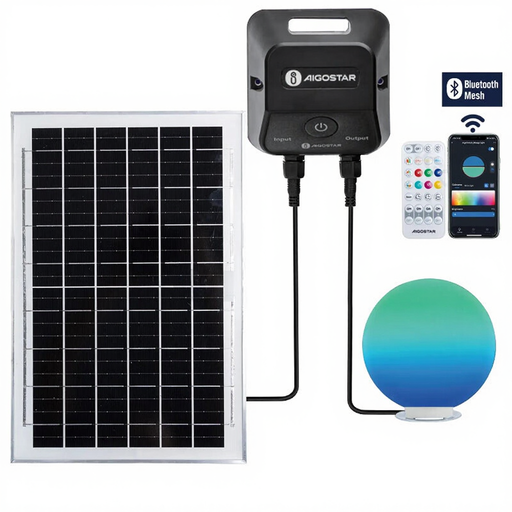
Why This Fits Their Persona: For users who want more than just light. This smart solar light allows full control over light color, brightness, and schedules via an app, and enables networking multiple lights for impressive lighting scenes.
The runtime trap is bypassed with a powerful 8000 mAh battery and a separate, large monocrystalline solar panel. This ensures reliable operation even with energy-intensive smart functions. The IP65 rating guarantees the necessary weather resistance.
Complete control via app using Bluetooth Mesh (networking of over 200 devices possible). RGBCCT technology allows for the seamless adjustment of millions of colors as well as white tones from warm to cool white.
We have compiled a complete, up-to-date list of products that fully meet these strict selection criteria and German safety regulations.
The lifespan depends on several components. The LEDs themselves often have a very long life of 20,000 hours or more. The critical factor is usually the battery. NiMH batteries typically last 1-3 years, while higher-quality lithium-ion batteries can function for 3-5 years or longer before their capacity noticeably diminishes. The weather resistance of the housing (determined by the IP rating) is also crucial for the overall lifespan.
Yes, but with limitations. The charging performance of solar panels is significantly reduced in winter due to shorter days and a lower sun angle. Monocrystalline panels have an advantage here, as they work more efficiently even in diffuse light. The runtime will be shorter in winter than in summer. Models with a motion sensor are particularly practical in this case, as they only light up when needed, thus saving energy.
No, that's one of the biggest advantages of cable-free garden lighting. Since no connection to the home's power grid is required, complex and expensive electrical installation work is eliminated. Most models can be simply staked into the ground with ground spikes or mounted on a wall or fence with a few screws.