Joybuy Insights

Outdoor Solar Lights: Buying Guide and Recommendations

The right outdoor lighting can transform a garden, patio, or balcony into a usable and atmospheric space after sunset. However, conventional lighting systems often come with high electricity costs and complex installation. Outdoor solar lights offer a flexible and cost-effective alternative without the hassle of wiring.

This article serves as a guide. As a Joybuy Product Recommendation Officer, I have compiled information on various models to provide you with an informed basis for your decision—whether for decorative purposes, pathway lighting, or to enhance security.

What to Look for When Buying Solar Lights

The selection of solar lights is vast. To find the right model for your needs, three key criteria should be considered.

1. Intended Use: Decoration, Orientation, or Security?

The primary purpose determines the type of light you need.

  • For Ambience and Decoration:Outdoor solar string lights are excellent for adorning railings, plants, or party tents. Models with warm white light and various lighting modes create an inviting atmosphere for patio lighting or on a balcony.
  • For Orientation and Accent Lighting: Individual solar garden lights, such as ground stakes or in-ground spotlights, are ideal for marking pathways or highlighting special features in the garden like shrubs or sculptures.
  • For Security: A solar floodlight with a motion sensor is the right choice for entrance areas, garages, or dark corners of your property. Here, a high light output (lumens) and a wide detection range for the sensor are crucial.

2. Technical Specifications: Weather Resistance and Performance

The technical data provides insight into the durability and reliability of an LED outdoor solar light.

  • IP Rating (Waterproofing): This feature is essential for outdoor use. The protection class is indicated by "IP" followed by two digits. For year-round use where rain and snow are common, a rating of IP65 is recommended. This means the light is dust-tight and protected against water jets from any angle.
  • Battery Capacity and Illumination Time: The battery's capacity (measured in milliampere-hours, mAh) and the solar panel's efficiency determine how long the light will stay on after dark. A longer illumination time generally requires a larger solar panel and a more powerful battery. The specified illumination time always depends on the intensity and duration of sunlight during the day.
  • Brightness and Light Colour: Brightness is measured in lumens (lm). For decorative purposes, low lumen values are often sufficient, whereas a security floodlight can reach 3000 lm or more. The light colour is specified in Kelvin (K). Values around 2700 K produce a warm white, cosy light, while values above 5000 K resemble cool daylight.

3. Additional Features: Smart Control

Modern smart garden lighting offers advanced control options. An app can be used to schedule lighting times, dim the brightness, or even change the light colour (RGBCCT). Such systems often use Bluetooth Mesh technology to network multiple lights together for centralised control.

Our Selection of Solar Lights for Different Applications

Based on the criteria mentioned, we present three different models, each designed for a specific purpose.


For Atmospheric Garden Decor: Vivreal Solar Copper Wire String Lights

Vivreal 2PCS Solar Copper Wire String Lights – 12M, 120 LEDs Warm White

Why this model stands out: These string lights combine flexibility with solid technical features. The pliable copper wire allows for creative decorations, while the upgraded solar panel and eight lighting modes ensure versatile applications.

Advantages:

  • Flexible Copper Wire: The 12-metre-long wire can be easily wrapped around objects like trees, fences, or balcony railings.
  • 8 Lighting Modes: Offers various effects from steady on to a gentle glow, including a memory function for the last setting.
  • Weather Resistance: With an IP65 certification, the string lights are designed for year-round outdoor use.
  • Long Illumination Time: After a full charge (approx. 6–8 hours of sunlight), the manufacturer states an illumination time of 8 to 14 hours.

Who is it for? Ideal for users looking for a straightforward and flexible solution for garden decor. Perfect for creating a warm and inviting atmosphere for parties, holidays, or everyday patio lighting.
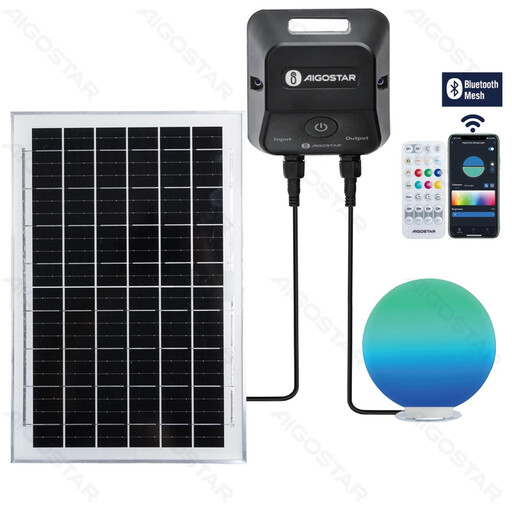

For Smart and Colourful Accents: Aigostar Smart Solar In-Ground Lights

Aigostar Bluetooth Mesh, Smart Solar Ground Light 35W RGBCCT Colorful Light Bulb

Why this model stands out: This model combines solar technology with the advantages of smart garden lighting. Via Bluetooth Mesh and an app, you can conveniently control colour, brightness, and schedules, enabling dynamic and personalised lighting design.

Advantages:

  • Smart Control: Up to 200 devices can be networked and controlled via the app. Schedules and light scenes are programmable.
  • RGBCCT Colour Control: Allows you to choose from a wide spectrum of colours and adjust the white light temperature from warm white (2700 K) to cool white (6500 K).
  • Robust Construction: The housing is protected against weather elements with an IP65 rating. The lithium iron phosphate battery (8 Ah) is known for its longevity.
  • Efficient Solar Panel: The 10W monocrystalline panel ensures reliable charging.

Who is it for? Suitable for tech-savvy users who want full control over their outdoor lighting and enjoy experimenting with colours and light scenes to individually stage pathways, flower beds, or the entrance area.
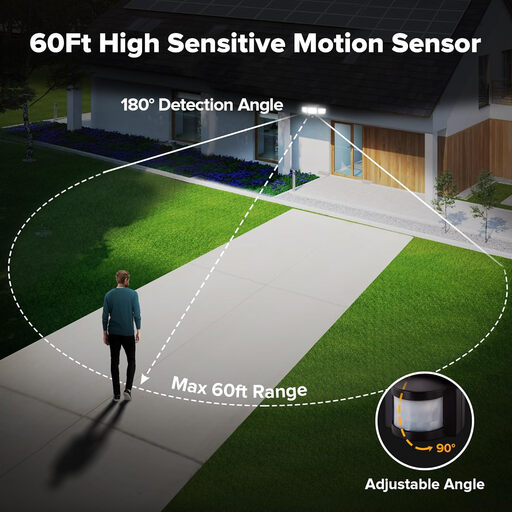

For Maximum Security: UME Solar Floodlight with Motion Sensor

UME Solar Outdoor Lights 302 LED 3000LM, IP65 Waterproof, Motion Sensor

Why this model stands out: This solar floodlight with a motion sensor is designed for maximum brightness and a wide detection range. With 3000 lumens and three adjustable heads, it reliably illuminates large areas and primarily serves for security.

Advantages:

  • High Light Output: The 302 LEDs produce a brightness of 3000 lumens, brightly illuminating driveways, yards, or gardens.
  • Wide Detection Range: The motion sensor covers a 180° angle and a range of up to 18 metres.
  • Flexible Alignment: The three light heads are pivotable, allowing for wide illumination of up to 270°.
  • Three Operating Modes: Offers various settings, such as light only on motion or a permanent dim light that brightens upon motion detection.
  • Weather-Resistant Construction: The ABS plastic housing and IP65 certification ensure operation in rain and snow.

Who is it for? The right choice for homeowners who need powerful and reliable security lighting for garages, entrance areas, or poorly visible parts of their property, without needing to lay any cables.

Looking for More Options?

The products presented cover common use cases. For special requirements, such as lighting solutions for shadier areas that need more powerful panels or external solar modules, you can find more models in our Shade-Tolerant Garden Lighting category.

Frequently Asked Questions

1. Do solar lights also work in winter or on cloudy days? Yes, solar lights also charge in diffuse light, but much more slowly than in direct sunlight. In winter or on heavily overcast days, this leads to a shorter illumination time at night. Models with high-quality monocrystalline solar panels and large batteries perform better in these conditions.

2. What is the lifespan of outdoor solar lights? The lifespan depends on several components. The LEDs themselves often have an operating life of over 50,000 hours. The battery is typically the component with the shortest lifespan, lasting about 1 to 3 years depending on quality and use. In some models, the battery can be replaced. The durability of the housing is determined by the material and the IP rating.

3. Do I need to bring solar lights indoors during winter? Models with a rating of IP65 or higher are designed to remain outdoors year-round and can withstand rain, snow, and frost. However, to maximise the battery's lifespan, it may still be advisable to bring the lights inside during prolonged periods of extreme sub-zero temperatures, especially if they are not being actively used.