
Lieferung heute & morgen

Qualitätsgarantie

Willkommens-Angebote freischalten: KOSTENLOSE Lieferung | Bis zu 80 % RABATT | Kostenlose 30-Tage-JoyPlus-Testphase
App herunterladen
Outdoor solar lights for the garden offer a cordless way to decorate flower beds, paths, lawns, balconies and patios. They can usually be installed without a mains connection, while automatic solar lights switch on by themselves when it gets dark. However, not every product is suitable for every application. The key factors are the technical specifications, the intended location and the light’s actual function.
The IP65 rating indicates protection against dust and water jets from various directions. This is relevant for rain and splashing water outdoors. However, it does not automatically mean that the solar light or solar panel can be left in water for extended periods. With many products, the protection rating explicitly applies only to certain components.
A solar light with an IP44 rating is protected against solid foreign objects and splashing water, but offers less protection than IP65. It may be suitable for a sheltered balcony or covered patio. In open, highly exposed areas, the product description should be checked carefully.
Claims such as “up to 12 hours” refer to specific charging conditions. In the shade, on short winter days or during overcast weather, the operating time may be shorter. A dirty solar panel also reduces the amount of energy collected. You should therefore consider the combination of charging time, battery capacity, panel type and the actual installation location.
A solar string light with numerous LEDs often creates a decorative line of light, but it does not replace a path light designed to provide focused illumination. Warm white or multicoloured LEDs are ideal for creating atmosphere. For finding your way along paths, however, lights with a suitable beam pattern and sufficient luminous flux are more useful. Luminous flux is measured in lumens and is more informative than the number of LEDs alone.
For freestanding outdoor solar lights, IP65 solar lights are often a suitable choice when the light is exposed to rain and dust. However, the rating should apply to the complete relevant product. For solar garden lighting with a separate panel, check whether the panel, battery housing and light body have the same level of protection.
Ground spikes need sufficiently firm ground. They can tilt in loose soil, while models with a base or adjustable mounting are more practical on hard patios. A solar torch in the garden should also be positioned so that it does not create a trip hazard.
The panel should receive several hours of direct sunlight and should not be permanently shaded by trees, walls or railings. Specifications such as 4–6 hours charging time or 6–8 hours in direct sunlight should be understood as product values, not as a guarantee for every type of weather.
Lithium batteries offer different capacities depending on the model. For example, the Aigostar string light is specified with a 1200 mAh lithium battery. According to the product data, the Smart Solar Floor Lamp has an 8000 mAh lithium battery. However, capacity is not the only factor that matters when choosing a product. The performance of the solar cell and the desired brightness are also important.
Warm white is ideal for calm patio or balcony lighting. RGB solar lights offer changing colours and are well suited to parties or seasonal decorations. With a string light, you should also consider the cable length, the distance between the LEDs and the available lighting modes.
Automatic switching off in daylight saves you from having to operate the light manually. Some models also offer memory functions, remote control or Bluetooth connectivity. These features are particularly useful when several lights need to be controlled together.

Why this product suits this profile: Two 8-metre multicoloured string lights are ideal for balconies, small patios, shrubs or seasonal decorations.
The specifications state an IP65 rating, eight lighting modes and automatic switching on and off. The 8–14-hour operating time still depends on the weather.
Two strings per set, 80 LEDs per string, eight modes with a memory function and flexible copper-wire construction.
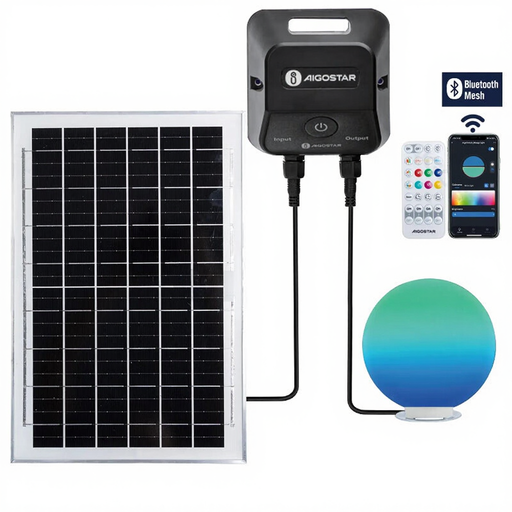
Why this product suits this profile: This freestanding outdoor light is designed for users who want to combine RGB, warm white and daylight-style lighting with several control options.
The product data states IP65, a charging time of 4–6 hours and automatic lighting at night. Even so, the installation location should allow direct sunlight.
350 lumens, RGB plus 2700–6500 K, Bluetooth Mesh control and a stated maximum battery life of 24 hours.

Why this product suits this profile: This longer string light is designed for larger patios, pergolas, garden parties or decorative areas used regularly.
With IP65 and a clearly stated battery capacity of 1200 mAh, the key technical specifications are easy to verify. However, the string light must not be submerged in water.
11.5 metres in total, 160 warm white LEDs, eight modes, 4–6 hours charging time and a stated operating time of up to 12 hours.
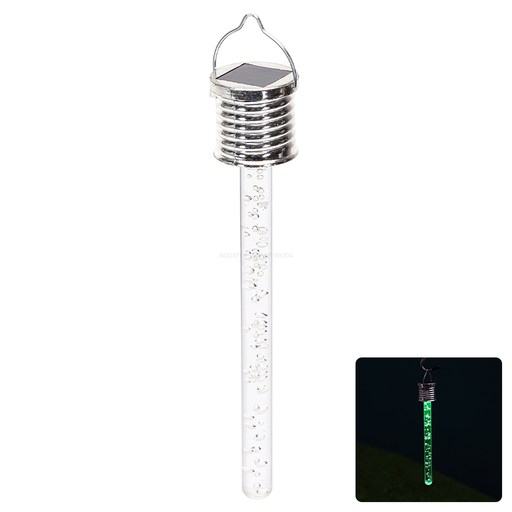
Why this product suits this profile: This compact solar decorative light with a ground spike adds colourful accents to flower beds, along paths or on small lawns.
The protection rating is specified as IP44, making it easier to assess. For unprotected areas that remain wet for long periods, the installation location should be chosen carefully.
RGB lighting, stainless-steel look, ground spike, automatic switching on and off, plus a stated operating time of 8–12 hours.
We have put together a complete, regularly updated list of products that fully meet these strict selection criteria and the safety regulations applicable in the EU.
Operating time depends on sunlight, battery condition, temperature, lighting mode and the age of the battery. Product claims such as 8–14 hours or up to 24 hours are maximum or guide values under certain conditions. In winter or after several overcast days, the operating time may be shorter.
IP65 solar lights are protected against dust and water jets. The term “waterproof” is often used as shorthand by retailers and should not be taken to mean complete impermeability or suitability for submersion. Check which components the protection rating applies to and avoid leaving the product in standing water.
While operating, solar lights draw their energy from the battery charged during the day and do not require a fixed mains connection. As a result, they normally incur no ongoing electricity costs from the mains. However, you should factor in the purchase price, any potential battery replacement and the proper disposal of electronic components.