
Lieferung heute & morgen

Qualitätsgarantie

Willkommens-Angebote freischalten: KOSTENLOSE Lieferung | Bis zu 80 % RABATT | Kostenlose 30-Tage-JoyPlus-Testphase
App herunterladen
The right outdoor lighting not only creates an inviting atmosphere but also enhances the security around your home. However, many are deterred by the hassle of wiring and ongoing electricity costs. Outdoor solar lights offer a practical and energy-efficient alternative. They harness the power of the sun, are easy to install, and require no external power supply.
This article serves as your guide. We'll introduce various types of solar lights and explain the key features to look for, helping you make an informed decision for your garden, patio, or driveway.
The market for solar-powered lights is vast. To find the right solution for your needs, a few technical aspects are crucial.
Since these lights are exposed to the elements year-round, high durability is essential. The IP (Ingress Protection) rating indicates how well a housing is protected against the entry of foreign objects (first digit) and water (second digit). For outdoor use, a minimum rating of IP44 (protection against splashing water) is recommended. For greater reliability, look for an IP65 waterproof classification, which ensures complete protection against dust and water jets from any angle. Products with this rating are well-equipped for use in all weather conditions.
The intended use determines the type of light you'll need.
The brightness of a solar-powered LED outdoor light is measured in lumens (lm). While a few hundred lumens are sufficient for ambient lighting, security floodlights should have a much higher output of 1000 lumens or more.
The battery capacity, specified in milliampere-hours (mAh), determines how long the light can operate after dusk. A larger battery stores more energy, ensuring more reliable illumination even on cloudy days or during the winter months.
Based on the criteria above, we have curated a selection of products that meet different needs for solar garden lighting.

Why It Stands Out: This string light combines a classic bulb design with modern LED technology. With a total length of 10 meters and 160 warm-white LEDs, it's ideal for creating an atmospheric glow over larger areas like pergolas, fences, or balcony railings. The eight different lighting modes allow for versatile designs.
Advantages:
Who It's For: Anyone looking for simple and atmospheric decorative lighting for parties, cozy evenings outdoors, or as a year-round garden feature.
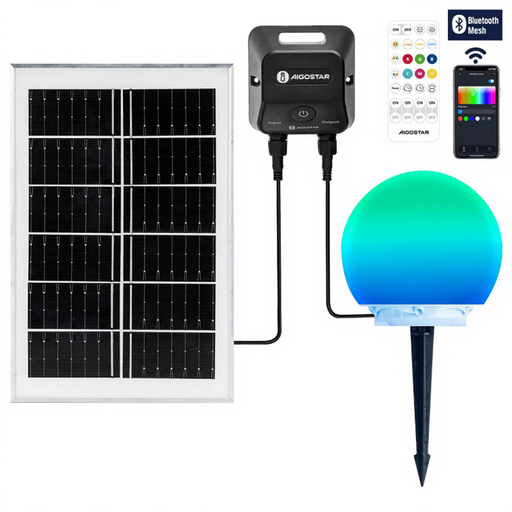
Why It Stands Out: This model takes smart garden lighting to the next level. Thanks to Bluetooth-Mesh technology, over 200 lights can be networked together and controlled centrally via a smartphone app. The RGBCCT color spectrum allows you to choose from millions of colors and adjust the white light temperature (2700K-6500K).
Advantages:
Who It's For: Tech-savvy users who want a fully customizable, networked, and modern lighting solution for pathways, flower beds, or as an architectural highlight in their garden.
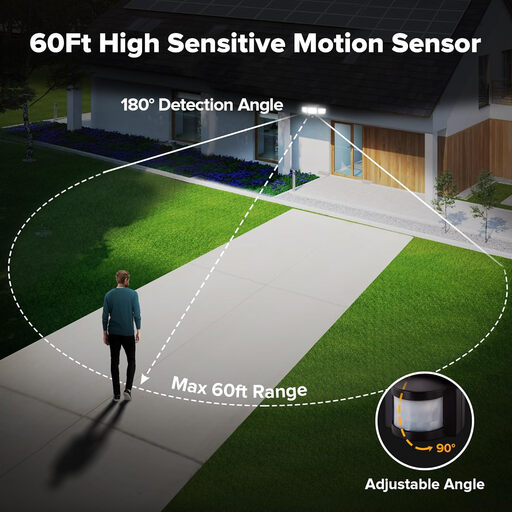
Why It Stands Out: This solar floodlight with motion sensor is designed for functionality and security. With a high light output of 3000 lumens per floodlight and three individually adjustable heads, it illuminates a wide 270° area. The motion sensor detects movement up to 18 meters away.
Advantages:
Who It's For: Homeowners who need powerful and reliable security lighting without the hassle of wiring to effectively protect their property.
Haven't found the right solution yet, or are you looking for a different type of light? You can find more models in our outdoor lighting category.
? Explore our full range of Outdoor Photocell Bulbs
Yes, modern solar lights also work in the winter and on cloudy days. The monocrystalline or polycrystalline silicon in the panels can convert diffuse light into energy. However, the charging performance is lower than with direct sunlight, which can lead to shorter runtimes at night. Models with large batteries and efficient panels are better suited for the darker months.
The lifespan of a solar light depends on the quality of its components. The LEDs themselves have a very long lifespan, often exceeding 50,000 hours. The solar panel is also very durable. The component most likely to lose performance over time is the battery. On high-quality models, the battery can be replaced after a few years, extending the life of the entire unit.
Installation is typically very simple and requires no special expertise. The most important factor is the placement of the solar panel. It should be mounted in a location that receives as much direct sunlight as possible throughout the day and is not shaded by trees, overhangs, or buildings. Ideally, orient the panel to the south to maximize sun exposure. The lights themselves can then be flexibly placed using a ground stake, wall mount, or by simply setting them up.