
Lieferung heute & morgen

Qualitätsgarantie

Willkommens-Angebote freischalten: KOSTENLOSE Lieferung | Bis zu 80 % RABATT | Kostenlose 30-Tage-JoyPlus-Testphase
App herunterladen
By Joybuy Product Recommendation OfficerDate: July 29, 2026
Outdoor solar lights promise a simple, cost-effective, and eco-friendly way to illuminate gardens, balconies, and pathways. With no wiring required and no additional electricity costs, they seem like the ideal solution. Yet, the reality is often different: many buyers are disappointed after a short time when the lights barely provide any illumination, fail after the first rainfall, or don't come close to their promised runtime.
This guide reveals the three most common purchasing traps and explains which technical features you should look for to make an informed decision and find durable, functional lighting for your outdoor space.
The disappointment many users experience can often be traced back to exaggerated marketing claims and poorly declared product specifications. Here are the critical points that are frequently overlooked:
Many products advertise a runtime of "up to 8 hours" or more. In practice, especially during the less sunny months in the UK, the light often goes out after just two to three hours. The reason is usually a combination of a low-performance solar panel and a low-quality battery. Budget models often use outdated Ni-MH batteries, which have a shorter lifespan and lower charging efficiency than modern Lithium-Ion (Li-Ion) or Lithium Iron Phosphate (LiFePO4) batteries.
The term "weatherproof" is not standardised and is often used misleadingly. A light that can only withstand light drizzle is unsuitable for unprotected use in the British climate. The crucial factor is the IP (Ingress Protection) rating. An IP44 certification only means protection against splashing water and is sufficient only for covered areas like balconies or eaves. For open use in the garden, where the light is exposed to heavy rain, at least IP65 (protection against water jets) is required.
Many decorative solar lights look appealing but produce only a faint glow that is insufficient for orientation or security. The brightness of a light is measured in lumens (lm). While 5 to 50 lumens may be enough for pure mood lighting, functional solar garden lights for pathway illumination or solar floodlights with motion sensors for deterrence require significantly higher values, from 300 to over 1000 lumens.
To avoid the pitfalls mentioned above, you should check three core technical parameters before purchasing. These provide insight into the actual performance and longevity of a solar light.
The heart of every solar light is its battery. Look for models with Lithium-Ion or LiFePO4 batteries. These offer higher energy density, a longer lifespan (more charge cycles), and more stable performance in cooler temperatures. The capacity, specified in milliampere-hours (mAh), is also critical: a higher mAh value generally means a longer runtime on a full charge.
Waterproof Solar Lights Are Truly DefinedThe IP rating consists of two digits. The first digit (0-6) describes protection against foreign objects (dust), and the second (0-9) describes protection against water.
balcony solar lights or under a roof overhang.solar lights in the garden that are exposed to rain.solar ground lights installed near the ground and potentially exposed to puddles.Match the brightness and light colour to the intended use:
outdoor solar string lights or decorative lights with 10-100 lumens and a warm white light colour (2700-3000 Kelvin) are suitable.Solar ground lights or bollard lights should provide 100-300 lumens to safely illuminate paths. A neutral white colour (approx. 4000 Kelvin) is often a good choice here.Solar floodlights with motion sensors or solar wall lights for driveways and entrances require high brightness of at least 500 lumens and often a daylight white colour (over 5000 Kelvin) for maximum visibility.Based on these objective criteria, we have identified several models that are well-suited for specific needs and user profiles.
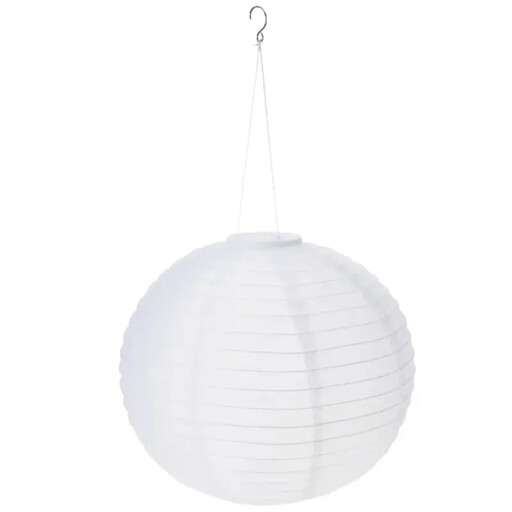
Why This Fits Their Persona: Ideal for users who value design and a warm, inviting atmosphere. The spherical shape and nylon material, reminiscent of a rice paper lantern, create a soft, diffused light that stands out from functional floodlights and serves as a stylish decorative element.
This light is clearly positioned as decorative mood lighting. It doesn't promise high brightness but instead delivers a targeted warm white ambience with 12 LEDs, which aligns with the expectations for a decorative light.
The weatherproof nylon fabric is quick-drying and robust. The integrated dusk-to-dawn sensor ensures fully automatic operation without manual intervention.
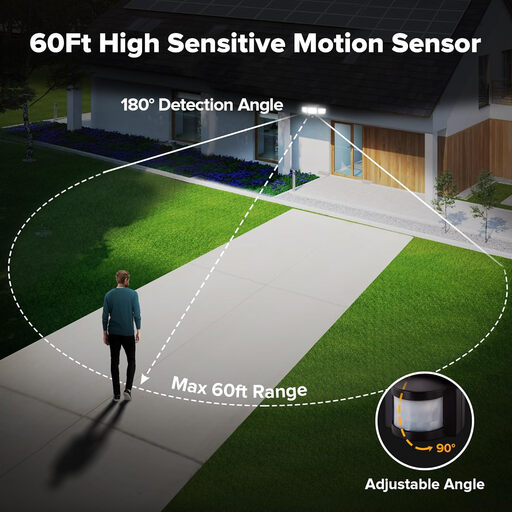
Why This Fits Their Persona: Perfect for homeowners who want to reliably illuminate driveways, garages, or dark corners of the garden. The focus here is clearly on functionality and security through high brightness and motion detection.
This floodlight avoids the "too dim" trap with a clearly stated luminous flux of 3000 lumens. The IP65 certification ensures it functions reliably even in heavy rain and won't fail after a short time.
Three adjustable light heads allow for a wide 270° illumination angle. The long-range motion sensor with three adjustable modes offers flexible security options.
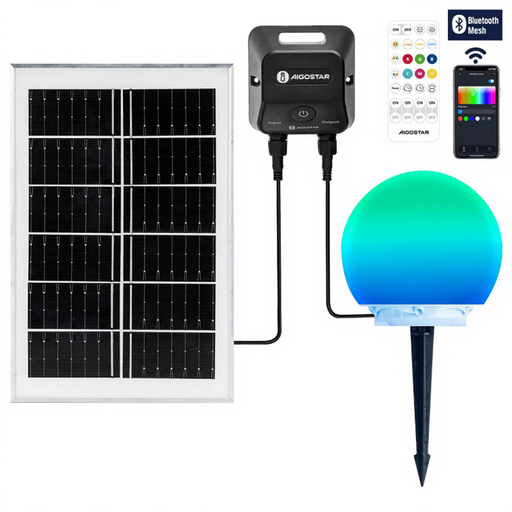
Why This Fits Their Persona: For users who want more than just on/off functionality. This light offers full control over colour, brightness, and schedules via an app, and allows multiple lights to be networked for synchronised lighting effects throughout the garden.
It avoids the trap of inflexible standard lights. Instead of a fixed light mode, it offers full RGBCCT colour control (millions of colours plus adjustable white light from 2700K-6500K) and smart scheduling.
The Bluetooth-Mesh technology allows for the control of over 200 lights. The powerful 4000mAh battery and monocrystalline solar panel provide a runtime of up to 24 hours.
We have compiled a complete, up-to-date list of products that fully meet these strict selection criteria and UK safety regulations.
The lifespan depends on three main components: the LED, the battery, and the housing. Modern LEDs have a very long life, often exceeding 20,000 hours. The battery is typically the first component that needs replacing. Lithium-Ion batteries usually last 2-4 years (approx. 500-1000 charge cycles), while Ni-MH batteries often lose capacity after just 1-2 years. The durability of the housing depends on the material (e.g., UV-resistant ABS plastic, stainless steel) and the IP rating.
Yes, but with limitations. The charging performance of a solar panel is directly dependent on the intensity and duration of sunlight. In winter, the days are shorter and the sky is more often overcast, which significantly reduces charging time. Therefore, the runtime will be shorter during the winter months. Models with high-efficiency solar panels and large batteries are better suited for year-round use.
For maximum energy harvesting, the solar panel should be placed in a location that receives at least 6-8 hours of direct, unobstructed sunlight daily. A south-facing orientation is ideal in the UK. Avoid locations in the shade of trees, buildings, or roof overhangs. Also, ensure that the panel is not illuminated by other artificial light sources at night (e.g., streetlights), as this can interfere with the dusk-to-dawn sensor and prevent the light from turning on.