
Lieferung heute & morgen

Qualitätsgarantie

Willkommens-Angebote freischalten: KOSTENLOSE Lieferung | Bis zu 80 % RABATT | Kostenlose 30-Tage-JoyPlus-Testphase
App herunterladen
Outdoor solar lights for the garden don’t need a fixed power supply and can usually be set up without tools. Even so, not every model is right for every garden. If you focus only on colour, design or a high number of LEDs, you can easily overlook important details such as IP rating, charging conditions and battery capacity.
Three common buying misconceptions come up particularly often:
The IP rating describes how well a casing is protected against the ingress of solid objects and water. Many decorative solar garden lights have an IP44 rating. This means they’re protected against splashing water from various directions, but not against water that remains standing around them.
For more exposed areas, models with a higher rating, such as IP65, may be worth considering. Even then, you shouldn’t deliberately place the light underwater. Also check the stated operating temperature, especially if you plan to leave the solar lights outdoors all year round.
Place solar ground lights and solar lights with ground stakes where the panel will receive as much direct sunlight as possible during the day. Trees, house walls, awnings and tall plants can reduce charging performance.
Several Aigostar models have a stated charging time of around 4 to 6 hours and a lighting time of 8 to 12 hours under suitable conditions. Treat these figures as a guide. Also check the battery type and capacity, and whether the battery can be replaced. A dirty panel can affect charging performance too. A soft, slightly damp cloth is enough for regular cleaning.
Warm white solar lights at around 2700 Kelvin create a gentle, yellowish glow and are often suitable for seating areas, flower beds and decorative accents. Cool white light at around 6500 Kelvin looks crisper and can make paths stand out more clearly.
RGB solar lights cycle through different colours and work well in decorative garden displays. They don’t usually replace functional path lighting. For a safe walkway, make sure the lights are spaced appropriately, positioned securely and actually illuminate the path.
Height and how the light is secured also matter. Solar garden stakes can be moved around easily, but need soft ground or a suitable spot to push them into. The stake could be damaged in hard, stony ground.
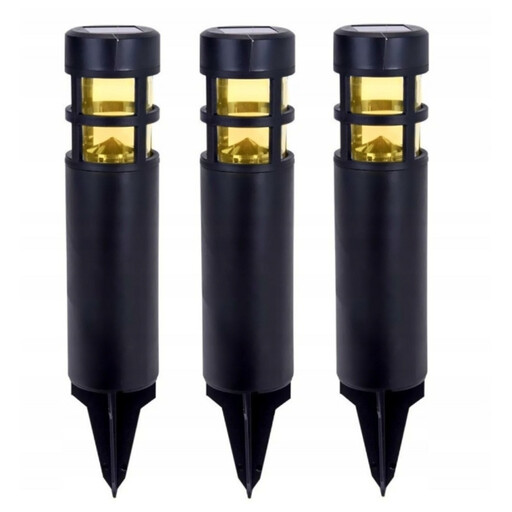
Why this product suits this type of shopper: This set of three lights is a good choice if you want to mark several points along a path, flower bed or boundary without having to choose each light separately.
The product description specifically mentions automatic activation at dusk and intended use along paths, flower beds and property boundaries. Still, check the full details on the IP rating and battery before buying.
Three lights in one set; no fixed power supply needed, with automatic dusk activation according to the product details.
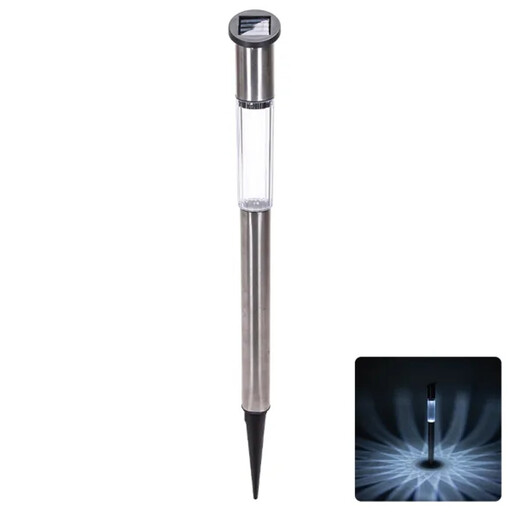
Why this product suits this type of shopper: The clearly specified 6500 Kelvin light colour and the stated technical details make it easier to choose a light for straight paths and neatly organised outdoor spaces.
The description states that it’s made from plastic with a stainless-steel look, so it won’t be mistaken for genuine stainless steel. The IP44 rating should be understood as protection against splashing water.
6500 Kelvin light, stated colour rendering index Ra≥70, IP44 rating and a stated lighting time of 8–12 hours under suitable charging conditions.
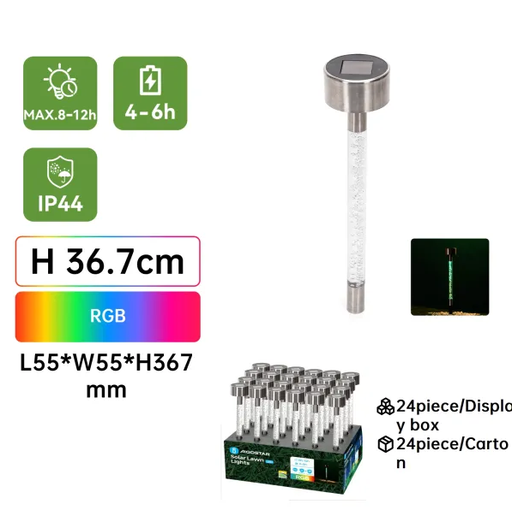
Why this product suits this type of shopper: The RGB feature is ideal if you’d like to add decorative splashes of changing colour to your lawn, flower beds or patio.
The product details specify a height of 36.7 cm, an IP44 rating, a NiMH battery and a charging time of around 4–6 hours. This helps you assess its size, protection rating and charging needs before you buy.
RGB lighting, integrated ground stake, stated lighting time of 8–12 hours under suitable conditions and a weight of around 80 g.
We’ve put together a complete, regularly updated list of products that meet these strict selection criteria and fully comply with the safety regulations in force in the EU.
Place solar lights in a sunny spot if possible, with the panel facing upwards. For solar path lights, space them evenly so that no single light dominates the path. Before pushing them into the ground for good, check that they’re charging sufficiently.
Clean the solar panel regularly with a soft cloth. Carefully remove leaves, dust and bird droppings. In frosty conditions or extreme weather, it may be worth following the manufacturer’s guidance. At the end of their useful life, batteries and electronic components should be taken to the appropriate collection points.
The run time depends on sunlight, charging time, battery condition and temperature. The Aigostar models mentioned above are stated to last around 8 to 12 hours under suitable conditions. In winter or on cloudy days, the actual lighting time may be shorter.
That depends on the IP rating. IP44 means protection against splashing water, not immersion in water. For very exposed locations, check the specific product’s IP rating and installation instructions.
During normal use, solar lights get their energy from the integrated solar panel and battery. So they don’t add to your ongoing mains electricity costs. However, remember to factor in the possible cost of replacement batteries, as well as any maintenance or replacement needs over time.