
Lieferung heute & morgen

Qualitätsgarantie

Willkommens-Angebote freischalten: KOSTENLOSE Lieferung | Bis zu 80 % RABATT | Kostenlose 30-Tage-JoyPlus-Testphase
App herunterladen
Outdoor solar lights for the garden don’t need a mains connection and, if they have the right features, switch on automatically when it gets dark. However, solar torches, solar garden torches and classic LED solar lights vary considerably in their ingress protection rating, light effect, charging performance and durability.
If you focus only on a high number of LEDs or a particularly decorative design, you could miss important details. Here are three common buying pitfalls to watch out for:
The IP rating consists of two digits. The first indicates protection against solid objects and dust, while the second indicates protection against water.
Even with waterproof solar lights, avoid leaving water to collect in recesses. Before setting them up, check the manufacturer’s guidance on outdoor temperatures and storage.
A solar light charges during the day via its panel. The actual run time depends not only on the battery specification and number of LEDs, but also on:
Charging time and run-time figures should therefore be treated as a guide for suitable conditions. A spot with six hours of direct sun is usually better for automatic solar lights than a bright spot that is shaded throughout the day.
A light colour of 2700 Kelvin is described as warm white and works well around seating areas, flower beds and as a decorative accent. A flame effect creates a flickering light, but does not provide even illumination.
Garden lights with ground spikes are practical for paths, as long as the ground is soft and stable enough. Stones, very compacted soil or frequent repositioning can put strain on the spike. On lawns and in flower beds, also make sure the light won’t get in the way when mowing or gardening.
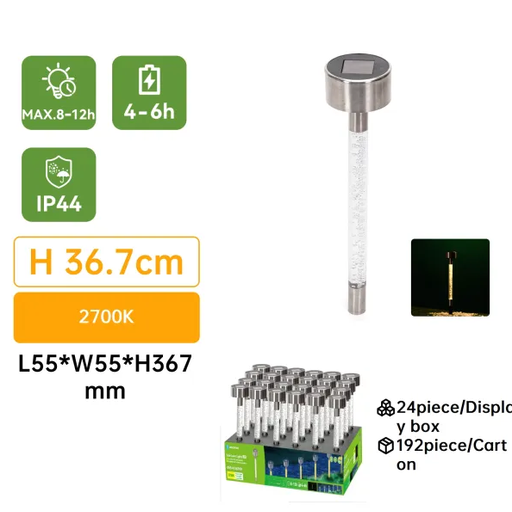
Why it suits this type of buyer: This compact solar light is ideal for flower beds, lawns and sheltered paths. Its warm-white 2700 Kelvin light is a subtle way to add a decorative touch.
The stated IP44 rating makes clear that this light is better suited to sheltered outdoor areas than to locations exposed to persistent wet weather.
2700 Kelvin light, ground spike, automatic switching on and off, and a stated run time of 8–12 hours under suitable charging conditions.
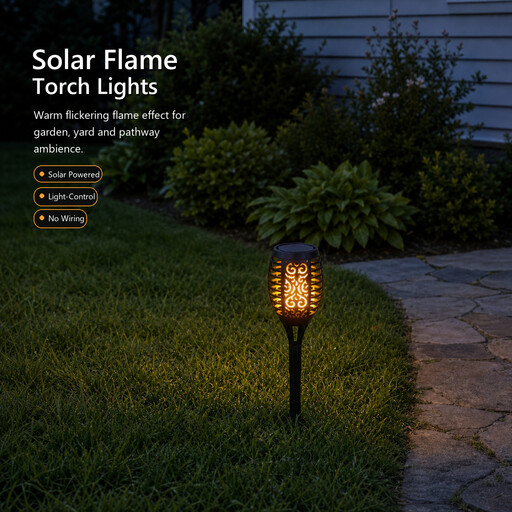
Why it suits this type of buyer: This set of four solar garden torches, each stated to be 51 centimetres high, is ideal for longer flower-bed borders, lawns or dressing up an entrance.
The stated IP65 rating is better suited to an exposed outdoor location than a rating that only indicates protection against splashing water. Even so, the lights should not be submerged.
Four lights, 12 LEDs per light, a flame effect, stated automatic switching on and off, and a height of 51 centimetres.
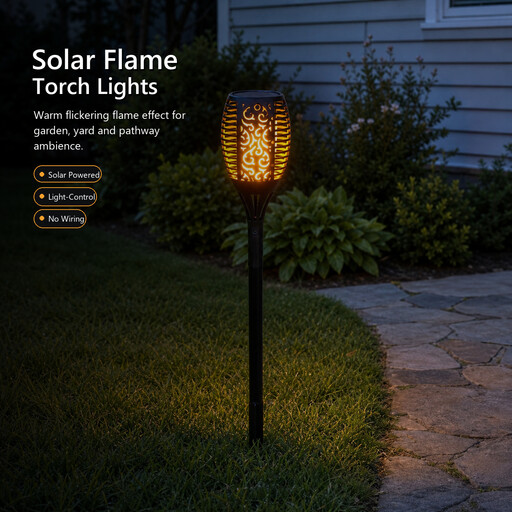
Why it suits this type of buyer: These two solar garden torches have 96 LEDs between them and a flickering flame effect, making them a good fit for patios, seating areas and decorative entrance paths.
The IP65 rating and automatic switching on and off are clearly stated. For lighting paths, bear in mind that the flame effect is primarily decorative.
Pack of two, 96 LEDs, flickering flame effect, IP65 rating and automatic switching on and off.
Position the solar panel in an open spot where it can get direct sunlight. Before using it for the first time, it may be worth giving it a full day’s charge, if the instruction manual recommends this. Wipe the panel regularly with a soft, dry cloth.
For garden lights with ground spikes, push the spike straight into the ground and make sure it is firmly in place. Don’t press down on the light housing, as this could damage its components. In freezing weather, heavy snowfall or during long periods when the lights won’t be used, follow the manufacturer’s advice on removing and storing them.
We’ve put together a complete, regularly updated list of products that meet these strict selection criteria and fully comply with the safety regulations in force in the EU.
It depends on the panel, battery, season and location. The Aigostar model is stated to take around 4–6 hours to charge. In winter or during heavy cloud, less energy may be available.
Their lifespan depends on the battery, electronics, housing, weather and how well they are maintained. A stated LED lifespan is not necessarily the same as the lifespan of the battery or the entire light. Check whether the battery can be replaced and what information is available about replacement parts.
They don’t need mains electricity while in use, as the battery charges during the day via the solar panel. However, the actual run time depends on how much solar energy has been stored and on the surrounding conditions.