
Lieferung heute & morgen

Qualitätsgarantie

Willkommens-Angebote freischalten: KOSTENLOSE Lieferung | Bis zu 80 % RABATT | Kostenlose 30-Tage-JoyPlus-Testphase
App herunterladen
Well-designed outdoor lighting enhances any garden, balcony, or patio. It not only creates a welcoming atmosphere after sunset but also increases safety on pathways and at entrances. However, installing conventional lamps can be complex and costly, requiring cables to be laid and power connections to be made. Outdoor solar lights offer a practical and energy-efficient alternative.
This article serves as a guide. It explains the key features of solar lights and presents various models to help you choose the right lighting for your needs.
The variety of solar lights is vast. To make the right decision, several technical aspects should be considered.
The lighting effect is a crucial criterion. Brightness is measured in lumens (lm), while the light colour is specified in Kelvin (K).
For orientation lighting, low lumen values (10-50 lm) are often sufficient. For illuminating paths or entrances, values of 100 lm or more are recommended.
Since the lights remain outdoors year-round, their resistance to weather conditions is of great importance. The IP rating indicates how well a device is protected against the ingress of foreign objects (first digit) and water (second digit).
Look for materials like stainless steel, durable ABS plastic, or weather-resistant nylon to ensure a long lifespan.
The core of every solar light is the battery, which stores the solar energy collected during the day. The illumination time depends on the battery capacity (specified in mAh) and the intensity of the sunlight during the day. Typical illumination times after a full charge are between 6 and 12 hours. Models with Lithium Iron Phosphate batteries (LiFePO4) are distinguished by a longer cycle life and greater safety compared to conventional lithium-ion batteries.
Based on different application areas, we have compiled a selection of various types of solar lights.

Why they stand out: This 5-piece set offers a high degree of flexibility in lighting design. A switch allows you to choose between an atmospheric warm white light and a dynamic RGB colour change. The spherical design blends discreetly into flowerbeds and lawns.
Advantages:
Who are they for? For garden owners looking for a hassle-free solution to mark paths, accentuate plants, or create a colourful atmosphere.
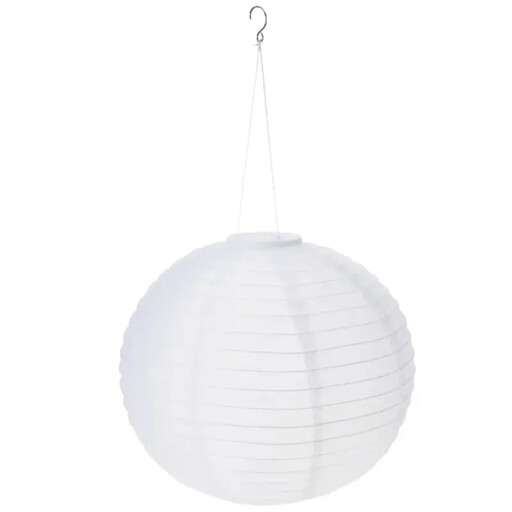
Why it stands out: This ball-shaped solar light is reminiscent of a classic lantern and produces a particularly soft, diffused light. With a diameter of 28 cm, it is a decorative element that is effective both day and night.
Advantages:
Who is it for? For users who prefer decorative and atmospheric lighting for balconies, patios, or sheltered garden corners and who value aesthetic design.
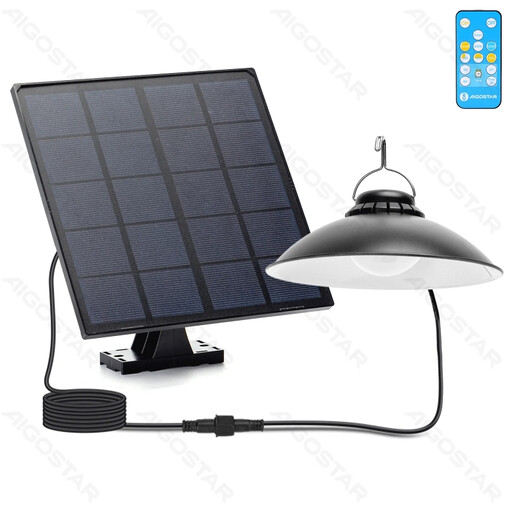
Why it stands out: This model is designed for functionality and performance. The solar panel is separated from the lamp by a 3-meter cable, allowing for optimal alignment with the sun, even if the lamp is hanging in a shaded area like a carport or a covered patio.
Advantages:
Who is it for? For users who need reliable and bright lighting for garden sheds, workshops, entrances, or covered outdoor areas where the solar panel needs to be placed in a sunnier spot.
The models presented cover many use cases, from decorative to functional lighting. However, if you need even more intense and wide-area illumination for driveways, facades, or large garden areas, high-performance floodlights might be the right solution.
Discover our selection of LED Outdoor Floodlights for more lighting solutions.
How long do outdoor solar lights stay on? The illumination time depends on several factors: the battery's capacity, the solar panel's efficiency, and the duration and intensity of sunlight during the day. On a sunny summer day, most models achieve an illumination time of 6 to 12 hours after a full charge.
Do solar lights work in winter or on cloudy days? Yes, modern solar panels can generate energy even in diffuse light, although their efficiency is lower than in direct sunlight. In winter, the days are shorter and the sun is lower, which reduces the charging time. This typically results in a shorter illumination time in the evening.
What does the IP rating mean for weatherproof solar lights? The IP rating classifies a housing's protection against foreign objects and water. For weatherproof solar lights, the most relevant ratings are IP44 (protection against splashing water from all directions) and IP65 (dust-tight and protection against water jets). For unprotected areas exposed to heavy rain, IP65 is the safer choice.
Your Joybuy Product Recommendation Officer