
Lieferung heute & morgen

Qualitätsgarantie

Willkommens-Angebote freischalten: KOSTENLOSE Lieferung | Bis zu 80 % RABATT | Kostenlose 30-Tage-JoyPlus-Testphase
App herunterladen
Outdoor toys for children should encourage movement, be easy to use and enrich family life. At the same time, products can vary considerably in terms of age suitability, space requirements, materials and supervision. Focusing only on bright colours or a long list of features can mean overlooking important details.
A bouncy castle with a slide or a comprehensive garden toy set can often look compact in product images. However, the assembled dimensions are what really matter. A model measuring 460 × 343 × 190 cm requires not only floor space, but also safety clearances from fences, trees and walls. Before buying, measure the available area in full.
“From 3 years” does not automatically mean that every child can use the toy independently. Height, motor skills and the complexity of the game are also relevant. Small parts may present a choking hazard. For products such as a children's golf set, bowling and ring-toss game or water-play track, the age recommendation and warnings should therefore always be considered together.
Children's water toys need to be emptied and dried after use. A bouncy castle with a slide requires a blower, a suitable power supply and a sheltered location. Even apparently simple children's movement toys may need cleaning after being used in sand or on damp ground. These ongoing tasks should form part of your buying decision.
Look out for:
For example, the bowling and ring-toss game is stated as suitable from 3 years. The product information also highlights small parts and the need for direct adult supervision. Such warnings apply even when the toy is generally intended for both indoor and outdoor use.
For garden toys, three dimensions are particularly important: the product size when assembled, the required safety zone and the packed size for storage. A children's slide should be placed on a level, stable surface. Kites for children require an open area away from roads, power lines and closely spaced trees.
With a water-play track set, you should also check that the surface is level and that water can drain away safely. For indoor use, smaller sets such as a children's golf set or a frisbee ball are more suitable than large-scale play equipment.
Plastic parts made from PP, Oxford fabric or other stated materials should be suitable for the intended use. The 2-in-1 bowling and ring-toss game is described as being made from impact-resistant PP plastic; according to the product description, the parts can be cleaned with a damp cloth and mild soap.
For an inflatable play structure, the construction is just as important as the fabric. According to the product information, the multifunctional model is made from waterproof Oxford fabric and features a 450-W blower. The statement “EN 71 certified” should be understood as information provided by the manufacturer or seller and checked against the details on the packaging and product page.
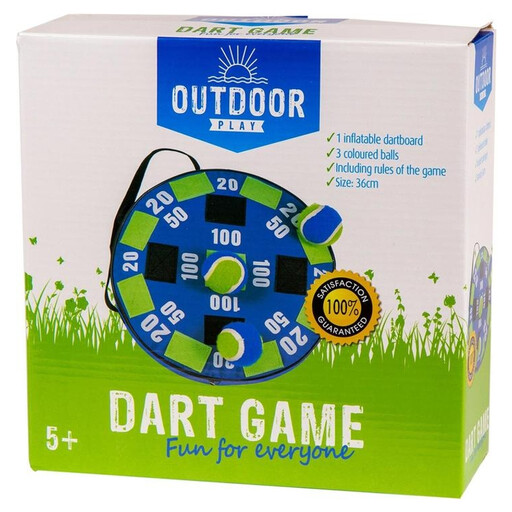
Why this product suits this profile: Compared with larger garden play equipment, the inflatable target game takes up little space and can be taken to the garden, park or beach. According to the product information, it is intended for children from 5 years.
The three hook-and-loop balls are included in the set, so there is no need to plan for additional throwing accessories. However, an adult is still expected to be present when inflating, hanging up and playing with the game.
36 cm diameter, three hook-and-loop balls and wipe-clean plastic surface; encourages simple target and throwing games.
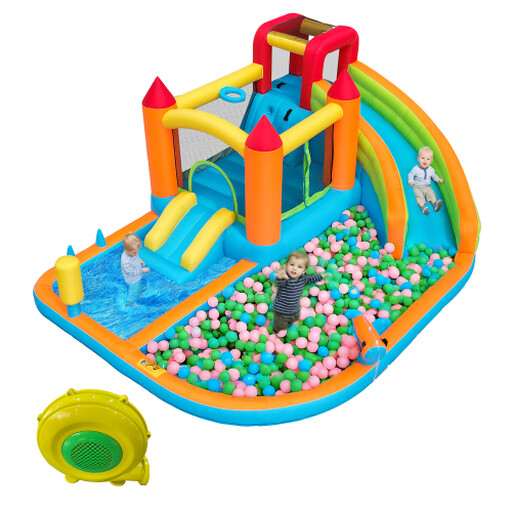
Why this product suits this profile: For families with plenty of space, this play structure combines dry and wet play with a slide, trampoline, climbing wall and basketball hoop. It is stated as suitable for ages 3 to 8, for a maximum of four children and a total load of 180 kg.
The assembled dimensions, blower output and load limit are specified. The blower must remain connected during use, and windy areas should be avoided according to the product warning.
460 × 343 × 190 cm when assembled, 450-W blower, two slides and dry or water-play use with a garden hose.

Why this product suits this profile: The canal system is aimed at children from 3 years and, according to the product description, can be used indoors and outdoors. It suits families, childminders and groups who enjoy shared, creative water play.
The intended process is clear: assemble the canals, add water, play and then drain the water completely. This keeps the maintenance requirements manageable.
Canals, locks, boats and accessories; according to the product information, it can be expanded and is designed for cooperative play.
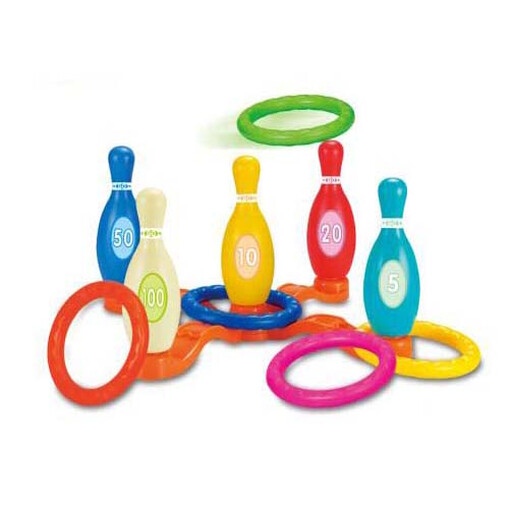
Why this product suits this profile: This manual set is intended for level surfaces in the child's room, garden, park or nursery, and requires no batteries.
It does not depend on electricity, a blower or water. The set is used directly on a stable, level surface and can be wiped clean with a damp cloth.
10 pins and 5 rings, a total weight of around 530 g and an age recommendation from 3 years.
We have put together a complete, regularly updated list of products that fully meet these strict selection criteria and the safety regulations applicable in the EU.
Simple sets with clear rules may be suitable, such as bowling, ring toss, a water-play track or age-appropriate movement games. The specific manufacturer's recommendation, any small parts and the child's abilities remain decisive. Supervision should always be arranged in line with the warnings.
Lifespan depends on the material, UV exposure, moisture, loads and storage conditions. Plastic parts should be cleaned after use and stored in a dry place. Inflatable products should be completely dry before being folded away. A water-play track should ideally be stored away from frost and direct sunlight.
In addition to the purchase price, you may incur electricity costs for the blower, water consumption for wet play and, where applicable, space or transport costs. For a realistic estimate, check the blower output, the planned play time and the connection to a garden hose. You can estimate the electricity cost using the formula “power in kW × operating hours × electricity price per kWh”.