
Lieferung heute & morgen

Qualitätsgarantie

Willkommens-Angebote freischalten: KOSTENLOSE Lieferung | Bis zu 80 % RABATT | Kostenlose 30-Tage-JoyPlus-Testphase
App herunterladen
Outdoor toys for children should suit their age, the space available and how you plan to use them. A small paddling pool for babies has different requirements from a bouncy castle with a slide or a remote-controlled water vehicle for children. More often than not, it’s unclear size details, missing accessories or choosing the wrong age range—not the price—that lead to disappointing purchases.
For inflatable products, the measurements usually refer to the maximum size when fully inflated. A bouncy castle with a splash pool also needs space for the blower, anchoring and a safety clearance. A children’s pool with a sunshade may take up more room than expected because of its side rings.
So be sure to check:
A paddling pool for babies is not the same as a swimming pool or a buoyancy aid. Even a few centimetres of water can be dangerous. The recommended age, maximum load and number of children who can play at once should all match how the product will actually be used.
For a bouncy castle, you should also check the maximum load and the recommended number of children. For example, the 5-in-1 model described here is suitable for children aged 3 to 10 years, with a maximum of three children and a weight limit of 135 kg. The blower must stay switched on while the castle is in use.
A low-priced purchase can lead to extra costs if an air pump, blower, anchors or repair kit aren’t included. Water toys also need to be cleaned, dried and stored properly. For small pools, a pool vacuum can be useful if you need to remove sand or leaves regularly.
Emptying the water is important too: after use, a children’s pool should be completely drained, cleaned and dried. Standing water adds to the maintenance and must not be left where children could access it unsupervised.
For children aged 1 to 3, shallow models with a manageable capacity are a good choice. The INTEX Sweet Blossom pool measures 86 x 25 cm, holds 56 litres according to the product details and has an inflatable floor. Another INTEX model, measuring 61 x 22 cm, is listed as suitable from 1 year old and has an inflatable floor and a drain.
A sunshade reduces direct exposure to the sun, but it doesn’t replace breaks in the shade or suitable sun protection. A responsible adult must remain close by and supervise children at all times when they’re playing in water.
When choosing inflatable water toys, check for PVC material, welded seams, sturdy valves and a repair patch. A soft floor can make the pool more comfortable to sit in, but it won’t prevent it from tipping over or children from slipping. Set the pool up on suitable, level ground and keep it away from sharp objects.
For a bouncy castle, look for a safety net, ground anchors and a suitable blower. Check whether the blower is included. Product 2 specifies a blower rated at 550 to 750 W, while Product 4 is explicitly sold without a blower.
Some play equipment can be used both wet and dry. This can be a good option for families who want to use the toy in the garden whatever the weather. For a bouncy castle with a splash pool, you’ll need to consider the water connections, drainage and drying. After use with water, let the material dry completely before packing it away.
Compact, lightweight products are more practical for the beach and holidays. An inflatable water play centre or a large bouncy castle, on the other hand, needs plenty of space and usually a permanent set-up spot.
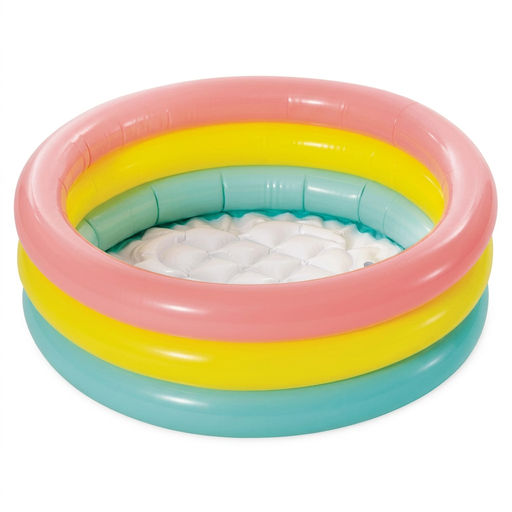
Why it suits this profile: Its compact size and stated 28-litre capacity make it a good fit for small gardens, patios or taking out and about in summer.
The dimensions, water capacity and inflatable floor are clearly specified, making it easier to assess the space and maintenance involved before you buy.
Compact dimensions, inflatable floor and drain plug, according to the product description.
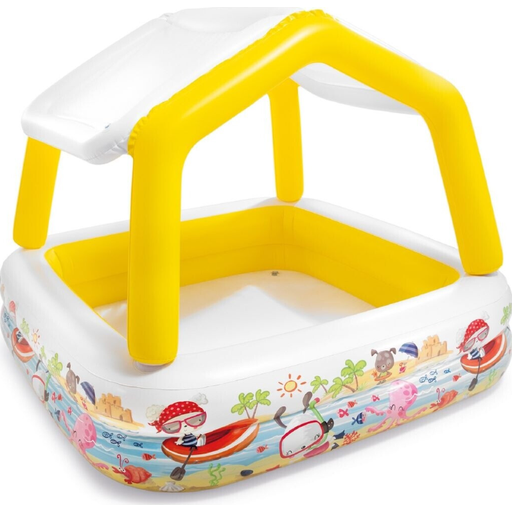
Why it suits this profile: At around 157 x 157 x 122 cm and with a 295-litre capacity, this model is for families with room for a larger interior and a sunshade.
The removable sunshade and drain plug are listed as specific features. The generous water capacity also makes the filling and cleaning involved clear.
Removable sunshade, 295-litre capacity, drain plug and repair patch, according to the product details.
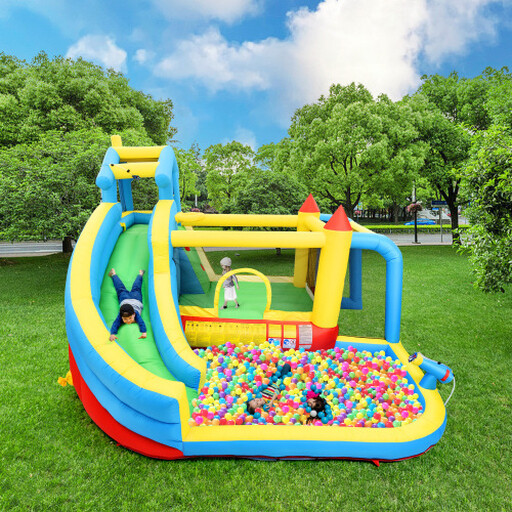
Why it suits this profile: This model combines a bouncing area, slide, water play and ball games for children aged 3 to 10, and needs a larger garden space.
The age range, maximum number of children, weight limit and blower requirements are all specified. This makes it easier to plan for space, supervision and ongoing running costs.
Five play areas, suitable for wet or dry use, and a blower included, according to the description.
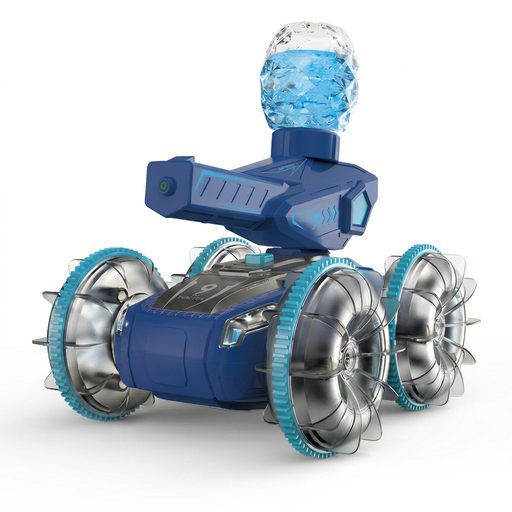
Why it suits this profile: This remote-controlled vehicle is designed for shallow water, as well as driving on grass, sand or firm ground.
The intended environments, minimum age and control options are described. This makes it easier to check before buying whether your pool, beach or garden is suitable.
Four-wheel drive, two control modes, a water-spraying function and a 2.4-GHz remote control, according to the product description.
We’ve put together a complete, regularly updated list of products that meet these strict selection criteria and fully comply with the safety regulations in force in the EU.
To help inflatable toys last longer, rinse them with clean water after each use and let them dry completely. Don’t fold PVC products while they’re still damp. Store them somewhere dry and cool, away from direct sunlight. Keep repair patches out of children’s reach.
For small pools, a cordless pool vacuum can make cleaning easier. According to the product details, the BWT BC02 is designed for pools up to 10 m³, runs cordlessly for up to 30 minutes and has a 0.42-litre dirt container. It’s an electrical appliance, not a toy, and must only be used by adults.
For babies and toddlers, the water should be shallow and within the manufacturer’s recommended limits. The key consideration isn’t just the depth, but uninterrupted supervision close by. A paddling pool is not a lifesaving aid.
How long they last depends on the material, how they’re used, how they’re stored and the surface they’re placed on. Sharp stones, overfilling, strong sunlight and damp storage can damage the material. A repair patch is only suitable for certain small areas of damage; it won’t fix damaged seams or unstable sections.
As well as the purchase price, you may need to factor in electricity for the blower, water use and maintenance. When choosing a model, consider the blower’s power rating, set-up time, water capacity and whether it can be dried completely.