
Lieferung heute & morgen

Qualitätsgarantie

Willkommens-Angebote freischalten: KOSTENLOSE Lieferung | Bis zu 80 % RABATT | Kostenlose 30-Tage-JoyPlus-Testphase
App herunterladen
An outdoor wall light needs to do more than complement your exterior. It must provide enough light for its intended location, cope with moisture and be safe to install. Many poor purchases happen because product images, wattage ratings or terms such as ‘weatherproof’ are considered in isolation.
Wattage primarily describes energy consumption. The luminous flux, measured in lumens, determines how bright a light actually is. Depending on its design and lighting technology, a 10-watt LED outdoor wall light can produce very different lumen levels. A moderate light output is often enough for an entrance, while an outdoor LED floodlight may need to provide more light for a courtyard, garage or driveway.
A weatherproof outdoor light should have a clearly stated IP rating. On an IP44 outdoor light, the first digit indicates protection against solid objects measuring 1 millimetre or more, while the second indicates protection against water splashes from different directions. IP44 is therefore suitable for many sheltered outdoor areas, but it does not mean the light can be used permanently under a jet of water or completely exposed in every situation.
Also check that the cable entries, seals and mounting surface are suitable for the stated IP rating. Poor installation can compromise the intended level of protection.
An outdoor wall light with a sensor can make life easier by switching on the light only when needed. For this to work well, the detection range, mounting height and direction need to suit the surroundings. Movement on a footpath, passing vehicles or animals can trigger the light unnecessarily, depending on the settings. When choosing an outdoor wall light with a sensor, also check whether it has a motion sensor, a light sensor or a combination of both.
Look beyond the lumen rating and check the beam angle too. Adjustable light heads can direct light more precisely onto a courtyard, doorway or façade. Up-and-down lights cast light upwards and downwards, making them better suited to architectural accents than to lighting a wide path.
An integrated LED is compact and does not need a separate bulb. Before buying, check whether the LED module can be replaced. Several models mentioned in this guide have a fixed, non-replaceable light source. If it fails, the entire light will generally need to be replaced.
A light with an E27 fitting, on the other hand, gives you more flexibility over light colour and brightness, and lets you replace the bulb later. The Westinghouse Eddystone, for example, takes an E27 bulb of up to 60 watts; the bulb is not included.
Metal housings made from aluminium or steel can be sturdy, but outdoor use requires a suitable surface treatment to protect against corrosion. Glass covers should be securely fitted and suitable for the intended use. A black outdoor wall light can look right at home on a modern façade, but colour should not be the only factor in your choice.
Lights connected directly to the mains at 220–240 V should be installed by a qualified electrician. Disconnect the power supply before carrying out any maintenance. With dimmable models, make sure the dimmer is compatible with LED lights.
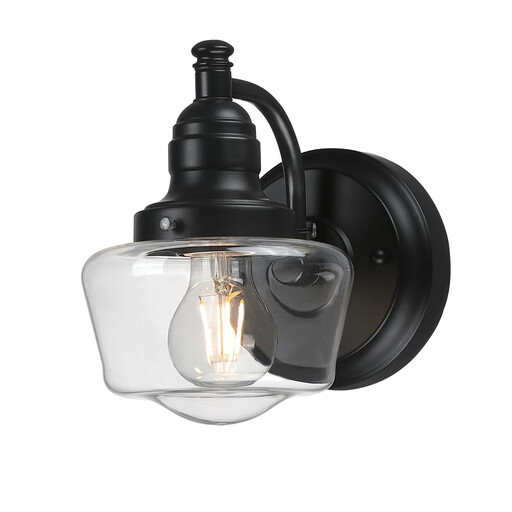
Why this product suits you: The E27 fitting lets you choose a compatible LED bulb for an entrance, balcony or terrace.
Brightness is not permanently fixed by a built-in LED module. You can choose a bulb separately and replace it when needed.
IP44 rating, E27 fitting, 220–240 V at 50 Hz and a compact housing measuring 15 cm wide.
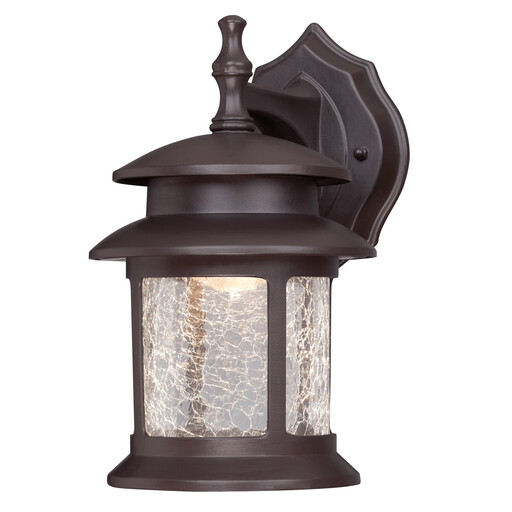
Why this product suits you: According to the product specifications, the integrated 9 W LED delivers 1,000 lumens at 3,000 Kelvin, making it suitable for controlled lighting at an entrance or on a terrace.
The lumen output, colour temperature, power consumption and IP rating are all clearly specified. That means ‘weatherproof’ is not the only information you have to go on.
IP44 rating, warm white light, dimmable with a compatible LED dimmer and a stated average lifespan of 35,000 hours.
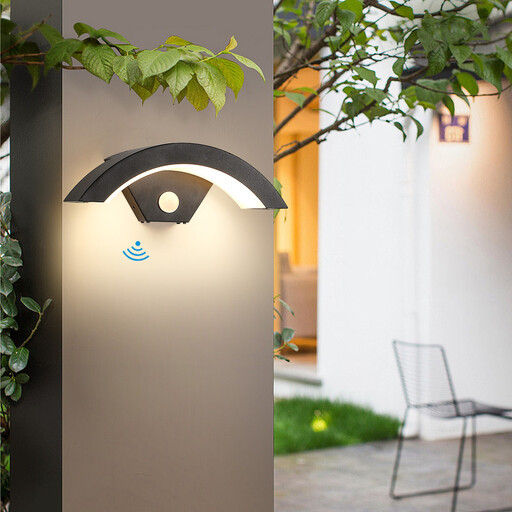
Why this product suits you: Its light and motion sensors make it suitable for frequently used entrances, garages, driveways, balconies or stairways.
The sensor functions are clearly stated, so you can check before buying whether automatic activation and ambient light detection are right for your installation location.
24 W, warm white colour temperature of 3,000 Kelvin, matt aluminium housing and designed for use in a range of outdoor areas.
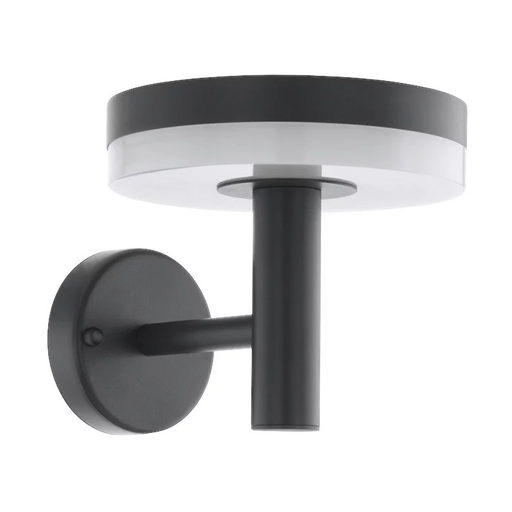
Why this product suits you: The anthracite metal and plastic housing with a white diffuser complements modern entrances, garden walls and terraces.
Your decision need not be based on design alone: the 11 W power rating, 950 lumens, 3,000 Kelvin colour temperature and integrated LED are all clearly specified.
Warm white light, anthracite finish, integrated LED module and dimensions of 24.5 × 18 × 24.5 cm.
We’ve put together a complete, regularly updated list of products that meet these strict selection criteria and the safety regulations in force in the EU.
IP44 is a commonly used rating for many sheltered entrances, terraces and façades. However, the right rating depends on the specific installation location, the light’s orientation and the manufacturer’s instructions. A higher rating may be advisable where the light is directly exposed to harsh weather. The light must also be installed and sealed correctly.
Consumption depends on the wattage and how many hours the light is on each day. A 10 W light running for five hours a day uses around 0.05 kWh per day. Motion or light sensors can reduce operating time when set up appropriately. To calculate the exact cost, multiply the energy used by your individual electricity rate.
Lifespan depends on the LED module, electronics, temperature, moisture and operating time. For lights with integrated LEDs, check the average lifespan stated by the manufacturer. With a light that has an E27 fitting, you can replace the bulb without replacing the housing. Regular visual checks, dry cleaning and keeping the seals intact all help the light work as intended.