
Lieferung heute & morgen

Qualitätsgarantie

Willkommens-Angebote freischalten: KOSTENLOSE Lieferung | Bis zu 80 % RABATT | Kostenlose 30-Tage-JoyPlus-Testphase
App herunterladen
An outdoor wall light should reliably illuminate your entrance, patio or garden while complementing your façade. The selection ranges from a portable LED outdoor wall light with a rechargeable battery to a permanently installed outdoor LED wall floodlight. However, product names and marketing promises alone reveal little about whether a light is genuinely suitable for your needs.
Three common purchasing problems occur particularly often:
The IP rating consists of two digits. The first describes protection against solid foreign objects, while the second indicates protection against water. IP44 means protection against solid objects from 1 mm in size and against splashing water from various directions.
A weatherproof outdoor wall lamp with IP44 is therefore often suitable for covered entrances, façades, patios or sheltered areas of the garden. If the wall is completely unprotected, you should also pay attention to a suitable installation height, a securely sealed wall bracket and the manufacturer's instructions. Water must not collect around cable entries or on the back of the light.
Wattage mainly describes energy consumption, not brightness. For comparison, luminous flux in lumens (lm) is more important:
Warm white light at around 3,000 Kelvin usually creates a subtle atmosphere around the home and is suitable for a garden wall light, entrance or patio lighting. 4,000 to 5,000 Kelvin produces a more neutral or daylight-like appearance. This can be useful for garages, driveways or work areas, but may feel less appropriate beside a cosy seating area.
Also consider how the light is distributed. A light with up-and-down illumination creates a decorative effect on the wall. An adjustable dual-head floodlight directs the light more precisely towards a path, driveway or garden area.
A permanently connected light requires a suitable power connection. In Germany, work on electrical installations must be carried out by an appropriately qualified professional. With a rechargeable-battery light, there is no need for a fixed connection, but you will need to consider charging intervals, access to the charging port and the available installation surface.
Check whether the LED module is integrated and non-replaceable or whether the light uses a standard bulb, such as one with an E27 cap. A dimmable outdoor wall light generally requires a compatible LED dimmer, which is often not included. A motion sensor should be suitable for its surroundings in terms of detection angle, range and switch-off delay.
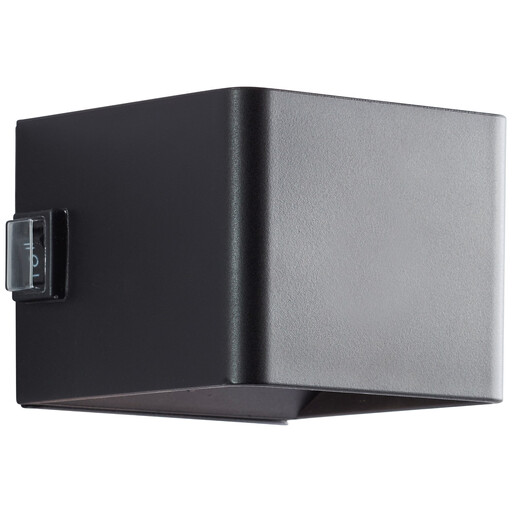
Why this product suits this profile: This portable light is suitable for tenants, small entrance areas or places without an existing power connection. The integrated battery is charged via USB.
The technical specifications clearly state 300 lm, 3,000 K and IP44. This makes it easier to assess the light realistically for smaller areas, rather than expecting it to illuminate a large space.
Battery, USB connection, magnet, rocker switch and integrated motion sensor. The stated protection rating is IP44.
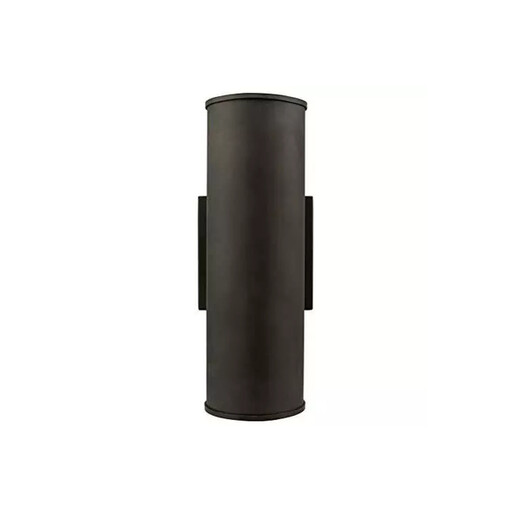
Why this product suits this profile: This rectangular light with up-and-down illumination is ideal for entrances, patios and garage doors when both functionality and the appearance of the façade matter.
The product description specifies an output of 870 lm, a colour temperature of 3,000 K and a protection rating of IP44. This makes it possible to choose based on the size of the area and the desired lighting effect.
Two integrated 8-W LEDs, 870 lm, 3,000 K, frosted glass elements and IP44 protection.
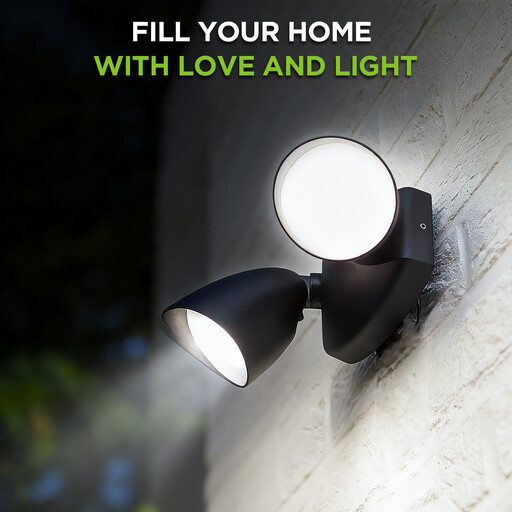
Why this product suits this profile: This dual-head floodlight is designed for larger areas such as courtyards, garages, gardens or driveways, where broad light coverage is more important than decorative accent lighting.
The two adjustable light heads allow more targeted distribution than a single fixed beam. Before buying, check the installation location and type of connection required.
1,800 lm, 20 W, 4,000 K and two light heads for functional area lighting.
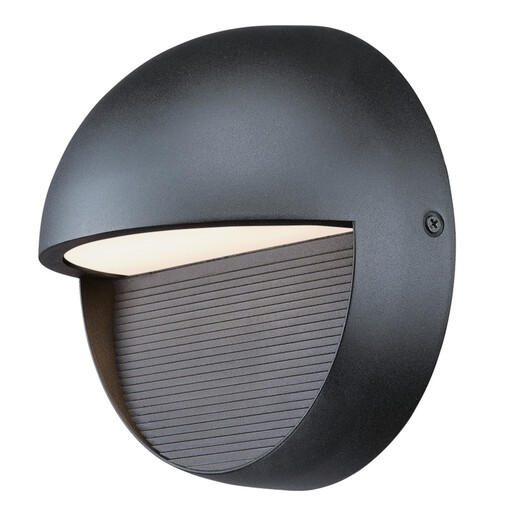
Why this product suits this profile: This compact light is suitable for anyone looking for a permanently installed outdoor wall light with a dimmable light source for a patio, entrance or garden wall.
The dimming function is explicitly dependent on a compatible external LED dimmer. This prevents the assumption that a dimmer is automatically included or that every model is suitable.
IP44, integrated 10-W LED, textured black housing, frosted opal glass and external dimming.
We have put together a complete, regularly updated list of products that fully meet these strict selection criteria and the safety regulations applicable in the EU.
For a permanently connected outdoor wall light, the wall surface should be level, stable and suitable for the intended fixings. Use corrosion-protected screws and make sure the seal is correctly positioned after installation. The power circuit must be switched off before any work is carried out.
Ongoing costs depend on energy consumption and daily operating time. A 10-W light switched on for five hours a day uses around 18.25 kWh per year in theory. A motion sensor can reduce the time the light is switched on, but it cannot replace correct positioning. With battery-powered models, regular charging cycles replace the electricity costs of mains operation; how often charging is needed depends on usage and battery capacity.
For many sheltered outdoor areas, IP44 is a common guideline. The light is then protected against splashing water. For direct exposure to the weather, highly exposed façades or areas with a lot of water, you should carefully follow the manufacturer's instructions on the installation position and choose a higher protection rating if necessary.
For a small entrance area, around 300 to 500 lm may be sufficient. For a wider façade, garage or path, 600 to 1,000 lm is often more practical. Depending on the size of the area, courtyards and driveways may also benefit from models offering 1,500 lm or more. Alongside luminous flux, the beam angle, installation height and desired colour temperature are also important.
An outdoor lamp with a motion sensor can limit operating time because it only switches on when movement is detected. How much energy is actually saved depends on sensitivity, switch-off delay and usage. Before buying, check whether the sensor range and detection area suit the path, entrance or parking space.