
Lieferung heute & morgen

Qualitätsgarantie

Willkommens-Angebote freischalten: KOSTENLOSE Lieferung | Bis zu 80 % RABATT | Kostenlose 30-Tage-JoyPlus-Testphase
App herunterladen
An outdoor wall light should reliably illuminate your entrance area, terrace, garage or façade. In practice, however, poor purchases are often not down to design, but to unsuitable technical specifications. A light may look weatherproof in product images, yet still be unsuitable for the specific installation location.
Three typical pitfalls are particularly relevant:
The code IP44 is common on many products for entrances, covered terraces and sheltered façades. The first digit describes protection against solid foreign bodies, the second against water.
For a weatherproof wall light, you should consider the installation position carefully:
The light should also be fitted with corrosion-resistant screws. For hardwired 220–240 volt models, installation by a qualified electrician is required.
For choosing brightness, lumens are more meaningful than watts. A light with 300 lumens is better suited for orientation and subtle garden lighting. For a garage, driveway or larger façade area, higher values may be sensible.
Colour temperature is given in Kelvin:
Light distribution is also crucial. An up-down outdoor light casts light upwards and downwards, creating an architectural effect on the façade. A twin-head floodlight with adjustable heads, on the other hand, can specifically illuminate certain areas such as a gate, shed or driveway.
An outdoor light with a motion sensor only switches on when movement is detected. This can be practical if you don't want the area to be permanently lit. Before buying, consider the detection range, the time delay and possible false triggers from animals or passing vehicles.
A dimmable outdoor light often requires a compatible LED dimmer, which is not always included. With fixed integrated LEDs, you should also check whether the light is explicitly compatible with your existing dimming system.
Solar lights don't need a mains connection and are suitable for garden walls, gates or areas without a power supply. However, their lighting duration depends on sunlight, battery capacity and the time of year. For consistently reliable brightness, a mains connection is usually more predictable.
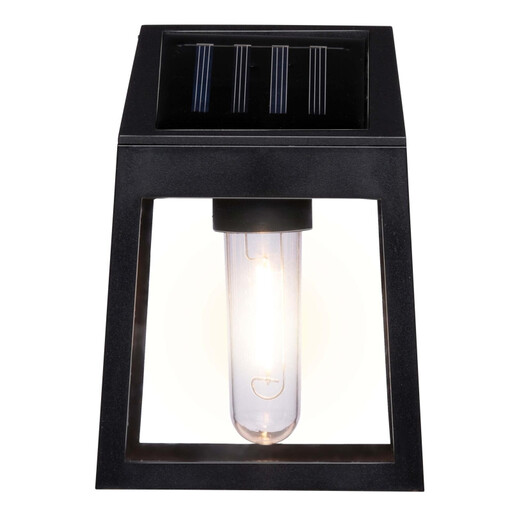
Why this product fits the profile: The solar outdoor wall light is suitable for users who prefer simple installation without a mains cable on a garden wall, gate or path.
The integrated solar power supply avoids additional mains cables. However, before installation you should check whether the location receives enough daylight.
Integrated solar panel, automatic switch-on at dusk, compact dimensions of 9.3 × 6.5 × 13 cm and a 1.2-volt Ni-MH battery.
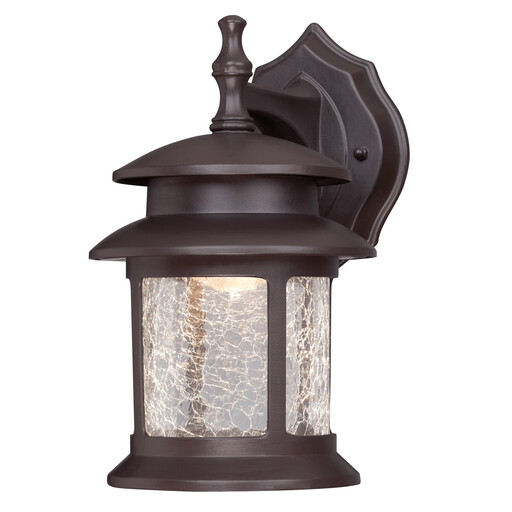
Why this product fits the profile: This model combines a fixed integrated LED, warm white colour temperature and a dimmable design for entrances, terraces or covered outdoor areas.
The product data states IP44, 220–240 volts, 3000 Kelvin and 1000 lumens. A compatible LED dimmer is required for the dimming function.
9-watt LED, 3000 Kelvin, 1000 lumens luminous flux, dimmable and housing made of aluminium with glass cover.
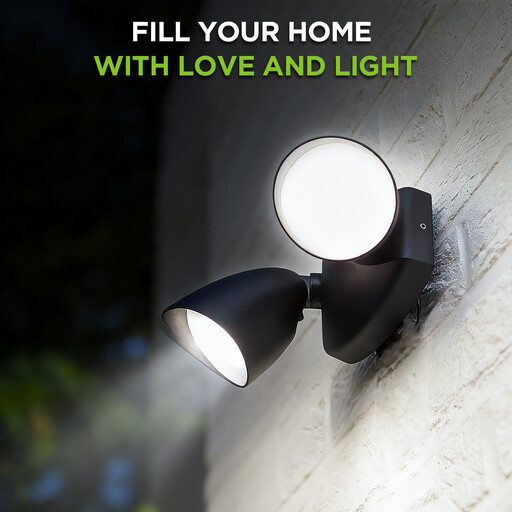
Why this product fits the profile: The twin-head floodlight is aimed at users who want to illuminate a garage, yard, garden or driveway with two separately adjustable light heads.
The two adjustable heads allow targeted positioning. Before buying, you should clarify the mains voltage and installation by a qualified electrician.
Rated at 1800 lumens, 20 watts and two adjustable light heads for broad, flexible illumination.
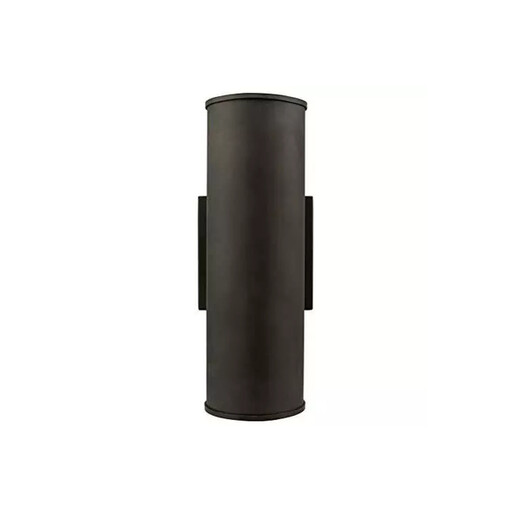
Why this product fits the profile: The slim up-down outdoor light is suitable for entrances, terraces and modern house façades where a directional light effect is desired.
The specifications state IP44, 3000 Kelvin and 870 lumens. This makes it easier to assess the light effect than by design alone.
Two integrated 8-watt LEDs, 870 lumens, 3000 Kelvin, up-down light distribution and IP44 rating.
We have put together a complete, regularly updated list of products that fully meet these strict selection criteria and the safety regulations in force in the EU.
For a hardwired LED outdoor wall light, the circuit should be switched off before starting work. Electrical installation should be carried out by a qualified professional. The light must sit flush against the wall so that the intended rating is not compromised by gaps or incorrectly routed cables.
For a longer service life, we recommend:
That depends on the installation location. IP44 protects against splashing water and is common for many sheltered outdoor areas. In completely exposed positions, you should check the manufacturer's specification for the specific weather exposure. IP44 does not mean the light can be submerged in water or cleaned with high water pressure.
For orientation and decorative garden lighting, around 300 lumens may be enough. For entrances, paths or garages, higher values are sensible depending on the area. With a twin-head floodlight, the light output can also be split between two directions. As well as lumens, the beam angle, mounting height and desired colour temperature are also important.
LED models generally need less electrical power than traditional bulbs for a comparable amount of light. For running costs, consider the wattage, daily operating time and your electricity tariff. A motion sensor or timer can reduce the on-time; with solar lights there is no mains connection, but the available lighting duration depends on the light conditions and the battery.