
Lieferung heute & morgen

Qualitätsgarantie

Willkommens-Angebote freischalten: KOSTENLOSE Lieferung | Bis zu 80 % RABATT | Kostenlose 30-Tage-JoyPlus-Testphase
App herunterladen
An outdoor wall light should illuminate your entrance area, terrace or façade both functionally and aesthetically. In practice, however, several typical buying decisions can lead to unnecessary costs: the light is too large for a narrow wall, the ingress protection rating doesn't suit the mounting position, or the advertised dimming function only works with a compatible additional device.
This guide shows what homeowners, tenants with suitable electrical installations, and garden and terrace owners should look for when choosing an outdoor wall light. The product examples are based on the manufacturer data provided.
An IP44 outdoor wall light is protected against solid foreign objects larger than 1 mm and against splashing water from any direction. However, this does not mean it is designed for direct water jets, pressure washing, or prolonged exposure to unprotected weather conditions. Under a canopy or against a sheltered house wall, IP44 can be suitable. For freestanding, highly exposed areas, the ingress protection rating should be checked against the specific mounting position.
With a dimmable outdoor wall light, a compatible LED dimmer is often required. The dimmer switch is not always included in the box. For integrated LED modules, you must also check whether your existing dimmer is compatible with this technology. An incompatible system can cause flickering or malfunctions.
An E27 outdoor wall light offers flexibility because you can choose the bulb separately and replace it later. An LED outdoor wall light with an integrated module, on the other hand, is ready to use straight away, but if the LED module fails, it cannot be replaced like a traditional bulb. Both solutions therefore have different maintenance and usage characteristics.
The ingress protection rating is given as an IP code. For many covered entrances, balconies and terraces, IP44 is a common choice. The light should also be professionally installed and correctly sealed at the intended cable entries. Incorrect installation can compromise the intended protection against splashing water.
Before ordering, you should compare at least the height, width, depth and wall clearance with the installation location. In a narrow passageway, a compact light can be sensible. Models with clear glass usually emit light more strongly outward, while frosted or opal glass can provide a more even light distribution. For outdoor lighting for terraces and entrances, it is also important whether the light shines downwards, to the side, or as up-and-down lighting.
For integrated LEDs, power output and colour temperature are important comparison values. Warm white light around 2700 to 3000 Kelvin is often chosen for entrances and seating areas. For façades with a security or orientation function, you should also consider the luminous flux in lumens.
With fittings such as E27, the bulb must be planned separately. The maximum wattage must not be exceeded. For all hardwired models operating at 220–240 V and 50 Hz, installation should be carried out by a qualified electrician. Before maintenance or cleaning, disconnect the power supply.
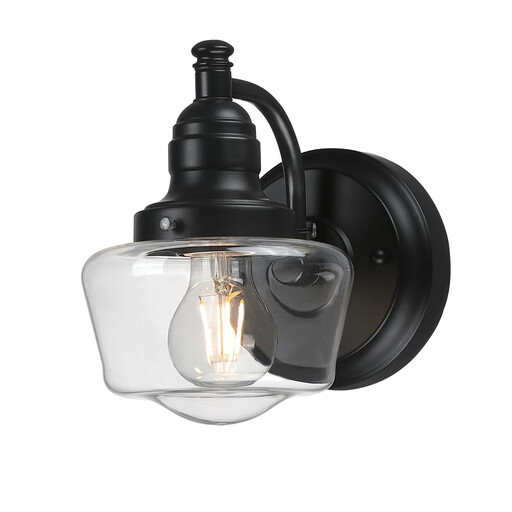
Why this product suits the profile: This compact outdoor wall light, measuring 15 cm wide and 21 cm high, is ideal for smaller entrance areas, narrow sections of façade or side paths.
The specifications clearly state IP44 and an E27 fitting for a bulb up to 60 W. This means the ingress protection rating and required bulb can be clearly checked before purchase.
IP44 splash-water protection, clear glass and replaceable E27 bulb; the bulb is not included.
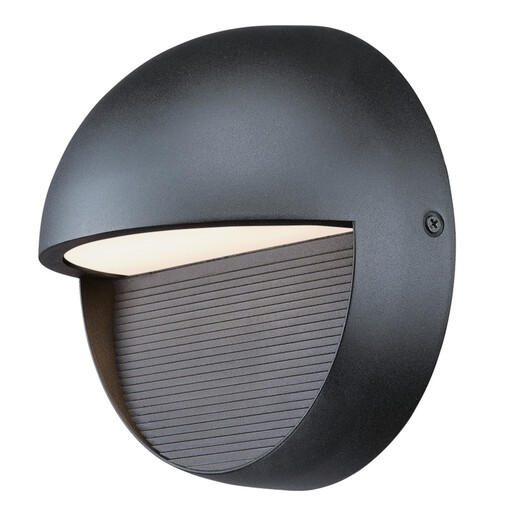
Why this product suits the profile: The round design with a textured black housing and opal frosted glass combines a clean shape with an integrated light source.
The integrated 10 W LED is clearly stated in the product data. For the dimming function mentioned, an external, LED-compatible dimmer is required.
IP44 splash-water protection, 10 W LED and compact dimensions of 16 × 16 cm; the dimmer is not included.
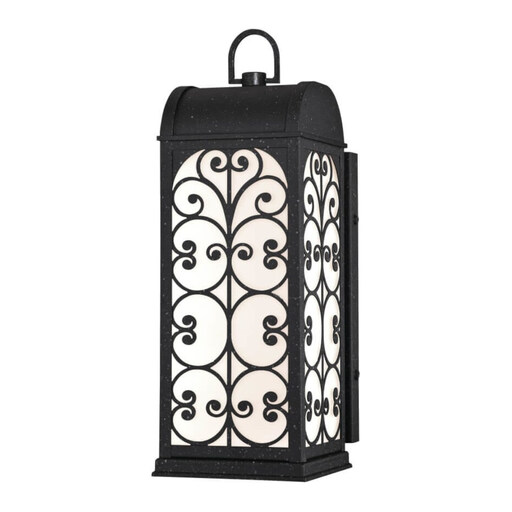
Why this product suits the profile: The slim, 41 cm high format is ideal for vertical mounting surfaces, such as next to doors or on narrow terrace walls.
The dimming function is not presented as being supplied complete: a compatible LED dimmer and professional installation are required.
16 W LED at 2700 Kelvin, IP44 and a slim format of 14 × 41 cm; matt iron and a milk glass shade define the design.
A hardwired outdoor wall light should be mounted on a suitable, level wall surface. The existing junction box, fixing materials and wall construction must be compatible with the light. For rental properties, you may need the landlord's permission before making changes to the external installation.
For electricity costs, the power consumption is key. A 10 W LED uses less electrical energy over the same operating time than a 60 W bulb. With E27 models, consumption depends on the bulb used. For a realistic calculation, you can multiply the wattage, daily usage time and electricity tariff together. An integrated LED is low-maintenance, while an E27 fitting allows you to replace the bulb later.
We have compiled a complete, regularly updated list of products that fully meet these strict selection criteria and the safety regulations in force in the EU.
For sheltered outdoor areas, IP44 is commonly used. This means the light is protected against splashing water, but not automatically suitable for direct water jets or prolonged exposure to unprotected weather conditions. You should consider both the installation location and the manufacturer's specifications together.
The lifespan depends on the LED module, operating conditions, heat dissipation and installation. A general durability figure cannot therefore be applied to every model. With integrated LEDs, the entire light fitting is replaced, whereas with an E27 outdoor wall light, the bulb can be changed separately.
The costs depend on the wattage, daily usage time and your electricity tariff. A 10 W light uses less energy over the same operating time than a 60 W bulb. With E27 models, the bulb you choose determines the actual consumption.