
Lieferung heute & morgen

Qualitätsgarantie

Willkommens-Angebote freischalten: KOSTENLOSE Lieferung | Bis zu 80 % RABATT | Kostenlose 30-Tage-JoyPlus-Testphase
App herunterladen
An outdoor wall light should reliably illuminate façades, doors, patios or garages while complementing the building’s look. In practice, however, it’s not just design and brightness that lead to wrong purchases. What really matters are the ingress protection rating, power supply, colour temperature, installation method and the specific location where the light will be used.
This buying guide from the Joybuy Product Recommendation Officer helps homeowners, tenants and garden owners to objectively assess marketing claims and choose a suitable outdoor wall light.
The term “weather-resistant” means very little without a technical specification. An IP44 outdoor light, for example, is protected against solid objects larger than 1 millimetre and against splashing water from any direction. However, it is not automatically suitable for direct high-pressure water jets, standing moisture or every unprotected roof installation.
Before buying, you should check:
The wattage primarily indicates energy consumption, not the actual amount of light. For comparing an LED outdoor wall light, the luminous flux in lumens is far more meaningful. A light with 950 lumens may be sufficient for an entrance area, whereas a wider garage driveway might benefit from a more directional solution.
Colour temperature also affects how you use the light:
An outdoor wall light with a motion sensor can replace a manual switch, but it needs the right detection angle and a suitable mounting position. Branches, passing vehicles or pets can trigger false alarms depending on the sensor type.
A solar-powered outdoor wall light needs enough direct sunlight. On a permanently shaded north-facing wall or under a balcony, charging performance may be reduced. For hardwired lights, on the other hand, electrical installation should be carried out by a qualified professional.
For many covered entrance areas, patios and façades, IP44 is a common protection rating. This protection only applies if the light is installed correctly. The wall surface should be level, cable entries must be sealed properly, and the supplied fixings must be suitable for the substrate.
For highly exposed locations, such as an open garden wall, a higher protection rating may be advisable. You should always check the manufacturer’s specifications and the specific installation conditions.
In the UK, mains voltage is particularly important for hardwired outdoor lights. Several of the Westinghouse models listed here are rated for 220–240 V, 50 Hz according to their product data. The LUTEC Twin LED Spotlight, however, is specified at 120 V, 60 Hz and therefore cannot simply be connected directly to a UK mains supply.
Battery-powered and USB lights offer more flexibility, but they generally serve a different purpose to permanently installed wall lights. Before ordering, compare voltage, connection type, cable outlet and installation instructions.
A twin spotlight with adjustable heads directs light precisely onto a driveway, garden path or garage door. An outdoor wall light with upward and downward light distribution, on the other hand, often creates a decorative façade effect.
With integrated LEDs, the module is usually not user-replaceable. With a light that has an E27 fitting, you can choose the bulb separately and replace it later. A dimmable outdoor light requires a compatible LED dimmer; an existing dimmer switch is not automatically suitable.
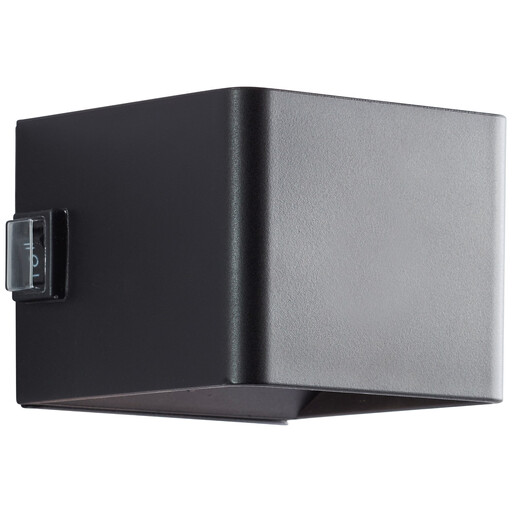
Why it fits: This battery-powered light with USB charging cable, magnetic mount, 300 lumens and 3,000 Kelvin is ideal for locations without an existing power supply.
The IP44 rating and battery power supply are clearly stated. However, it should not be submerged in water or cleaned with a pressure washer.
Cordless operation, motion sensor, toggle switch and 300 lumens according to product specifications.
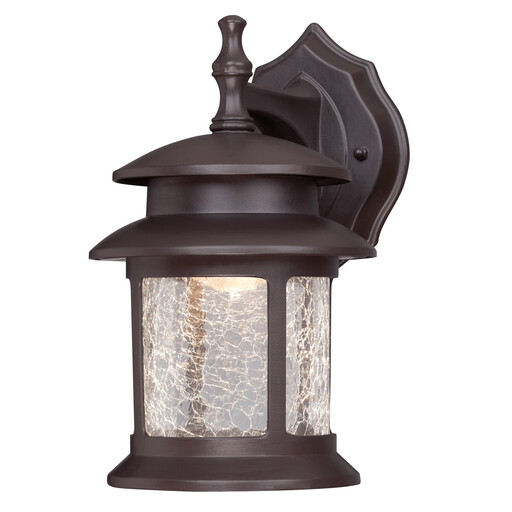
Why it fits: For hardwired entrance lighting with warm white light, this model offers a 9 W LED, 1,000 lumens light source output and a stated IP44 rating.
The specifications for voltage, power, colour temperature, protection rating and dimmability are all concrete. A compatible LED dimmer is required separately.
Aluminium housing, crackle clear glass, 3,000 Kelvin, 220–240 V and a stated average lifespan of 35,000 hours.
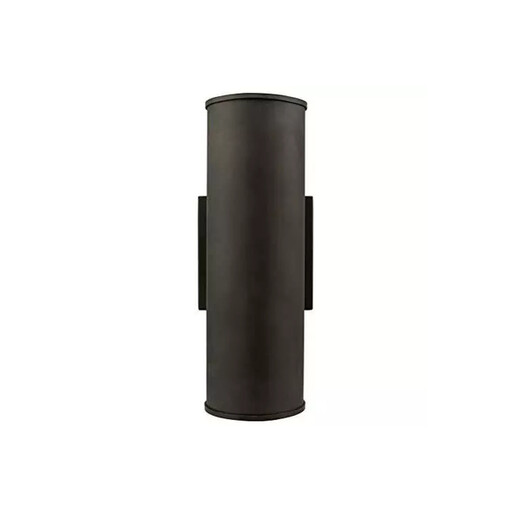
Why it fits: This rectangular light with upward and downward light distribution is designed for entrances, patios, garage doors and façades.
The fixed mains supply at 220–240 V and the stated IP44 rating make it easy to match with UK installation conditions. Professional installation is required.
Two integrated 8 W LEDs, 870 lumens, 3,000 Kelvin, IP44 and mounting accessories according to the product description.
In the full category you will find more outdoor wall lights for entrances, façades, garages, gardens and patios. Compare protection ratings, light output, power supply and design there.
For a front door, warm white models around 2,700 to 3,000 Kelvin are often a good choice. In a covered area, IP44 may be sufficient, provided the installation instructions confirm this. A motion sensor is practical if you don’t want the light to be on permanently.
The lifespan depends on the LED module, heat dissipation, operating hours, ambient temperature and installation. Manufacturer claims such as 35,000 hours are average values and not a guarantee of identical performance in every environment. With integrated LEDs, you should also check whether the module is replaceable.
You can estimate the running costs using the following calculation:
Power in watts ÷ 1,000 × operating hours × electricity price per kilowatt-hour
A 10 W light running for five hours a day would theoretically consume around 18.25 kilowatt-hours per year. The actual amount depends on your individual electricity tariff. Motion sensors, timer functions or dimming can reduce the operating time.