
Lieferung heute & morgen

Qualitätsgarantie

Willkommens-Angebote freischalten: KOSTENLOSE Lieferung | Bis zu 80 % RABATT | Kostenlose 30-Tage-JoyPlus-Testphase
App herunterladen
An outdoor wall light with a motion sensor should switch on reliably when movement is detected, illuminate the way and keep installation straightforward. In practice, however, three common marketing traps in particular can lead to disappointing purchases: a high lumen figure is advertised without specifying the right application, an IP rating is not properly explained, and the stated lighting time for solar lights is mistaken for a guaranteed operating time.
For homeowners, tenants and garden owners in Germany, there is another consideration: not every light is suitable for permanently exposed outdoor areas. Before buying, you should therefore assess brightness, sensor technology, power supply, installation location and weather resistance together.
Lumens describe luminous flux, in other words the total amount of light emitted. However, how the light is distributed is also important. A compact LED outdoor wall light with 300 lm may be sufficient for a balcony or entrance. For a garage, courtyard or longer driveway, higher light output and a wide beam angle are often more useful.
For security lights with multiple light heads, you should also check whether the heads can be adjusted. This allows the light to be directed more precisely towards doors, paths or parking spaces.
The IP rating consists of two digits. The first describes protection against solid foreign objects and dust, while the second indicates protection against water. IP44 includes protection against splashing water from various directions. IP65 indicates dust protection and protection against water jets.
An outdoor wall light with IP65 therefore generally offers greater protection for exposed installation locations than an IP44 model. Nevertheless, it should not be cleaned permanently with a high-pressure washer or submerged in water. Cable connections, screws and the mounting surface must also be suitable for outdoor use.
With a solar outdoor light, orientation, shade, time of year, dirt on the panel and the selected operating mode all affect how long it runs. Statements such as “up to 24 hours” should therefore be understood as manufacturer specifications under certain conditions, not as a fixed daily performance guarantee.
For a battery-powered outdoor wall light, you should also consider how and where it is charged. USB charging is flexible, but requires you to check the charge level regularly. With mains-powered models, the connection should be left to a suitably qualified professional if there is any doubt.
A motion sensor should suit the installation location. A limited detection angle is often sufficient for a narrow entrance area. At a garage, courtyard or garden path, a wider angle and greater range are more practical. Look for specifications such as a 120° detection angle, 2 to 5 metres’ range or an automatic switch-off time.
An additional dusk or light sensor prevents the outdoor light with motion sensor from being activated unnecessarily during the day. With dimmable outdoor lighting or several operating modes, you can adjust how it is used to suit your needs.
The lumen rating should be appropriate for the area. For decorative patio lighting, 200 to 500 lm is often sufficient. Larger courtyards or driveways may require considerably higher light output. However, higher output normally also increases energy consumption.
Mains-powered models deliver consistent performance, but require professional electrical installation. Solar lights eliminate the need for mains cabling, but need a location that receives as much sunlight as possible. Battery lights with a USB connection can be installed flexibly and may sometimes be attached magnetically.
Material specifications such as aluminium, ABS or PE should always be assessed together with the IP rating and installation instructions. For a weather-resistant outdoor light, corrosion-resistant screws and a stable, level mounting surface are important. Check existing drill holes, wall material and cable routing before placing your order.
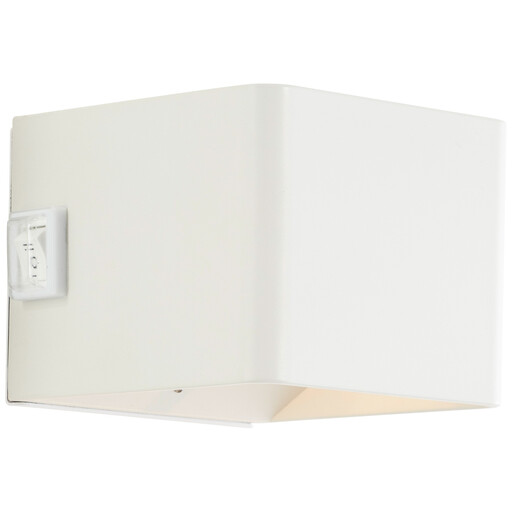
Why this product suits this profile: This compact rechargeable light is suitable for smaller entrance areas, balconies and patios without an existing power connection. USB charging and magnetic mounting make it easy to use wherever you need it.
The technical specifications clearly state 300 lm, 3,000 K and IP44. This makes it easier to assess the light as suitable for sheltered areas rather than assuming it is suitable for every weather condition.
300 lm, warm white light at 3,000 K, integrated battery, USB connection and motion sensor.
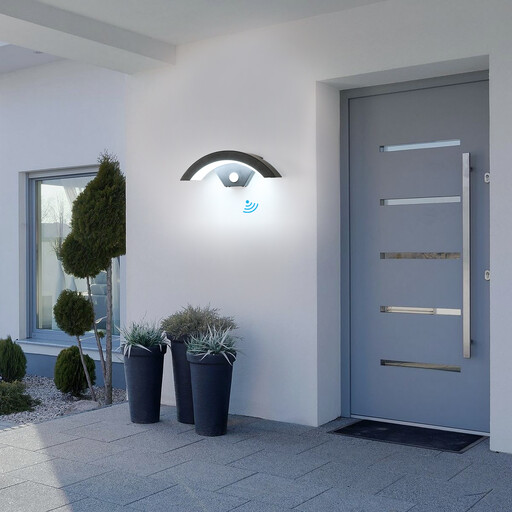
Why this product suits this profile: For entrances, garages and paths, this permanently installed light offers a high stated light output and a robust aluminium construction.
With IP65 and a stated switch-off time of 45 seconds, the protection rating and sensor operation are described more specifically than with vague “weatherproof” promises.
24 W, stated 2,700 lm, IP65, 120° detection angle and 2 to 5 m detection range.

Why this product suits this profile: This solar security light is designed for courtyards, garages, driveways and larger garden areas where several zones need to be illuminated.
Three light heads, 270° coverage, three operating modes and specific details about IP65 and the sensor range make its limitations easier to understand.
Stated 3,000 lm, 302 LEDs, 180° sensor angle, 60-foot detection distance and 1,800-mAh battery.
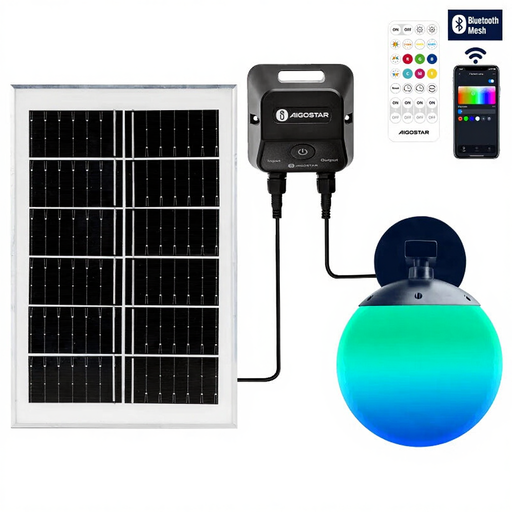
Why this product suits this profile: For users who want to combine a solar outdoor light with colour changing and app control, this model offers several light colours ranging from RGB to 2,700–6,500 K.
The specifications state 200 lm, IP65, a 5 W solar panel and a charging time of 4 to 6 hours. Important: the description confirms automatic lighting, but does not explicitly mention a motion sensor.
IP65, RGB+CCT, Bluetooth Mesh connection, 5 m cable to the panel and stated automatic lighting.
We have put together a complete, regularly updated list of products that fully meet these strict selection criteria and the safety regulations applicable in the EU.
Before installation, check the sensor’s detection area. Otherwise, movement on pavements or in adjoining areas may trigger the light unnecessarily. The sensor should not point directly at highly reflective surfaces or branches that move constantly.
For mains-powered lights, electrical connections and any other work must only be carried out by a suitably qualified professional. Solar and battery-powered models do not require a fixed mains cable, but they must be securely attached. Solar panels should be kept clear of shade and cleaned regularly. The light itself should not be treated with aggressive cleaning products or a pressure washer.
For a balcony, front door or small patio area, around 200 to 500 lm may be sufficient. Garages, courtyards and larger paths benefit from higher figures. The beam angle, installation height and preferred light colour are also important.
IP44 may be suitable for partially sheltered outdoor areas, such as beneath a porch roof. For an exposed wall subject to regular rain and dust, IP65 offers greater protection. The manufacturer’s installation instructions should always be followed.
A solar light normally incurs no mains electricity costs while operating. However, the actual availability of light depends on sunlight, the battery, temperature and operating mode. With LED models, power consumption is also affected by the wattage and the length of time the light is activated each day.