
Lieferung heute & morgen

Qualitätsgarantie

Willkommens-Angebote freischalten: KOSTENLOSE Lieferung | Bis zu 80 % RABATT | Kostenlose 30-Tage-JoyPlus-Testphase
App herunterladen
An outdoor wall light with a motion sensor should only switch on when light is needed. This sounds straightforward for homeowners, tenants and garden owners – but in practice, unclear technical specifications, unsuitable installation locations or a battery that is too small can quickly lead to the wrong purchase.
The lumen rating describes the luminous flux, not automatically the range or evenness of the illumination. An LED outdoor light with a motion sensor can still be unsuitable despite having a high luminous flux if the beam angle is very narrow or the light is installed too high. For a house entrance, even illumination is usually more important than the highest possible number.
The IP code should be checked before purchase. An IP44 outdoor light is protected against solid foreign objects from 1 mm in size and against splashing water from various directions. This makes it suitable for many sheltered outdoor areas, but not automatically for direct jets of water or permanently exposed, extreme locations. If a light has no specified IP rating, its suitability for outdoor use should be assessed particularly carefully.
A motion sensor needs a suitable detection area. If it points towards a busy road, the light may be triggered frequently. With a solar-powered or battery-operated outdoor light, charge level, sunlight and charging intervals also need to be considered. An existing on/off switch can also be useful if you do not want the automatic function to operate at certain times.
For an outdoor wall light at an entrance or on a terrace, three specifications are particularly relevant:
The right brightness depends on the installation height, beam angle and size of the area. A garden light with a motion sensor should not be selected based on wattage alone.
For a weatherproof outdoor light, the exact installation location is crucial. Conditions beneath a porch roof differ from those on a completely exposed wall. Check the following before purchase:
For permanently connected lights, electrical work must only be carried out by suitably qualified people. Battery-powered and USB models reduce the installation effort, but do not replace the manufacturer’s instructions on secure mounting.
A motion sensor responds to movement within its detection area. An additional light sensor can prevent the light from switching on when there is sufficient ambient light. Details of range, run-on time and detection angle should be included in the technical specifications. If this information is missing, it is only possible to assess the light’s suitability for a driveway, stairway or garden path to a limited extent.
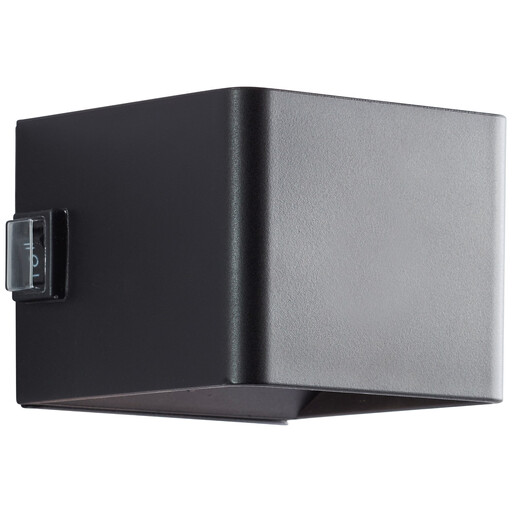
Why this product suits this profile: This battery-powered LED outdoor wall light does not require a permanent power connection and can be charged via USB. It is suitable for smaller entrance, balcony or terrace areas.
The technical specifications clearly state 300 lm, 3,000 K, IP44, an integrated battery, a USB connection and a motion sensor. This makes the key selection criteria easy to verify.
Integrated battery, USB charging, magnetic mount, rocker switch and IP44 protection.
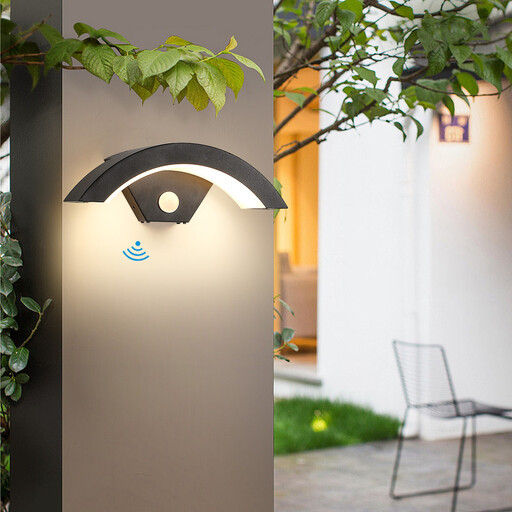
Why this product suits this profile: This U-shaped LED outdoor wall light is designed for functional and decorative use on verandas, garages, balconies, terraces or driveways.
The light and motion sensors are explicitly stated. Even so, the choice should be based on the installation location, as suitability for every type of weather exposure cannot be assumed.
24 W, 3,000 K, matt aluminium housing and combined light and motion sensor.
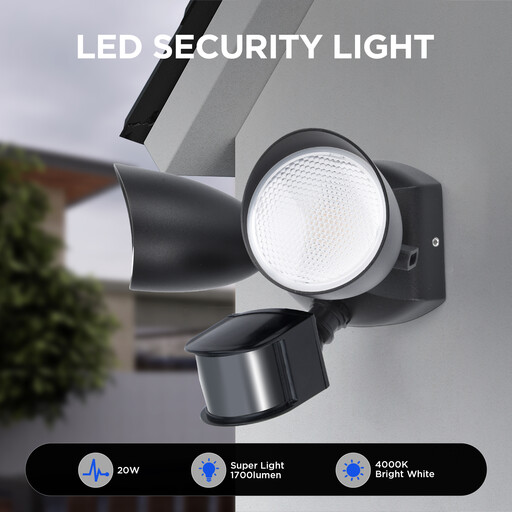
Why this product suits this profile: The two adjustable light heads and stated luminous flux of 1,700 lm are designed for larger outdoor areas such as courtyards, gardens, driveways or garages.
The separate light heads allow more targeted positioning than a fixed light. Before purchase, check whether the installation position will cover the area you want to illuminate.
20 W, 1,700 lm, 4,000 K, integrated sensor and twin-head design.
Before installation, observe the area where movement occurs: people should cross the sensor’s field of detection from the side wherever possible, rather than walk directly towards it. Also avoid branches, reflective surfaces or heat sources in the immediate detection area, as these can cause false triggers depending on the sensor technology.
With battery-powered and USB lights, access for charging is an important practical consideration. A magnetic mount makes positioning easier, provided the surface is suitable. The housing must not be immersed in water or cleaned with a pressure washer. Damaged lights should be taken out of use and repaired only in accordance with the manufacturer’s instructions.
We have put together a complete, regularly updated list of products that fully meet these strict selection criteria and the safety regulations applicable in the EU.
This depends on the detection angle, range and structural conditions. The light is often installed above normal head height so that it cannot easily be touched. However, the manufacturer’s specifications are decisive. The sensor should cover the path or entrance area you want to illuminate and must not be obstructed by walls or solid structures.
It is not possible to give a standard lifespan for every model. Among other things, it depends on operating time, ambient temperature, moisture, the quality of the power supply and the battery in mobile models. With a solar-powered or battery-operated outdoor light, you should also take the ageing of the integrated battery into account. Check the technical specifications and replacement options before purchase.
Consumption depends on wattage, daily operating time and how often the light is triggered. A light with a motion sensor normally does not stay on continuously, which can reduce energy consumption compared with a lamp that remains lit all the time. For a rough comparison, multiply the power consumption in watts by the daily operating time and the current electricity price. With battery-powered or solar lights, charging or maintenance requirements replace ongoing mains electricity costs.