
Lieferung heute & morgen

Qualitätsgarantie

Willkommens-Angebote freischalten: KOSTENLOSE Lieferung | Bis zu 80 % RABATT | Kostenlose 30-Tage-JoyPlus-Testphase
App herunterladen
An outdoor wall light with a motion sensor can automatically illuminate your entrance, patio, balcony or garage. In practice, however, choosing the right light involves more than just lumens or a modern-looking design. The key considerations are where you plan to use it, its IP rating, how it’s powered and how the sensor responds.
A light with a particularly high lumen output isn’t automatically suitable for every area. 300 lumens may be enough for a small entrance, while a wide driveway needs brighter lighting. Light that’s too bright can also disturb neighbours or feel uncomfortable on the patio.
So be sure to consider:
The term “weatherproof” isn’t precise enough for everyday use. The IP rating is what matters. An IP44 outdoor light is protected against solid objects above a specified size and against splashing water from different directions. This makes it suitable for many sheltered outdoor areas, but not automatically for exposed locations that are constantly subject to the elements.
Before you buy, check whether the light will be mounted on a sheltered wall, under a porch or on a wall exposed to the weather. Pools of water, snow and prolonged damp can also affect its suitability.
Sensors can be triggered by passing vehicles, pets, warm air or movement outside the area you want to monitor. Mounting the light too low or covering the sensor can also limit its detection range.
So find out about:
The IP rating is one of the first things to check when choosing an LED outdoor wall light. The rating consists of “IP” followed by two digits. The first digit indicates protection against solid objects, while the second indicates protection against water.
An IP44 weatherproof wall light, for example, can be used at a sheltered entrance, on a covered patio or on a balcony. For completely exposed walls, read the manufacturer’s guidance for your specific mounting location particularly carefully.
For mains-powered models, the electrical connection and any installation work must be carried out by a suitably qualified professional. This is especially important for hard-wired outdoor motion sensor lights.
Light output is measured in lumens. 300 lumens is a reasonable starting point for a compact light by an entrance or on a small patio. Models with 1,700 lumens, on the other hand, illuminate a considerably larger area and may be better suited to a courtyard, garage or driveway.
Colour temperature is measured in kelvins:
Warm white outdoor lighting is often a good choice for patios, balconies and gardens. Neutral white light can be more practical for a security light by a garage or driveway if you want a clearer view of the area.
A hard-wired light doesn’t need regular charging, but it does require suitable electrical wiring. A solar or battery-powered outdoor light gives you more flexibility, but its performance depends on the charge level, sunlight and how often it’s used.
The Brilliant Iseo has a built-in battery and charges via a USB cable. This means you can use it in places without a power socket. Its built-in magnet lets you attach it to metal surfaces. If you plan to use it on a busy path, check how often it will need charging in your intended setup.
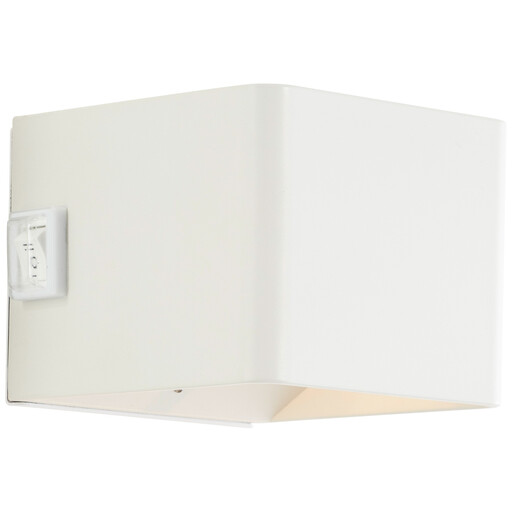
Why this product suits this profile: This portable LED outdoor wall light doesn’t need a fixed power supply, making it suitable for smaller entrances, patios or areas of the garden.
The specifications list 300 lumens, 3,000 kelvins, IP44 and a built-in motion sensor. This makes it easier to check whether the light is right for your mounting location, rather than relying on marketing claims alone.
4 watts, 300 lumens, 3,000 kelvins, rechargeable battery, USB charging cable, magnetic mounting and a rocker switch.
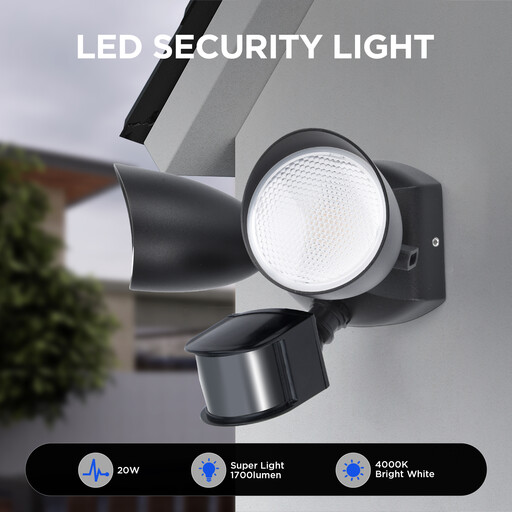
Why this product suits this profile: With 20 watts, 1,700 lumens and 4,000 kelvins, this light is designed for buyers who want to illuminate a larger outdoor area, such as a courtyard, garage or driveway.
The specific figures for light output, power consumption and colour temperature make it easier to check whether the brightness is right for the area you want to illuminate. Be sure to check the product details for the IP rating before installation too.
20 watts, 1,700 lumens, 4,000 kelvins and integrated sensors, according to the product name.
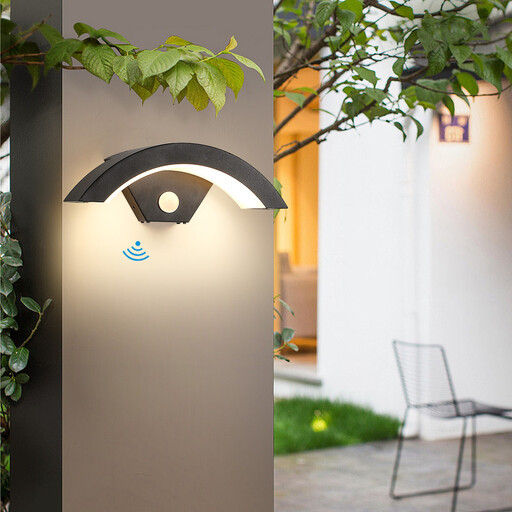
Why this product suits this profile: This light is designed for frequently used areas such as paths, balconies, patios, garages, driveways and stairs.
The product description specifically mentions light and motion sensors, as well as a design for outdoor use. Before buying, you should still check the mounting surface, connection type and exact IP rating.
24 watts, 3,000 kelvins, U-shaped design, matt aluminium housing, and light and motion sensors, according to the product description.
Position the sensor so that the usual route of travel crosses its detection area. Depending on the design, movement directly towards the sensor may be less reliably detected. After installation, test whether the light comes on too early or too late.
These points are also worth bearing in mind when using an outdoor motion sensor light:
We’ve put together a comprehensive, regularly updated list of products that meet these strict selection criteria and fully comply with the safety regulations in force in the EU.
This depends on the design, sensor angle and detection area you want. Mounting the light above easy reach is often a good idea. The important thing is that the sensor can detect the route people take and isn’t blocked by projections, roof edges or plants. Always follow the manufacturer’s specific guidance.
Consumption depends on the light’s power rating and how long it’s on each day. A 4-watt light running for one hour uses 0.004 kilowatt hours. With motion sensor lights, the actual time they’re switched on is often shorter than with outdoor lighting that stays on continuously. Battery and solar lights don’t need a fixed mains connection, but they do need charging depending on the model and how often they’re used.
IP44 can be suitable for sheltered outdoor areas such as covered entrances, balconies or patios. For an exposed wall subject to heavy rain and snow, the manufacturer’s approval for that specific mounting location is what matters. The IP rating doesn’t replace proper installation and won’t protect the light against every kind of prolonged damp.