
Lieferung heute & morgen

Qualitätsgarantie

Willkommens-Angebote freischalten: KOSTENLOSE Lieferung | Bis zu 80 % RABATT | Kostenlose 30-Tage-JoyPlus-Testphase
App herunterladen
An outdoor wall light should reliably illuminate your entrance, patio or garage while complementing your façade. In practice, however, poor purchases are not caused by design considerations alone. Lights are often chosen for their eye-catching appearance or high wattage, even though important technical details are missing.
Three common buying misconceptions are particularly important:
An IP44 outdoor light is generally suitable for many covered or partially protected outdoor areas, such as entrances, balconies, patios and garden walls. The light should be installed so that water cannot collect permanently on the housing, connection point or wall bracket.
Before buying, check the following:
A weatherproof outdoor light also requires proper sealing. If the light is not installed correctly, its specified level of protection may be compromised.
For paths, garage driveways or security-focused lighting, lumens and beam angle are crucial. A light colour of 2700 to 3000 Kelvin creates a warm white effect and is often suitable for entrances and decorative façade lighting. More neutral light colours may be useful for work and security areas.
An up-and-down outdoor light distributes light upwards and downwards. This creates a focused lighting effect on the wall, while the ground may be illuminated less strongly. For a larger area, you may need two lights or a model with a wider beam.
Spotlights with adjustable heads allow you to direct the light more precisely. This is practical for garages, sheds and driveways, but it does not replace careful planning of the installation height.
In Germany, 220–240 V at 50 Hz is typically relevant for permanently connected lights. The electrical connection should be carried out by a qualified electrician. Disconnect the power supply before installation and maintenance.
With integrated LEDs, the light source is permanently built in. This can keep the design compact, but it also means that, depending on the model, the entire light may need to be replaced if a fault occurs. Lights with an E27 fitting, on the other hand, give you more freedom when choosing a bulb, provided the maximum wattage is observed.
An outdoor wall light with a sensor or an outdoor light with a motion sensor should be selected based on its detection angle, range and activation duration. A sensor is not always suitable for decorative continuous lighting; for paths and entrances, however, automatic activation can reduce the need for manual operation.
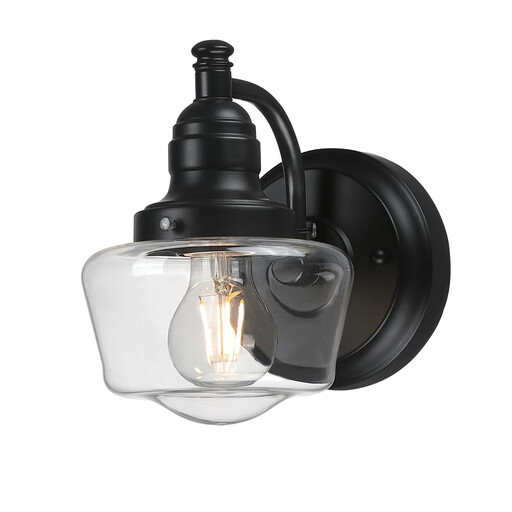
Why this product suits this profile: The light uses an E27 fitting, giving you the option to choose a suitable LED bulb. This is practical if you want to adjust the brightness or light colour later.
The specified maximum power of 60 W helps prevent an unsuitable bulb from being used. IP44 protection is specified, but the light must still be sealed correctly during installation.
E27 fitting, 220–240 V and compact dimensions of 15 × 21 × 22 cm; bulb not included.
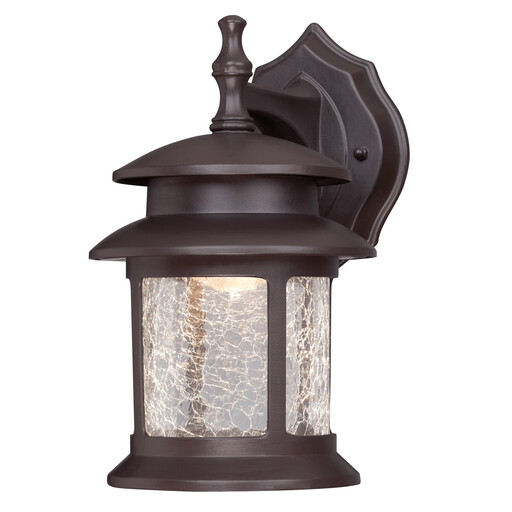
Why this product suits this profile: The combination of an aluminium housing, crackle glass, 3000 K and 1000 lm is ideal for stylish entrances and façades where both materials and lighting effects matter.
The product details state both the light source’s luminous flux and the effective luminous flux. This makes it easier to assess the expected amount of light than by looking at wattage alone.
9 W integrated LED, 1000 lm light source luminous flux, 3000 K, IP44 and dimmable with a compatible LED dimmer.
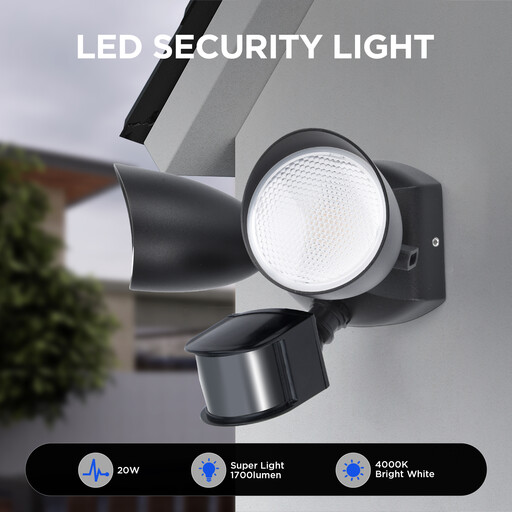
Why this product suits this profile: A sensor spotlight with two light heads is designed for driveways, courtyards, garages and larger garden areas where directional lighting and automatic activation are required.
The heads can be directed towards the specific area you want to illuminate. Before buying, check the sensor range, installation height and preferred activation settings.
20 W, 1700 lm, 4000 K and integrated sensor; suitable for functional lighting across larger outdoor areas.
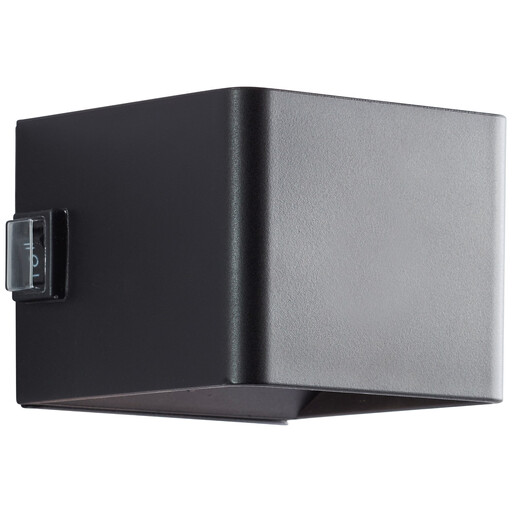
Why this product suits this profile: This battery-powered light with a USB charging cable requires no fixed power connection and can be attached flexibly to suitable metal surfaces using a magnet.
The portable design reduces the need for drilling and wiring. However, IP44 only means protection against water splashes; the light must not be immersed in water or cleaned with a pressure washer.
4 W, 300 lm, 3000 K, rechargeable battery, USB connection, magnetic mounting and motion sensor; dimensions 8 × 10.3 × 10.1 cm.
We have put together a complete, regularly updated list of products that fully meet these strict selection criteria and the safety regulations applicable in the EU.
For permanently installed models, a qualified electrician should carry out the connection. We also recommend the following checklist:
If you are using a garden wall light with a sensor, also make sure that branches, passing vehicles or warm exhaust air cannot trigger the sensor unintentionally.
IP44 is used for many protected outdoor areas. This protection rating means protection against solid foreign objects measuring 1 mm or more and against water splashes. A higher protection rating may be advisable in highly exposed locations, areas subject to direct rain or where specific structural conditions apply. The key factors are the installation location, exposure to water and the manufacturer’s specifications.
Consumption depends on the wattage and the number of hours the light operates each day. A 10 W LED that is switched on for five hours a day uses 0.05 kWh per day in theory. Sensor operation or a timer can reduce the actual operating time. When choosing a light, consider wattage, lumens and usage duration together.
For a permanently connected 220–240 V model, a qualified electrician should carry out the installation for safety reasons. Portable USB lights do not require a fixed mains connection, but they must still be securely mounted and protected from unsuitable levels of moisture. Always follow the relevant installation and safety instructions.