
Lieferung heute & morgen

Qualitätsgarantie

Willkommens-Angebote freischalten: KOSTENLOSE Lieferung | Bis zu 80 % RABATT | Kostenlose 30-Tage-JoyPlus-Testphase
App herunterladen
Outdoor wall lights should reliably illuminate entrances, patios, balconies or garden walls while complementing the façade. However, eye-catching product images and general marketing claims do not always lead to the right solution. The key is to consider technical specifications that suit the installation location and intended use.
An IP44 outdoor light is protected against solid foreign objects measuring 1 mm or more, as well as splashing water from different directions. This makes it suitable for many sheltered outdoor areas, such as beneath a porch or on a covered patio. However, this does not mean it is designed to withstand constant exposure to strong weather or being sprayed directly with a garden hose.
A higher ingress protection rating may be advisable for more exposed locations. Even so, the installation, seals and orientation of the light remain important. You should therefore choose a weatherproof outdoor lamp based not solely on the term ‘weatherproof’, but on its specific IP protection rating.
An LED outdoor wall light may provide warm white, neutral white or adjustable lighting. For entrances and patios, around 2700 to 3000 Kelvin is often considered pleasant. A more neutral light colour may be more practical for paths or functional areas.
You should also check the luminous flux in lumens. Wattage primarily describes power consumption, not brightness directly. An integrated LED saves space, but if it develops a fault, it usually cannot be replaced separately. With an E27 outdoor wall light, on the other hand, you can change the bulb as required and choose the light colour yourself.
With a dimmable outdoor wall light, the dimmer used must be compatible with LED technology. Some models require an external LED-compatible dimmer, which is not included in the package. Without the right component, the light may flicker or only work partially.
Motion sensors are also frequently advertised in a misleading way. An outdoor lamp with a motion sensor should be assessed in terms of detection angle, range, switch-on duration and sensitivity. In the product specifications considered here, most mains-powered wall models do not list an integrated motion sensor.
First, check whether the light will be installed on a sheltered wall, beneath a roof or on a completely exposed façade. With IP44, the light must be installed in such a way that unnecessary water ingress is avoided. Drill holes, the wall surface and the cable entry should be properly sealed by a professional.
For a wall light for patios and entrances, the distance from the wall and the dimensions are also important. A wide light may look out of place on a narrow wall, while a longer model can appear more balanced on a tall façade.
Decide whether you need decorative orientation lighting or stronger functional illumination. Up-and-down lights distribute light upwards and downwards, creating a directional effect on the façade. Models with glass shades often diffuse light differently from compact lights with enclosed housings.
Compare:
A mains-powered light requires a suitable electrical connection and should be installed in Germany by a qualified electrician. A solar outdoor wall light, on the other hand, works with a solar panel and rechargeable battery. The actual lighting duration depends on sunlight, the time of year, shading and battery capacity.
A smart solar wall light may also offer app control, schedules and, where applicable, Bluetooth Mesh. These functions are useful when several lights need to be controlled together. However, they also increase the number of components that need to be checked. The solar panel must be cleaned regularly and receive sufficient daylight.
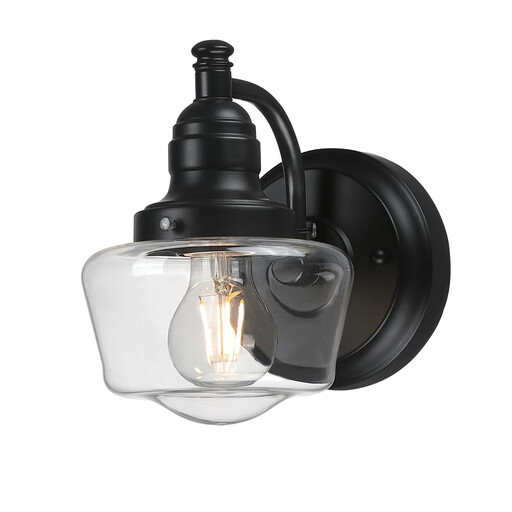
Why this product suits this profile: This compact model is suitable for entrances and smaller exterior walls. It uses a separately available E27 bulb of up to 60 W, allowing you to adjust the light colour and bulb later.
The technical specifications explicitly state IP44, 220–240 V and the maximum E27 rating. This makes it easier to select a suitable bulb with confidence.
IP44 splash protection, a width of 15 cm and a replaceable E27 bulb of up to 60 W.
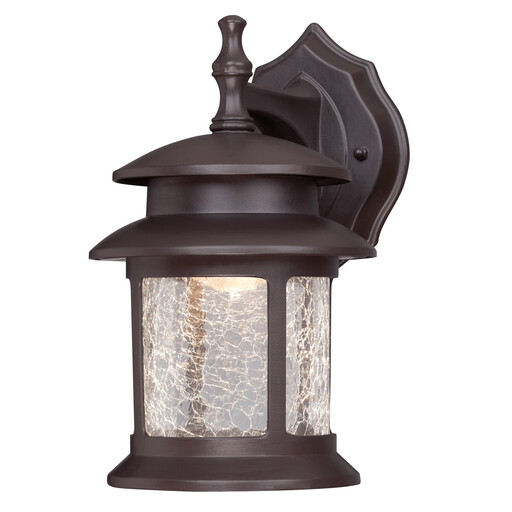
Why this product suits this profile: According to the product specifications, the integrated 9 W LED delivers 1000 lm at 3000 K. This light is ideal for users looking for a fixed lighting solution with a dimming option and clear technical specifications.
The dimming function is not promised without qualification: a compatible LED dimmer is required and must be checked separately. The LED is integrated.
9 W LED, 3000 K, stated luminous flux of 1000 lm and IP44 splash protection.
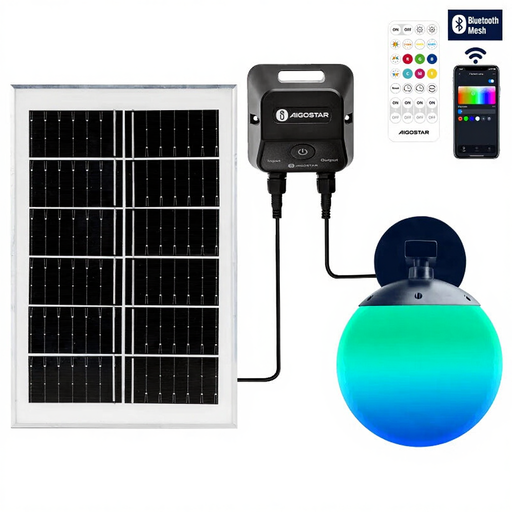
Why this product suits this profile: This solar light is designed for outdoor areas without an existing power connection. RGBCCT, Bluetooth Mesh and app control provide additional options for gardens, patios or decorative façade lighting.
The power source, IP65 rating and required connection between the panel and light are specified. However, solar performance on shaded north-facing walls still depends on the location.
5 W solar panel with a 5 m cable, RGB+CCT from 2700 to 6500 K and Bluetooth Mesh control.
We have put together a complete, regularly updated list of products that fully meet these strict selection criteria and the safety regulations applicable in the EU.
For permanently connected outdoor wall lights, installation should be carried out by a qualified electrician. Disconnect the power supply before carrying out maintenance or cleaning. Use a soft, dry cloth for cleaning and avoid high-pressure water and aggressive cleaning products.
You should also check the following before buying:
IP44 is standard for many sheltered outdoor areas. A higher protection rating may be advisable where the light is more directly exposed to the weather. Suitability also depends on the installation location, orientation and proper sealing.
Consumption depends on the power rating and daily operating time. A 9 W light operating for five hours uses 45 Wh per day in theory. With solar lights, the available operating time depends on sunlight and the battery charge.
For integrated LEDs, manufacturers often state an average service life in operating hours. This is a manufacturer’s estimate, not a guarantee for every installation location. With E27 lights, the bulb can be replaced separately; with integrated LEDs, the entire light usually needs to be replaced if it develops a fault.