
Lieferung heute & morgen

Qualitätsgarantie

Willkommens-Angebote freischalten: KOSTENLOSE Lieferung | Bis zu 80 % RABATT | Kostenlose 30-Tage-JoyPlus-Testphase
App herunterladen
An outdoor wall light with a motion sensor should switch on automatically when it gets dark, make your entrance easier to navigate and avoid unnecessary operating time. In practice, however, unclear product specifications, poorly chosen installation locations and unsuitable IP ratings can quickly lead to disappointing purchases.
This buying guide explains which technical specifications to check before buying an LED outdoor light with a motion sensor, and which product features suit different everyday situations.
A high luminous flux does not automatically mean that a light is suitable for every location. 300 lumens may be enough for a small entrance, while a driveway or larger garden area requires wider coverage. Beam angle, light position and possible obstructions are also important.
A very bright outdoor LED security light can be dazzling at close range. For paths and patios, the colour temperature is therefore just as important as the lumen rating: warm white light around 3000 Kelvin is generally more subtle in areas where people spend time, while 6500 to 7000 Kelvin appears noticeably cooler.
The IP44 rating generally protects against splashing water from different directions. IP65 indicates protection against dust and water jets. This is suitable for many outdoor areas, but it does not mean that the light can stand in water or be exposed to a pressure washer continuously.
For a waterproof IP65 outdoor light, you should also check whether the cable entries, housing and installation instructions are suitable for the intended location. A sheltered balcony has different requirements from a garage driveway fully exposed to the weather.
A sensor with a wide detection angle can be useful when people approach the light from the side. However, if the light is installed too high or the sensor points towards a busy road, false activations may occur. Before buying, check the detection angle, range and automatic switch-off time.
Luminous flux is measured in lumens (lm). It describes the amount of light emitted, but not automatically the distance it will reach. As a general guide:
Colour temperature is measured in Kelvin (K). 3000 K indicates warm white light, 4000 K neutral white light and 6500 K cool white light. Warm white light may be more pleasant for a wall light at an entrance, while a more neutral or cooler colour temperature is often chosen for work areas or driveways.
For a weatherproof outdoor wall light, the IP rating is a key purchasing criterion. You should also consider:
For mains-powered lights, electrical connections must only be carried out by a suitably qualified professional. Battery-powered and solar-powered models do not require a permanent power cable, but they do need to be recharged regularly or receive sufficient sunlight.
A motion sensor responds to movement caused by heat within its detection area. An additional dusk or light sensor prevents the light from being activated unnecessarily during daylight. Before buying, check whether the desired outdoor lighting with a sensor offers an adjustable lighting duration, several operating modes or a manual switch.
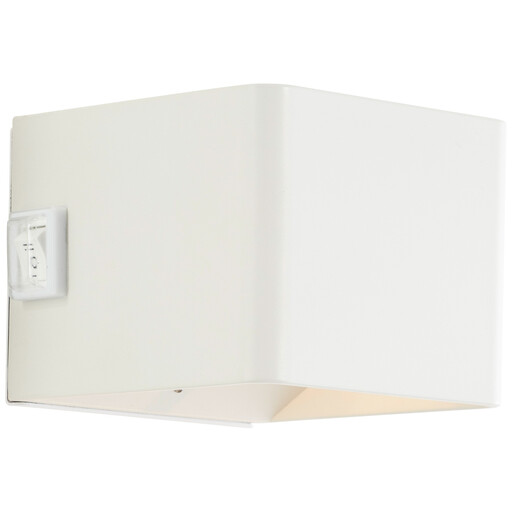
Why this product suits this profile: The battery-powered light is suitable for small entrances, patios or locations without an existing power connection.
The technical specifications state 300 lm, 3000 K and IP44. This makes it easier to assess the light as suitable for sheltered outdoor areas, rather than planning to use it in highly exposed locations.
Integrated battery, USB charging cable, magnetic mounting and motion sensor; 4 W power consumption according to the product specifications.
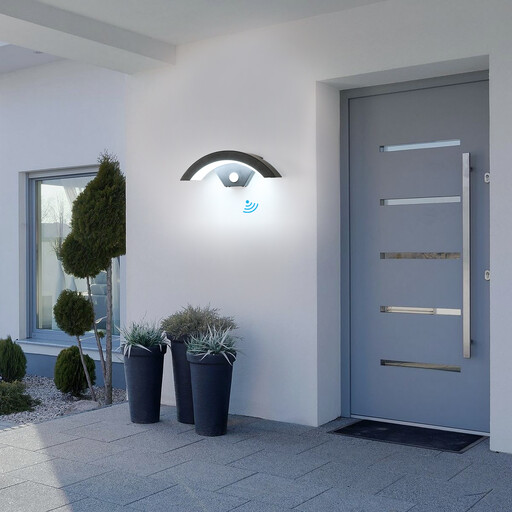
Why this product suits this profile: Ideal for anyone looking for a permanently mounted light with clearly defined sensor and protection specifications for driveways, garages or larger outdoor areas.
The product description states IP65, a detection angle of 120°, a range of 2 to 5 m and switch-off after 45 seconds.
24 W, 2700 lm, 6500 K, aluminium housing and stated IP65 protection rating.

Why this product suits this profile: This solar-powered outdoor light is designed for gardens, driveways, garages and larger areas without a permanent power connection.
The specifications state an IP65 protection rating, three operating modes and installation without electrical wiring. For reliable operation, the solar panel must receive sufficient direct daylight during the day.
302 LEDs, stated 3000 lm, 180° sensor angle, 60-foot detection distance and three lighting modes according to the product description.
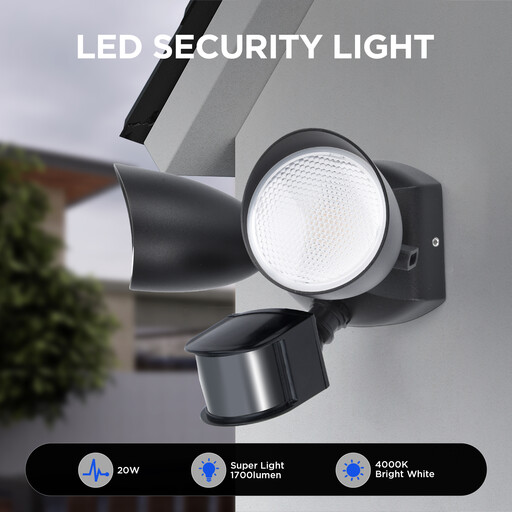
Why this product suits this profile: The two independently adjustable light heads could be a good choice for larger outdoor areas such as patios, gardens or courtyards.
The specifications state 1700 lm, 4000 K and 20 W. Before buying, check the full product details for the missing IP rating if the light is to be installed in a location fully exposed to the weather.
Integrated LED, 1700 lm, 4000 K and two light heads according to the product name.
We have put together a complete, regularly updated list of products that fully meet these strict selection criteria and the safety regulations applicable in the EU.
Install the light so that the sensor covers the usual route people take and does not point directly at a busy road. For a solar-powered outdoor light, the panel should be kept as free from shade as possible. The sensor window and solar panel should be cleaned regularly with a soft, damp cloth.
The running costs of a mains-powered light depend on its wattage and operating time. A 20 W light used for 30 minutes per day consumes approximately 0.01 kWh per day in theory. In practice, the motion sensor determines how often and for how long the light is activated. Battery-powered models do not incur direct electricity costs at the installation site, but the battery must be recharged regularly.
IP44 may be sufficient for sheltered areas. For walls fully exposed to the weather, a higher rating such as IP65 is often chosen. Suitability depends on the installation location and the manufacturer’s specifications.
The appropriate height depends on the sensor’s detection area and the design of the light. The key is to ensure that the sensor reliably detects people approaching, without constantly picking up movement outside your property. The installation instructions should be followed.
This depends on the sun’s position, shading, battery capacity and operating mode. In winter, the available charging time may be shorter. A location with as much direct sunlight as possible, combined with an economical sensor setting, can support longer operation.