
Lieferung heute & morgen

Qualitätsgarantie

Willkommens-Angebote freischalten: KOSTENLOSE Lieferung | Bis zu 80 % RABATT | Kostenlose 30-Tage-JoyPlus-Testphase
App herunterladen
An outdoor wall light with a motion sensor should illuminate paths and entrances, switching on automatically when needed. In practice, poor purchases are often caused not by brightness alone, but by unsuitable positioning, an inadequate IP rating or a power supply that is wrong for the location.
A high lumen rating does not automatically mean the light will be right for your space. 300 lumens may be enough for a small entrance, while a wide driveway or courtyard may benefit from a brighter outdoor LED security light. Beam angle, light position and potential obstructions from porches or projecting walls also matter.
The term weatherproof wall light is only meaningful if a specific IP rating is given. An IP44 outdoor light is protected against solid objects 1 millimetre or larger, as well as water splashes from different directions. However, it is not automatically suitable for permanently exposed locations subject to heavy driving rain, standing water or pressure washing.
A sensor can be triggered by passing vehicles, pets, branches or heat sources. Before buying, check the detection range, timer setting and mounting height. The way you want the light to switch on is important too: some models can also be operated manually, while others work only automatically.
Brightness is measured in lumens. As a rough guide:
Colour temperature affects the quality of the light:
A twin-head outdoor wall light can spread light in two directions. For an outdoor wall floodlight, also check whether the light shines upwards, downwards or to the sides. This helps prevent unnecessary light spill into windows or neighbouring properties.
IP44 may be sufficient for partially sheltered outdoor areas. For a fully exposed exterior wall or a wall that is particularly exposed to the weather, consider a higher IP rating. Always refer to the specific product data sheet.
Aluminium housings and corrosion-resistant fixings are a sensible choice for an outdoor light. When installing it, make sure the wall material, wall plugs and cable routing are all suitable. Mains-wired models must only be installed by a suitably qualified professional. Battery-powered options do not need a mains connection, but you will need to check their charge level regularly.
A mains-powered non-solar outdoor light provides light regardless of sunlight, but needs a power connection. Battery or USB models are more flexible to position and are also suitable for rented homes or places without existing wiring. However, you should consider charging intervals, battery capacity and the position of the charging port.
The selection below groups the available models by typical use. Details such as lumens, kelvins, wattage and IP rating are based on the information provided for each product.
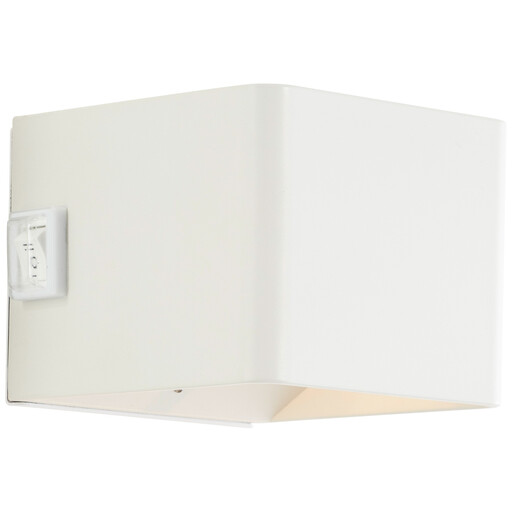
Why this product suits this profile: This compact, rechargeable LED outdoor wall light provides 300 lumens, needs no fixed power connection and can be charged via USB. The magnet allows for flexible attachment to suitable metal surfaces.
Its power source is clearly described as a built-in battery with a USB cable. This removes the need to plan for a mains connection, though the charge level will still need checking regularly.
300 lumens, 3000 K, built-in motion sensor, magnet, USB charging and IP44 rating.
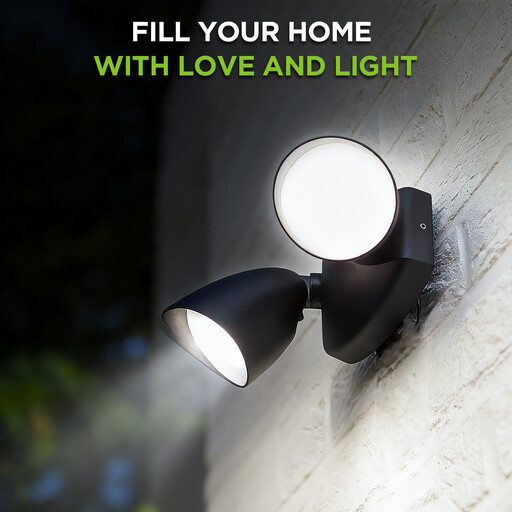
Why this product suits this profile: This twin-head outdoor wall light is a good option if you want to illuminate a courtyard, patio or larger garden area with neutral white light.
The product name specifies 1800 lumens, 20 watts, 4000 K and two light heads. This makes it easier to assess the brightness and colour temperature before you buy.
1800 lumens, 4000 K, 20 watts, dual-head design and metal construction, according to the product information.
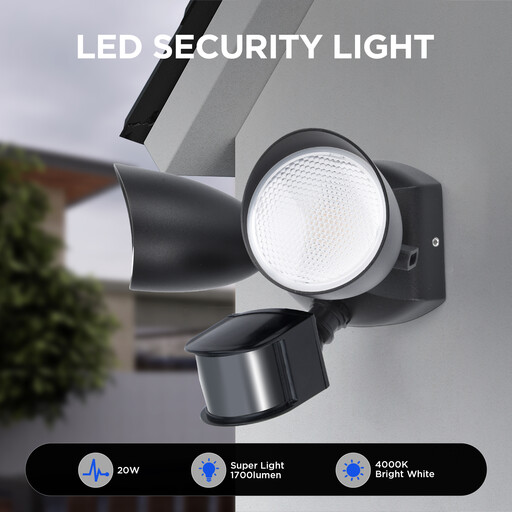
Why this product suits this profile: With 1700 lumens and a twin-head design, this model is intended for larger outdoor areas such as courtyards, garages, driveways or gardens.
Specific figures for wattage, light output and colour temperature make it easier to compare the light with your actual needs, rather than relying on vague marketing claims.
1700 lumens, 20 watts, 4000 K and an integrated twin-head design, according to the product name.

Why this product suits this profile: Its U-shaped design makes it suitable for entrances, balconies, patios and paths when the style of the fitting matters as well as automatic switching.
The product description specifies an integrated motion and light sensor, as well as a matt aluminium housing. Check the specific IP rating in the listing before installation.
24 watts, 3000 K warm white, U-shaped design and aluminium housing, according to the product information.
We’ve put together a complete, regularly updated list of products that meet these strict selection criteria and fully comply with the safety regulations in force in the EU.
The right height depends on the sensor’s detection angle and the area you want it to cover. It is often mounted above direct eye level. The sensor should have a clear view of the path or driveway and should not point directly at a busy road. Follow the manufacturer’s guidance on mounting height and detection range.
Its lifespan depends on the LED module, operating hours, ambient temperature, moisture and the quality of the power supply. It is not possible to give a reliable lifespan without specific information from the manufacturer. With built-in LEDs, the light source usually cannot be replaced as it can with a traditional bulb fitting, so check the warranty terms and spare-part information before buying.
Electricity consumption depends mainly on the wattage and how long the light is on each day. A 20-watt light that is on for 30 minutes a day uses around 0,01 kWh per day based on calculation. Battery or solar-powered models do not incur comparable mains electricity costs, but you should take charging cycles and available power into account.