
Lieferung heute & morgen

Qualitätsgarantie

Willkommens-Angebote freischalten: KOSTENLOSE Lieferung | Bis zu 80 % RABATT | Kostenlose 30-Tage-JoyPlus-Testphase
App herunterladen
An outdoor wall light with a motion sensor should switch on automatically when it gets dark and be suitable for the place where you plan to install it. But lumens, wattage and a low price aren’t the only things to consider when buying. Unclear information about the IP rating, a sensor with too small a detection range or an unsuitable power supply can easily lead to the wrong choice.
An LED floodlight with a high lumen output isn’t automatically suitable for every location. A narrow beam, for example, may light a front door well, while a courtyard or large patio may benefit more from adjustable light heads. Conversely, a very bright motion-sensor floodlight could dazzle neighbours or passers-by.
So make sure you check:
The term “weatherproof” alone doesn’t tell you how well a light is protected against dust or water. The IP rating stated for the product is what matters. For an IP44 outdoor light, the first digit indicates protection against solid objects, while the second indicates protection against splashing water.
IP44 may be suitable for many sheltered entrances, covered patios or balconies. If you’re installing a light on an exposed wall that receives direct rainfall, check the installation instructions and the specific IP rating particularly carefully. Even the right IP rating doesn’t replace properly sealing the cable entry through the wall.
A motion sensor won’t respond in the same way in every location. Obstacles, an unsuitable installation height, passing cars or heat sources can all affect detection. So check the range, detection angle and adjustment options.
In Germany, hard-wired lights may only be installed by a suitably qualified electrician. Battery-powered or USB models offer more flexibility, but need to be recharged regularly. An outdoor sensor light should also be positioned so that the sensor doesn’t point directly at the light itself.
Wattage describes energy consumption, not brightness. Light output in lumens is a more useful measure when comparing how much light different models produce. A 300-lumen model may be enough for a small entrance, while a courtyard or garage drive may need a more powerful LED floodlight.
Colour temperature affects the way the light looks:
For a weatherproof wall light, the housing material, seals and intended installation position all matter. Aluminium housings can provide a sturdy construction, but the manufacturer’s technical specifications are still key. Check whether fixings are included and whether your wall is suitable for installation.
Before buying a hard-wired outdoor security light, check the cable, connection type and installation height. If you’re considering a light with a built-in camera, you’ll also need to think about Wi-Fi range, storage options and data protection.
A motion sensor switches on the light when it detects movement. An outdoor light with a camera also records or streams video. Check whether it needs a microSD card, a separate base station or a paid service.
For camera models, it’s also important to check the field of view, resolution, Wi-Fi frequencies and recommended installation height. Recording public areas or someone else’s property may have data protection implications. Only point the system at areas you’re permitted to monitor.
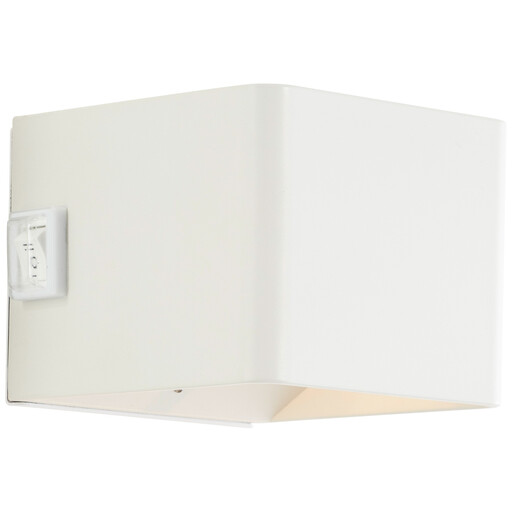
Why it suits this type of user: This battery-powered light is ideal for smaller areas without a fixed power supply, such as a balcony, patio or side entrance.
The built-in rechargeable battery means there’s no need to worry about an unclear hard-wired installation. The product details also specify IP44, 300 lumens and a motion sensor.
Rechargeable battery, USB connection, magnetic mounting, 3000 K and 300 lumens.

Why it suits this type of user: The U-shaped design and matt-finish aluminium housing make this a good fit for entrances, garages, paths and covered patios.
Both motion and light sensors are clearly specified, so you can distinguish automatic motion activation from a general dusk-to-dawn function.
24 W, warm white light at 3000 K, aluminium housing and sensor control according to the product description.

Why it suits this type of user: This model combines a floodlight with motion activation and camera features, making it a good option if you want to record a larger area.
The product details specify 2000 lumens, dual-band Wi-Fi, two cameras and local storage via a microSD card up to 128 GB or HomeBase 3.
360-degree pan and tilt, 24/7 recording according to the product description, plus a 2K telephoto and 3K wide-angle camera.
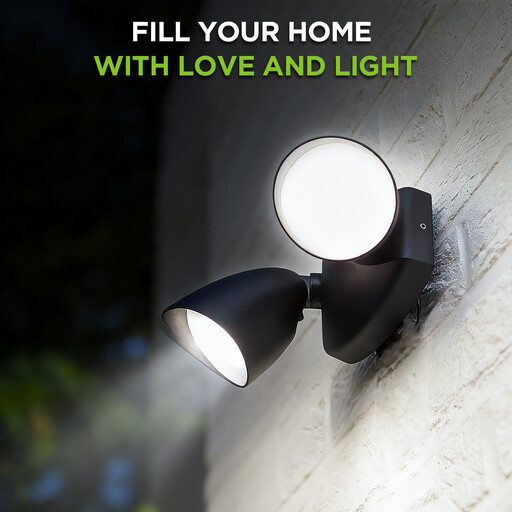
Why it suits this type of user: With two light heads and a stated brightness of 1800 lumens, this model could be a good choice for lighting a wider area, such as a courtyard, garden or driveway.
The twin-head design addresses the common limitation of a single, fixed beam. The product name also specifies 20 W and 4000 K.
Two light heads, 1800 lumens, 20 W and neutral white 4000 K lighting according to the product name.
We’ve put together a complete, regularly updated list of products that meet these strict selection criteria and fully comply with the safety regulations in force in the EU.
The right height depends on the detection angle, range and manufacturer’s instructions. Camera lights are often recommended for installation at around 2 to 3 metres. The sensor should cover the area where you expect movement without pointing directly at busy roads or heat sources.
It depends on where you plan to install it. An IP44 outdoor light is protected against solid objects and splashing water, and may be suitable for sheltered areas. For exposed walls, heavy rain or direct exposure to the elements, check whether a higher rating is needed or consult the manufacturer’s specific guidance.
Energy use depends on the light’s power, how long it’s on each day and the sensor settings. A 20 W light running for one hour uses 0.02 kWh. A short run-on time can help prevent the light staying on unnecessarily. Battery-powered models need to be recharged regularly instead of being connected to the mains.