
Lieferung heute & morgen

Qualitätsgarantie

Willkommens-Angebote freischalten: KOSTENLOSE Lieferung | Bis zu 80 % RABATT | Kostenlose 30-Tage-JoyPlus-Testphase
App herunterladen
An outdoor light with a motion sensor should switch on when someone enters a path, doorway or driveway. In practice, poor choices are often not down to the sensor itself, but to unsuitable ranges, inadequate weather protection or a misjudged power supply. If you check a few technical details before buying, you can tailor your choice much better to your conditions in Germany.
A high lumen figure sounds convincing at first. For a small front door, a powerful solar floodlight can be overkill and cause glare. For a long drive or a larger courtyard, a compact LED outdoor lamp with 300 lumens may, on the other hand, be insufficient.
So, what matters is not just the lumens, but also:
A sensor can trigger too early if it points towards a pavement or a road. If the range is too short, the outdoor light with sensor will only switch on when the person is already close to the door. Figures such as a 60-foot detection distance should therefore be converted into metres and compared with the actual mounting location. The detection angle and any potential obstructions also matter.
The IP code describes protection against solid foreign objects and water, but it does not replace correct installation. A waterproof outdoor light with IP65, for example, is protected against dust and water jets. Cables, connectors and drilled holes must still be installed correctly. IP44 offers protection against splashing water and is not automatically suitable for every unprotected wall or permanently exposed spot.
For entrance areas, patios and short paths, a moderate light output is often sufficient. For garage drives, courtyards or larger garden areas, a light with multiple heads can make sense. An LED motion-sensor light is generally more efficient than many older lamp types, but actual consumption depends on output and switch-on duration.
Colour temperature is given in Kelvin:
A wide sensor angle is useful when people approach the light from the side. For a straight drive, a more targeted alignment may suffice. Several adjustable light heads allow you to split coverage between the door, parking space and path. Also make sure that trees, wall projections or moving branches do not continuously affect the sensor.
A solar outdoor light needs a location with as much direct sunlight as possible. In winter, under cloud cover or on shaded façades, the available lighting time can be reduced. For battery-powered models, check capacity, charging method and replaceability.
Mains-powered models provide more consistent power but require a suitable electrical connection. A portable LED outdoor light with a USB charging cable can be a good alternative for rented homes, metal surfaces or changing locations. The solar panel and the sensor window should be cleaned regularly with a soft, slightly damp cloth.

Why this product suits this profile: The solar-powered light is ideal for homeowners and gardeners who don’t want to run a power cable and want to illuminate a larger area such as a courtyard, garage or driveway.
The product details specify three light heads, a 180° detection angle and three lighting modes. This makes it easier to tailor the alignment to the location than with a single fixed head.
302 LEDs, a stated 3,000 lumens, 1,800 mAh battery and IP65 rating. Installation is cable-free.

Why this product suits this profile: The fixed outdoor wall light suits façades, front doors, balconies and covered patios when an integrated solution with warm white light is desired.
The description mentions a matte die-cast aluminium body and a constant current driver. These are tangible construction features you can factor into the choice of a permanently installed light.
24 watts output, 3,000 Kelvin colour temperature and, as stated in the product title, light and motion sensors. A qualified professional is required for electrical connection.

Why this product suits this profile: For tenants, small patios or changing locations, the portable, battery-powered light with USB charging cable and magnetic mount is very practical.
The IP44 rating is explicitly stated and should confine installation to a sheltered location with exposure to splashing water only. This helps avoid equating a portable light with higher weather protection.
300 lumens, 3,000 Kelvin, integrated battery, USB port, magnet and motion sensor according to the product data.
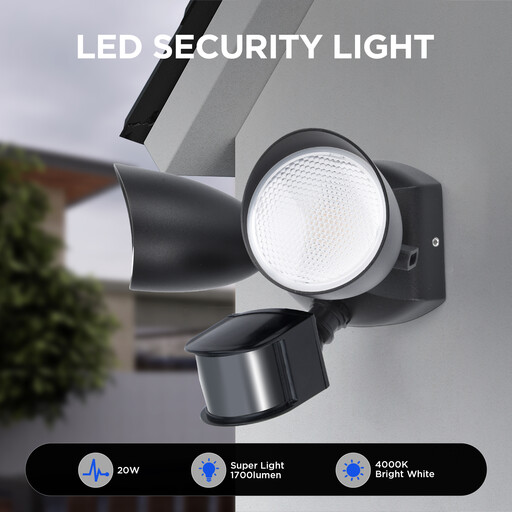
Why this product suits this profile: This light targets users who prefer a stronger courtyard or driveway light with two heads and want to illuminate a fixed outdoor area.
The title states 1,700 lumens, 4,000 Kelvin, 20 watts, sensor and twin heads. These details make it easier to match the light to the area, preferred colour temperature and mounting position.
LED technology, two light heads, 1,700 lumens and motion sensor as per the product name. Check suitability for your exact mounting location against the full technical data.
We’ve compiled a complete, regularly updated list of products that fully meet these strict selection criteria and the safety regulations applicable in the EU.
Mount an outdoor light with a motion sensor so that the sensor covers the expected movement area, but does not point directly at busy roads, windows or heat sources. For solar lights, make sure the panel is not shaded by roof overhangs or trees. A fixed outdoor wall light may only be installed according to the instructions and with suitable, corrosion-protected screws.
A simple calculation helps with running costs:
Power in watts × operating hours ÷ 1,000 = kilowatt-hours
With a sensor-controlled light, actual operating hours are usually much lower than with continuous lighting. Even so, brightness, sensitivity, run-on time and the frequency of activation affect consumption.
A mounting height of around two to three metres is common for many outdoor lights, unless the manufacturer’s instructions specify otherwise. What’s crucial is that the sensor covers the relevant area and the light is not obscured by walls, branches or projections.
Performance can drop in winter due to shorter days, a low sun, cloud cover and shading. Choose the sunniest possible location, clean the panel regularly and check the battery and lighting time specifications. For consistently steady lighting, a mains connection is less dependent on sunlight.
The IP65 rating stands for complete protection against dust and protection against water jets. It is not a carte blanche for any installation situation. Connections, seals and installation according to the instructions remain vital. For a sheltered spot, IP44 may be sufficient, while particularly exposed areas may require a suitably higher rating.