Choosing a pair of ski goggles depends on a range of technical parameters that significantly impact vision, comfort, and safety on the slopes. An informed decision requires an analysis of lens technology, frame construction, and functional features. This article examines the specifications of OutdoorMaster ski goggles to provide an objective basis for evaluation for dedicated skiers and snowboarders.
Buyer's Guide: Key Technical Aspects of Ski Goggles
The performance of snowboard goggles or ski goggles is determined by the interplay of several components. The following criteria are essential for making a rational purchasing decision.
1. Lens Technology and Visible Light Transmission (VLT)
The lens is the core component of any ski goggle. Its quality determines clarity, contrast, and protection.
- VLT (Visible Light Transmission): This value, expressed as a percentage, indicates how much light passes through the lens to your eye. A low VLT (e.g., 10–20%) is designed for sunny conditions, as it darkens your view and reduces glare. A high VLT (e.g., 60–90%) is suitable for overcast days, snowfall, or dusk, as it brightens your vision.
- Lens Shape:
- Spherical Lenses are curved both horizontally and vertically, which provides a wider field of view and less optical distortion.
- Toric Lenses combine a spherical curve on the horizontal axis with a flatter vertical curve. This design mimics the shape of the human eye, further optimising peripheral vision and minimising distortion.
- UV Protection: Complete protection against UVA, UVB, and UVC rays is essential to shield the eyes from intense solar radiation at alpine altitudes. The UV400 protection standard blocks all harmful rays up to a wavelength of 400 nanometres.
2. Interchangeable Lens Systems: Flexibility for Changing Conditions
Mountain weather conditions can change rapidly. Ski goggles with interchangeable lenses offer the necessary adaptability.
- Manual Systems: These require clicking or pressing the lens out of the frame. This process can be more time-consuming.
- Magnetic Systems: A magnetic ski goggle uses strong magnets to hold the lens in the frame. This allows for a lens change in seconds, often without even having to take the goggles off.
3. Ventilation and Anti-Fog Properties
Fogging up is a safety risk. Effective anti-fog measures are therefore crucial.
- Dual Lenses: A thermal barrier between the cold outside air and the warm air inside the goggle reduces the tendency for condensation.
- Vents: Strategically placed openings in the frame and lens promote airflow and vent moist air.
- Anti-Fog Coating: A hydrophilic coating on the inner lens absorbs moisture and prevents the formation of droplets.
- Face Foam: Multi-layer foam not only provides a good seal but can also have moisture-wicking properties.
4. Fit and Compatibility
- OTG (Over The Glasses): OTG ski goggles for glasses wearers feature cut-outs in the frame and sufficient volume to allow prescription glasses to be worn underneath.
- Helmet Compatibility: The goggle strap should be long and elastic enough to fit over any standard ski helmet. Silicone strips on the inside of the strap prevent it from slipping.
- Frame Design: A frameless ski goggle offers a maximum field of view, as the frame does not obstruct peripheral vision. In contrast, models with a frame can offer greater structural integrity.
Products we selected for you
Based on the technical criteria above, we present two models from OutdoorMaster that are suited for different user profiles thanks to their specific features.
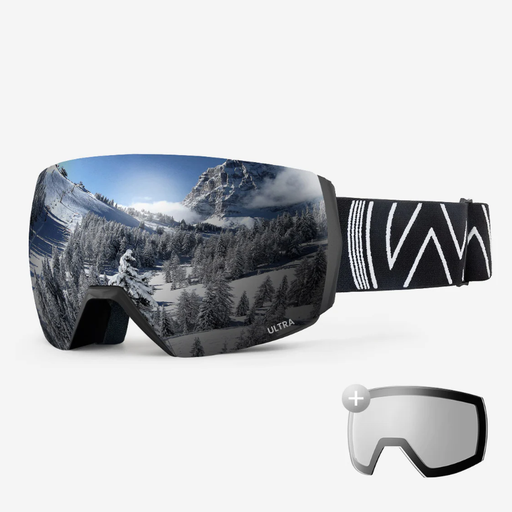
OutdoorMaster ULTRA Ski Snow Goggles and Lens Bundle
Why We Recommend This Product
The ULTRA model is designed as an all-in-one package. It combines advanced lens technology with an extremely fast magnetic interchange system. The bundle already includes multiple lenses for different light conditions, making it a versatile solution for riders who want to be prepared for anything. The toric lens maximises the field of view and optical precision.
Pros
- Magnetic Interchange System: The MagKlick system allows for a lens change in under a second.
- Comprehensive Lens Package: Includes one lens for sunny conditions (10% VLT) and one for low light (90% VLT).
- Advanced Optics: The toric lens features UCT (Ultra-Chroma Transmittance) and OVP (Optimal Visual Perception) technologies to enhance contrast and reduce eye fatigue.
- Effective Ventilation: Triple-layer foam and a Triple-Effect VS Treatment coating ensure superior anti-fog performance.
- OTG Compatible: Designed to be worn over prescription glasses.
Who It's For
This model is aimed at skiers and snowboarders (men and women) who value maximum flexibility and comfort. It is ideal for those who frequently ride in changeable weather and prefer a system that allows for quick, hassle-free adjustments.
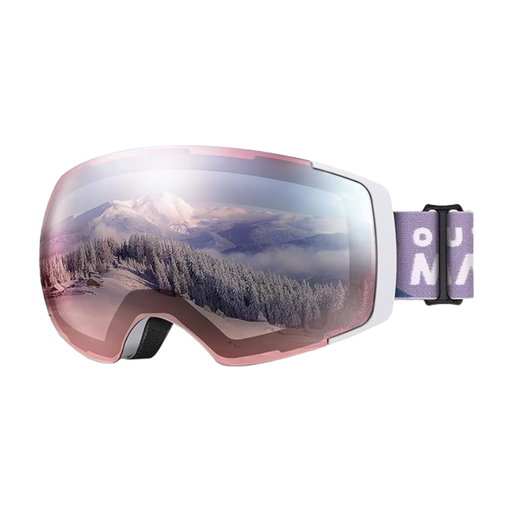
OutdoorMaster PRO Ski Goggles PRO
Why We Recommend This Product
The PRO model focuses on a maximum, unobstructed field of view through its frameless design and large spherical lens. It is designed as a modular system compatible with over 20 separately available interchangeable lenses. This gives users the opportunity to build a custom lens collection for their specific needs.
Pros
- Maximum Field of View: The frameless, spherical lens provides a wide and clear peripheral vision.
- Highly Modular: The system is compatible with a wide range of separately available interchangeable lenses.
- OTG Design: This model is also designed as OTG ski goggles for glasses wearers.
- Universal Helmet Compatibility: An extra-long, elastic strap ensures a secure fit on all helmet types.
- 100% UV400 Protection: Offers complete protection against harmful UV radiation.
Who It's For
The PRO goggle is a great choice for riders who prioritise an extremely wide field of view and appreciate the flexibility to expand their lens collection over time. It is suitable for performance-oriented users who want to precisely tailor their gear to their needs.
More Options for Your Gear
In addition to high-performance ski goggles, the rest of your gear is also crucial for performance and safety on the slopes. You can find a selection of matching Women's Sports Equipment as well as corresponding products for men in our dedicated category.
Frequently Asked Questions (FAQ)
1. What does OTG mean for ski goggles? OTG stands for "Over The Glasses." Goggles with this designation are designed to be worn over regular prescription glasses. They offer more internal volume and have side cut-outs in the foam to accommodate the arms of the glasses.
2. How do magnetic ski goggles work? Magnetic ski goggles use several strong neodymium magnets integrated into the frame and the lens. These magnets create a firm and secure connection while also allowing the lens to be quickly and easily removed and attached for a swap.
3. Which VLT values are suitable for which weather conditions?
- 10–25% VLT (S1-S2): Ideal for bright, sunny days. These lenses reduce glare and protect the eyes.
- 25–60% VLT (S2-S3): All-round lenses for mixed conditions with sun and clouds.
- 60–90% VLT (S3-S4): Optimal for heavily overcast days, snowfall, or riding at dusk, as they enhance contrast and brighten vision.
Written by: Joybuy Product Recommendation Officer


