
Lieferung heute & morgen

Qualitätsgarantie

Willkommens-Angebote freischalten: KOSTENLOSE Lieferung | Bis zu 80 % RABATT | Kostenlose 30-Tage-JoyPlus-Testphase
App herunterladen
An oval cast-iron casserole is a practical choice for whole chickens, leg of lamb, stews and large roasts. Its elongated shape makes better use of the available space for similarly shaped ingredients than a round pot. At the same time, its considerable weight brings a key disadvantage: an unsuitable model can quickly become awkward to handle in everyday use.
If you are looking to buy an oval Dutch oven or cocotte, you should therefore consider more than just the colour and brand name. Common buying problems arise from three points:
An enamelled cast-iron casserole is made from cast iron with a glass-like enamel coating. The material retains heat for a long time and is ideal for slow cooking, searing and keeping food warm. Compared with uncoated cast iron, enamel reduces the effort required for care, as regular seasoning is generally not necessary.
Look for a fully intact internal surface. Chips, deep scratches or exposed cast iron can affect how the casserole can be used. Soft sponges and mild cleaning products are suitable for cleaning. Metal utensils and abrasive powders can damage the surface.
The right size depends on your recipes, household size and available storage space:
An oval casserole is especially practical when ingredients do not fit into a round pot. Nevertheless, measure the internal surface as well as the length including the handles and lid. On an induction hob, the base must also sit sufficiently over the cooking zone.
A cast-iron casserole for induction should be explicitly approved for induction cooking. The product details should also clearly mention gas, electric and ceramic hobs if you want to use the casserole flexibly.
With an oval casserole that has a lid, the stated oven temperature may apply to the entire casserole or only to the pot itself. You should therefore check the lid knob. Models with a metal knob are often designed for higher temperatures than versions with plastic elements. Depending on the model, the product details featured here specify suitability up to 250 °C or 260 °C.
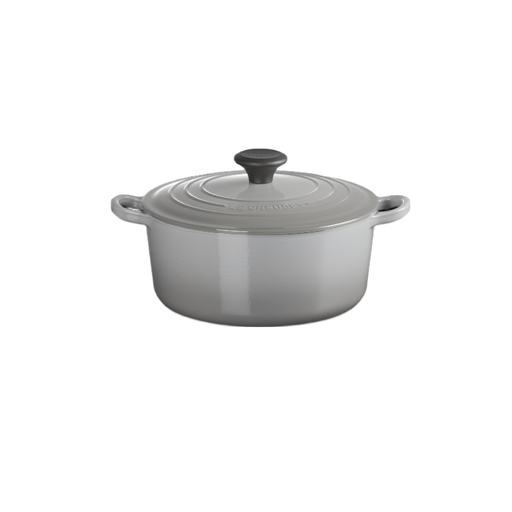
Why this product suits this profile: With a stated capacity of around 4.7 litres, it caters to typical family portions without immediately requiring a very large and heavy model. Its oval design is well suited to elongated roasts and poultry.
The product description clearly states the material, capacity and compatible hob types. This makes it easier to compare the capacity and intended uses before buying.
Enamelled cast iron, around 4.7 litres of capacity and suitability for induction, gas, electric and ceramic hobs.
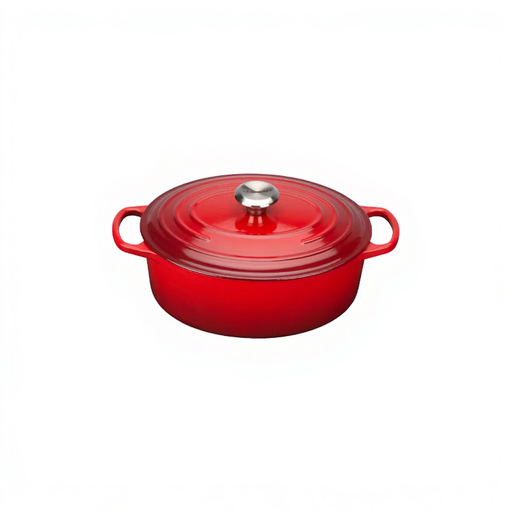
Why this product suits this profile: This model combines an oval 4.7-litre design with enamelled cast iron and a light-coloured internal enamel. It is suitable for all hobs, including induction, and according to the product details, can be used in the oven up to 250 °C.
The stated empty weight of 4.64 kg, 4.7-litre capacity and 250 °C rating help you assess the weight, portion size and oven suitability realistically.
4.7-litre capacity, a tightly sealing lid and suitability for induction, gas, electric and ceramic hobs, as well as oven use.
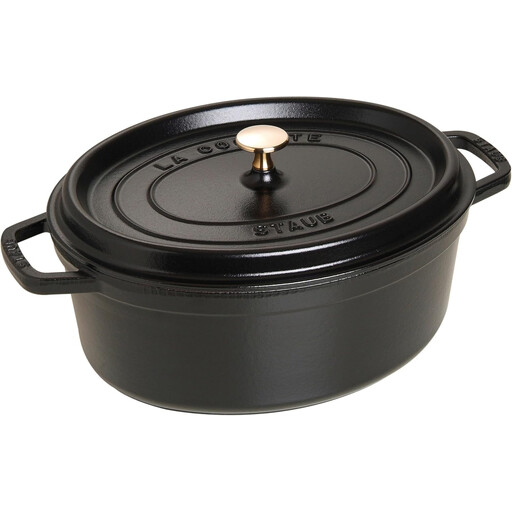
Why this product suits this profile: With an 8-litre capacity and a weight of 9.1 kg including the lid, this model is aimed at households that regularly prepare large cuts of meat, whole chickens or substantial stews.
The technical details make the substantial weight and dimensions clear. Before buying, check that your hob, oven and storage space are suitable.
8-litre capacity, suitability for induction and oven use up to 250 °C, plus enamel on the inside and outside.
We have put together a complete, regularly updated list of products that fully meet these strict selection criteria and the safety regulations applicable in the EU.
Cast iron retains heat for a long time. For this reason, a medium to moderate heat setting is often sufficient for searing once the casserole has heated through completely. On an induction hob, the cooking zone should ideally match the base area. Do not drag the casserole across a ceramic hob, as this could cause scratches.
The following points are important for a long service life:
Ongoing costs mainly depend on the heating time, the type of hob used and the quantity of food being cooked. An oversized casserole can use unnecessary amounts of energy and space when preparing small portions. So do not automatically choose the largest capacity. Instead, select the size that suits the recipes you usually prepare.
Many enamelled models are approved for induction cooking. However, the manufacturer’s specifications are decisive. Also check the base area, weight and diameter of the induction zone, as a very long casserole may not be detected evenly across its entire base.
For a regular whole chicken, models holding around 4.7 litres are often sufficient. For larger poultry, side dishes or several portions, 6.7 to 8 litres provide more room. In addition to capacity, the usable internal length is crucial.
With normal household use, an enamelled cast-iron casserole can last for many years. Its service life mainly depends on protecting the enamel from knocks, metal utensils and sudden changes in temperature. Before every use, check the internal surface, rim and lid for damage.