
Lieferung heute & morgen

Qualitätsgarantie

Willkommens-Angebote freischalten: KOSTENLOSE Lieferung | Bis zu 80 % RABATT | Kostenlose 30-Tage-JoyPlus-Testphase
App herunterladen
An oval cast-iron casserole is particularly well suited to elongated ingredients such as whole poultry, fish, roasting joints or a leg of lamb. At the same time, models vary considerably in capacity, weight, lid design and heat resistance. If you focus only on colour or brand name, you can quickly end up buying a dish that is impractical for your hob or the portions you plan to prepare.
The “29 cm” measurement for an oval casserole usually refers to its longest axis. Handles, the lid and the outer walls are not always included consistently. You should therefore also consider capacity, base area and external dimensions.
A 4.7-litre model may be suitable for several portions, while an 8-litre casserole requires considerably more space on the hob and in the kitchen cupboard. For a small two-person household, a very large model is often unnecessarily heavy and cumbersome to handle.
A traditional cast-iron casserole without a suitable surface may require special care. An enameled cast-iron casserole, on the other hand, is often ready to use straight away and does not require the separate seasoning process needed for uncoated cast iron. Even so, buyers should check the manufacturer’s stated suitability for induction, gas, electric hobs, ceramic hobs and ovens.
With induction, it also matters whether the base makes sufficient contact with the hob. An oval casserole may extend beyond a round induction zone. Although the cast iron continues to distribute the heat, the cooking zone itself must be compatible with the base.
The maximum oven temperature for the casserole body may differ from that of the lid knob. A metal knob is often more heat-resistant than one made from plastic or wood. Before buying, you should therefore check whether the stated maximum temperature applies to the casserole, lid and knob together.
Enameled cast iron retains heat and releases it comparatively evenly. This supports slow braising, searing and keeping food warm. The enamel creates a smooth surface that can be cleaned with mild washing-up liquid and, when used correctly, does not require the seasoning care associated with raw cast iron.
Nevertheless, we recommend using wooden, silicone or plastic utensils wherever possible. Metal can damage the enamel. Hot cookware should also not be placed straight under cold water, as sudden temperature changes can put stress on both the material and the coating.
When choosing a casserole for braised dishes, the shape is more important than the litre capacity alone. An oval casserole provides more lengthwise space for ingredients that would need to be bent or cut up in a round pot.
As a rough guide:
Bear the empty weight in mind: a filled cast-iron casserole will be considerably heavier than its unfilled weight. Large models with an empty weight of 8.5 to 11.9 kg require sturdy surfaces and should ideally be carried with both hands.
A well-fitting lid helps retain moisture inside the pot. STAUB models are described as featuring a lid structure that allows condensed moisture to drip back into the dish. Depending on the range, Le Creuset models come with heavy, tightly fitting lids and large handles as part of the product specification.
You should also check the following before buying:
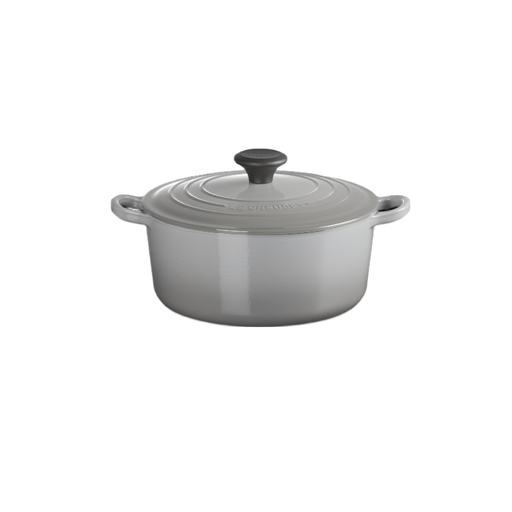
Why this product suits the profile: With a capacity of around 4.7 litres, this oval casserole offers a comparatively compact size for everyday braised dishes and smaller family portions. According to the product information, it is suitable for induction, gas, electric hobs and ovens.
The specifications state the capacity, compatible hob types and oven suitability up to 260 °C. This makes it easier to assess the size and range of uses than by relying on the centimetre measurement alone.
Enameled cast iron, a 4.7-litre capacity and a close-fitting lid according to the product description.

Why this product suits the profile: This model offers a 4.7-litre capacity, an enameled cast-iron construction and a stainless-steel knob. According to the product information, it can be used on all common hob types, including induction, as well as in the oven.
The product data specifies the material, weight of around 4.675 kg, dimensions and temperature limit. This makes it easier to assess handling, oven suitability and storage requirements.
Large handles, an enameled interior, lid included and suitability for all hob types according to the supplier’s information.
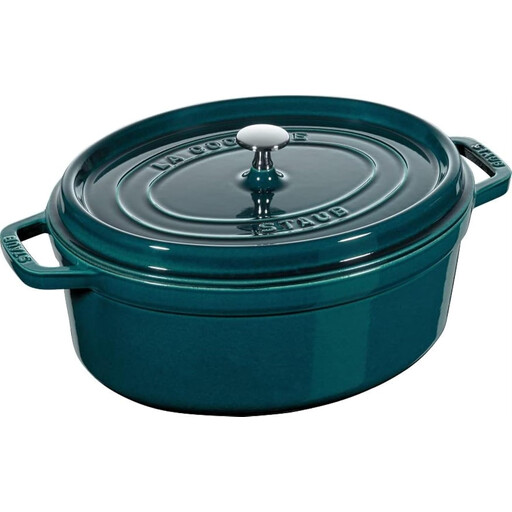
Why this product suits the profile: The elongated shape and 6.7-litre capacity are designed for whole poultry, fish, a leg of lamb and larger family meals. According to the description, this model is suitable for induction and other hob types.
The technical data states the interior capacity, base area, weight and maximum oven temperature. This allows you to assess the balance between capacity, ease of handling and available space before buying.
6.7-litre capacity, black enameled interior and lid with a specified condensation-return design.
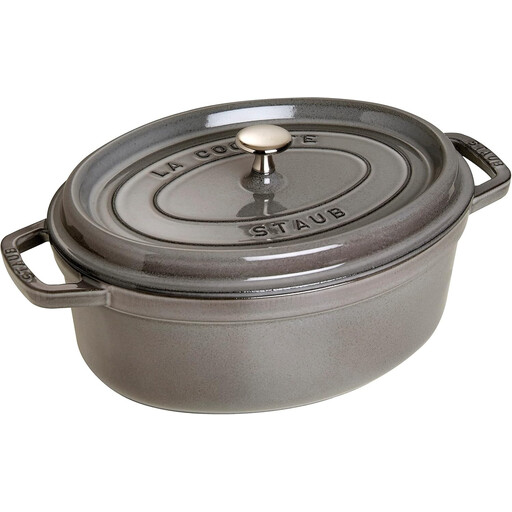
Why this product suits the profile: With an 8-litre capacity and a length of 37 cm, this model is aimed at households that want to prepare large roasting joints, whole poultry or meals for several people.
The 37 cm dimensions, empty weight of around 8.5 kg and oven suitability up to 260 °C are stated explicitly. This helps you plan realistically for the considerable space and lifting requirements.
8-litre capacity, enameled cast iron and suitability for induction, gas, electric hobs and ovens according to the product data.
We have put together a complete, regularly updated list of products that fully meet these strict selection criteria and the safety regulations applicable in the EU.
Many enameled models are designed as cast-iron casseroles for induction. However, the specific manufacturer’s information is decisive. You should also check whether the oval base sits sufficiently on the induction zone being used.
For several people, around 4.7 to 6.7 litres is often sufficient. If you regularly prepare whole poultry, large roasting joints or meals for guests, you may want to choose an 8-litre model. A 12-litre casserole is mainly useful for very large quantities and comes with a significantly higher weight.
Its lifespan depends on the coating, build quality and how it is handled. Gradual heating, avoiding thermal shock and gentle cleaning help reduce stress on the enamel. If visible chips appear on the interior, the dish should no longer be used for food preparation.