Batch-cooking for the week
If you prepare several portions for the working week, the usable baking tray area and the heating functions specified for the particular model are important.


A large built-in oven is a good choice for batch-cooking several portions if you have a suitable recess and need the usable baking tray area or explicitly specified multi-level cooking. For smaller quantities, a countertop oven may be enough, provided the tray fits and you can maintain the required clearances. Compare the heating functions, cleaning requirements and energy use for your needs, and check the compliance information for the specific listing.
If you prepare several portions for the working week, the usable baking tray area and the heating functions specified for the particular model are important.
A countertop oven may be an option if you have enough clear worktop space and can maintain the clearances set out in the instructions.
If you use your oven frequently, it’s worth looking at its heating functions, cleaning requirements and comparable energy-use figures together.
A good fit if: You regularly cook several portions, have a suitable recess and the specific model explicitly states that it supports multi-level cooking.
Bear in mind: The recess, installation and trays all need to be suitable. A larger oven cavity alone tells you neither the usable tray area nor what results to expect.
A good fit if: You don’t want to use a built-in recess but can accommodate a larger tray. Rommelsbacher states that the BG 1805/E has a 42 l oven cavity.
Bear in mind: Rommelsbacher requires a worktop at least 55 cm wide for the BG 1805/E, including the feet. Its shelf positions don’t guarantee that several loaded trays can be used at once.
A good fit if: You’re cooking smaller quantities and are happy to allow for several batches if needed. According to the manufacturer, the Severin TO 2068 has an oven cavity of around 20 l and a fan-assisted function.
Bear in mind: The TO 2068 instructions specify clearances for this model. Check the instructions for the appliance you’re considering rather than applying measurements to other countertop ovens.
| Priority | What to check when buying | Who is this particularly important to? |
|---|---|---|
| Tray area for batch-cooking for the week | Check the number of portions, usable tray area and included accessories. Only assume multi-level cooking is possible if it’s specified for the model. | When I’m preparing several lunches, I want to fit as much pumpkin as possible on the tray I can actually use; around 36% of consumers put tray area for batch-cooking at the top of their list. |
| A suitable place to put it | Compare the appliance, recess and worktop dimensions, as well as the clearances specified in the instructions for the exact model. | In my kitchen, there needs to be enough room for the appliance, the door to open and the required clearances; that’s why around 29% of consumers prioritise finding a suitable spot. |
| Heating function for your recipe | Check whether the exact model has a fan-assisted function and conventional top and bottom heat. Check whether the food is cooked to your liking using your own recipe. | I want to choose the right heating function for my pumpkin recipe and check for myself when it’s cooked; around 21% of consumers focus primarily on the heating function. |
| Energy use and cleaning | For ovens with the relevant energy label, compare energy use per standard cycle and oven cavity volume. Check the cleaning system and removable parts for the specific model. | If I batch-cook regularly, I want to keep energy use and cleaning in mind; around 14% of consumers put ongoing effort first. |
The German Environment Agency explains that the energy label for ovens covered by the scheme shows, among other things, oven cavity volume and energy use per standard cycle. The Verbraucherzentrale notes that standard cycles don’t show how much energy you’ll use for your particular portion of pumpkin.
The stated capacity in litres and the number of shelf positions alone don’t tell you how much pumpkin will fit on a tray or whether several trays can be used at the same time.
First decide how many portions you need, then check the dimensions of the actual tray and whether the model supports multi-level cooking.
Depending on the tray area, you may need to cook in additional batches or buy another compatible tray.
Required clearances and the width including the feet can affect how much space you’ll need. For the Severin TO 2068, the instructions specify 12 cm of clearance at the sides and back and 30 cm above it, and state that it must not be built into a cupboard.
Measure the available space and compare it with the instructions for the exact model you’re considering.
Rated power and standardised energy use per cycle are different measures. The number of batches you actually need will also depend on the tray area and quantity of food.
Only compare energy-use figures on the same basis, and factor in the number of batches you’ll need for your portions.
Buying an oven doesn’t remove the need to cool prepared food promptly and then store it chilled.
The German Federal Institute for Risk Assessment recommends cooling hot food quickly to below 7 °C for longer-term storage. If you’re keeping portions for later in the week, plan to freeze them in good time.
Built-in ovens; the HBA272BB3 is a specific example with stated hot-air cooking on several levels.
Freestanding baking and grilling ovens; the BG 1805/E is an example with a larger oven cavity.
Compact baking and toaster ovens; the TO 2068 is an example of a freestanding appliance.
Built-in ovens; the HB572ABS3 is an example with explicitly specified multi-level hot-air cooking.
Built-in ovens; NEFF lists CircoTherm and a slide-and-hide door for the B6ACJ7AG3.
This selection includes a built-in oven for larger batches and a compact countertop appliance for baking and roasting. Compare the space available and usable area with the number of portions you need to make.
 No image available
This built-in appliance may suit larger batches if you have a suitable recess; according to the product description, it must be installed by a qualified professional.
The product description lists a 71 l oven cavity, a baking tray, perfectCooking 4D for up to four levels and pyrolytic cleaning.
Before buying, check the compliance information and required CE marking for this specific listing.
 No image available
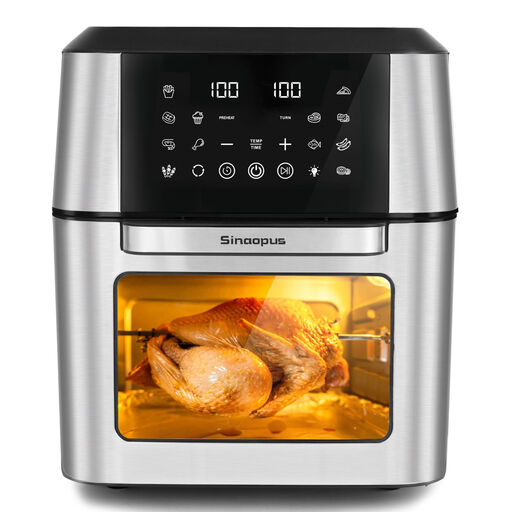
Its compact size may suit smaller quantities if the usable area is large enough for your tray; it’s not a substitute for a built-in oven.
The product title lists 12 l and 1800 W. The product description lists baking and roasting functions, hot-air circulation, 12 programmes and a temperature range of 80–200 °C.
Before buying, check the compliance information and required CE marking for this specific listing.
First decide how many portions you need, then check how much will fit on the actual tray supplied. The German Federal Centre for Nutrition lists roasted vegetables as one option for meal prep; having several shelf positions alone doesn’t guarantee that you can use several trays at once.
A countertop oven may be enough for smaller quantities if the tray area and available space are suitable, and you allow for extra batches if needed. For the Severin TO 2068, the instructions specify 12 cm of clearance at the sides and back and 30 cm above it; these measurements apply only to this model.
It depends on the model. The manufacturer’s instructions for the Severin TO 2068 state that it must not be built into a cupboard and specify the required clearances. For other appliances, follow their own instructions.
For longer-term storage, cool hot food quickly to below 7 °C and keep it in the fridge. The German Federal Institute for Risk Assessment recommends eating leftovers within two to three days; freeze portions in good time if you want to keep them for later in the week.
For an electric domestic oven sold for the German market, check the relevant EU conformity requirements and the CE marking required for the specific listing. The German Federal Network Agency explains that the manufacturer declares conformity by applying the CE marking under its own responsibility; it isn’t an independent quality mark.