Groups cooking lots of slices
If you’re preparing several trays for a baking session with friends or family, focus on usable shelf levels and tray dimensions rather than cavity capacity alone.


If you’re preparing lots of aubergine slices for a baking session with friends or family and have a suitable built-in space, a built-in oven with a clearly stated multi-level fan setting could be a good option. If you don’t have space for a built-in model, a freestanding compact oven may suit you, as long as you’re happy to bake smaller batches. Check usable tray dimensions, approved shelf combinations and what’s included rather than looking at cavity capacity alone. If you’ll use the oven regularly, also consider the cleaning method and relevant energy information.
If you’re preparing several trays for a baking session with friends or family, focus on usable shelf levels and tray dimensions rather than cavity capacity alone.
If you need a freestanding appliance, a compact oven could be an option, provided you’re happy to bake smaller batches.
If you’ll use the oven regularly beyond your baking session, factor in energy information and the cleaning method when choosing a model.
| What matters | What to check when buying | Who is it important to? |
|---|---|---|
| Tray area and usable shelf levels | Check tray dimensions, which trays are included and which shelf combinations are approved for the heating mode. | If I’m preparing lots of slices for a baking session with friends or family, I want to plan my batches properly. Around 36 % of consumers put usable tray area and shelf levels first. |
| Available space and built-in housing | For built-in ovens, check the housing dimensions and connection requirements. For freestanding models, check the space available and the positioning instructions. | If there isn’t a suitable built-in space, I need a freestanding option and can plan to bake smaller batches. Around 29 % of consumers prioritise finding an appliance that fits their space. |
| Energy consumption for regular use | For ovens with an energy label, check the kWh per standard cycle and consider how often you expect to use the oven and how many batches you’ll need. | If I use the oven regularly, I want to compare energy information for appliances of the same type. Around 21 % of consumers put ongoing energy costs first. |
| Cleaning after cooking with oil | Check the cleaning method, removable parts and model-specific guidance on accessories. | If oily residue may be left behind after cooking, I want to know how to clean the specific appliance. Around 14 % of consumers prioritise how much effort cleaning takes. |
The cavity volume doesn’t tell you how much usable space there is on each tray. You may need several trays to spread out aubergine slices in a single layer.
Check the tray dimensions, what’s included and which shelf levels the manufacturer approves before planning your batches.
The European Commission excludes small and portable ovens from the scope of energy labelling for household ovens. So, the absence of a label doesn’t in itself tell you how much electricity the appliance actually uses.
Consider the type of appliance and the number of batches you plan to cook separately. Don’t judge energy use per portion by the efficiency class alone.
The appliance dimensions alone don’t tell you whether the housing, clearances and connection are suitable for that particular model. Changes to fixed electrical installations are also subject to specific requirements.
Check the installation or positioning instructions against your situation. Work on the electrical installation must comply with the requirements of § 13 NAV.
An unsuitable housing space or work needed on the electrical installation may involve additional planning and installation costs.
Built-in ovens with model-specific information on multi-level cooking and cleaning functions.
Built-in ovens with information on multi-level cooking and access to the oven cavity.
Built-in ovens whose cavity capacity, heating modes and cleaning functions can be compared by model.
Built-in ovens with additional controls and cleaning functions that you can compare by model.
Freestanding mini ovens that could be an alternative if you don’t have space for a built-in model.
The Joybuy products below include built-in ovens with a stated multi-level fan setting and freestanding compact ovens. Your tray plan, available space and preferred batch size are the key things to consider.
 No image available
The stated 3D hot-air function for up to three levels is useful if you’re cooking several trays. Check the instructions for the recommended tray positions.
71 l cavity; 3D hot air for up to three levels; pyrolytic self-cleaning; grill function.
Check the housing dimensions against your installation space.
 No image available
The stated 3D hot-air function for up to three levels is useful when preparing several trays. Check the instructions for the recommended tray positions.
71 l cavity; pyrolysis; fan-assisted cooking and grill functions; one baking tray and one Air Fry tray listed as accessories.
Check the housing dimensions and installation guidance.
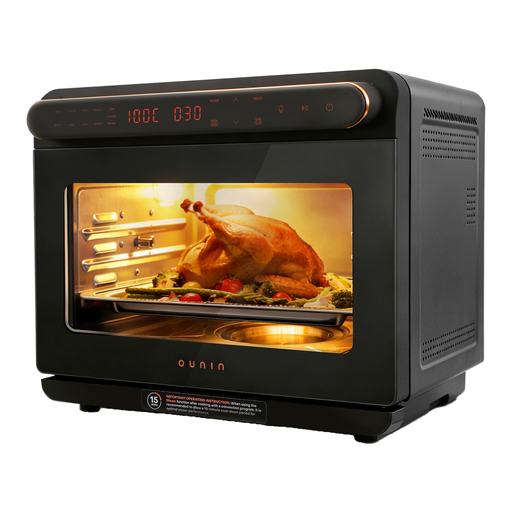 No image available
This freestanding worktop model could suit you if you don’t have a built-in space and can work with its compact cavity.
24 l; 1-l water tank; baking and steam baking; steam-cleaning function; one baking pan listed as an accessory.
 No image available
This freestanding mini oven could be an option if you want to bake without a built-in space and are happy to adjust your batches to fit the cavity.
32 l; 1,600 W; temperature range of 100 to 250 °C; timer and crumb tray. One baking pan and one wire rack listed as accessories.
 No image available
The stated fan-assisted cooking and multiple shelf positions could be useful in a freestanding oven. Check which trays will suit your batches.
28 l; three heating modes; three shelf positions.
Follow your recipe and the instructions for your appliance. The thickness of the slices, how you arrange them on the tray and the heating mode you choose all affect how you plan the cooking. If you’re using several trays, follow the guidance on suitable shelf levels and when to swap them around.
If this involves installing, extending or altering the electrical system, under § 13 para. 2 NAV the work may only be carried out by the network operator or an installation company registered with a network operator. An existing suitable socket connection is not the same as work on the fixed installation, so check the appliance’s connection requirements.
Not all mini ovens are covered. The European Commission excludes small and portable ovens from the scope of energy labelling for household ovens, while the labelling requirements still apply to covered household ovens. So, the absence of a label on a mini oven doesn’t tell you how much electricity it actually uses.
Follow the instructions for your specific appliance, particularly the guidance on trays and accessories during a cleaning programme. If a fault develops, remember that your statutory rights against the seller are separate from any voluntary guarantee. The consumer advice centre also highlights this distinction.