For regular, larger weekly batches, a built-in oven that is explicitly documented as suitable for use on multiple levels can be a good option, provided you have a suitable housing unit. If you’re making smaller quantities and don’t have space for a built-in appliance, a freestanding countertop oven could be worth considering. With either type, first check that your muffin tin will fit; having several shelf positions does not, on its own, mean you can bake on multiple levels at the same time.
Who are these types of oven suitable for?
Preparing lunchboxes for several days
If you want to bake larger quantities in fewer batches, check the size of your muffin tin and whether the appliance is explicitly designed for use on multiple levels. The REWE recipe uses a 12-cup muffin tin; Bosch Hausgeräte specifies that the HBA571BB4 can use hot air on up to three levels.
Occasional baking in a small kitchen
If you’re making smaller batches and don’t have a built-in housing unit, a freestanding oven could be an option. Compare the space it takes up and its internal dimensions with your tin, rather than relying on the oven’s capacity in litres alone. Rommelsbacher specifies that the BG 1550 accommodates baking tins up to 29 cm in diameter; CASO Design publishes the internal dimensions of the TO 26 SilverStyle.
Using your oven regularly for a range of dishes
If you regularly cook other dishes as well as muffins, factor ease of use and cleaning into your choice. For ovens with the relevant energy label, the Verbraucherzentrale explains how energy consumption is measured per standard baking cycle and heating function.
What should you look for when buying?
Built-in oven with hot air
A good fit if: You regularly bake larger quantities for several lunchboxes, have a suitable housing unit and want to use multiple levels.
Things to consider: The installation dimensions and accessories need to be right; energy consumption figures per standard baking cycle don’t directly show how much energy a particular batch of muffins will use.
Freestanding countertop or mini oven
A good fit if: You tend to bake smaller batches or don’t have a built-in housing unit.
Things to consider: Internal dimensions, the height of your tin and the space available are all important. Capacity in litres and shelf positions don’t confirm that a particular tin will fit or that you can bake on multiple levels at once.
First check your tin and the space available, then consider the heating functions and controls. Energy consumption is only useful to compare when it has been measured on the same basis.
| What matters |
What to look for when buying |
Who this matters most to |
| Muffin tin and batch size |
Compare the tin’s external dimensions and height with the oven interior, shelf and door opening. The REWE recipe is designed for a 12-cup muffin tin. |
If you’re preparing muffins for several lunchboxes, you’ll want to avoid unnecessary baking rounds. Around 36% of consumers would put the tin size and weekly batch quantity first. |
| Kitchen space |
For built-in appliances, check that you have a suitable housing unit; for countertop ovens, check the space available and follow the instructions in the appliance manual. |
If you don’t have a free housing unit or have limited worktop space, you’ll need an oven that suits your kitchen. Around 29% of consumers would make the space available their most important consideration. |
| Heating functions and controls |
Check the specific appliance for fan-assisted cooking or conventional top and bottom heat, as well as temperature settings and a timer. The REWE recipe specifies 150 °C fan-assisted cooking and a baking time of 25–30 minutes for this recipe. |
If you want to follow recipe instructions reliably and use your oven regularly, suitable heating functions and straightforward controls matter. Around 21% of consumers would prioritise these features. |
| Estimating energy use |
For ovens with the relevant energy label, compare kWh per standard baking cycle and heating function. The European Commission excludes small and portable ovens from the scope of this oven energy label. |
If you bake often and want to keep energy use in mind, check the basis on which consumption is measured and the type of appliance. Around 14% of consumers would put running costs first. |
Avoid common assumptions
-
Assuming oven capacity in litres tells you how many muffins will fit
The specific REWE recipe uses a tin with 12 cups. The capacity in litres doesn’t tell you whether the tin’s external dimensions and height will fit in the oven.
Measure your tin and compare its dimensions with the oven interior, shelf and door opening.
If your tin doesn’t fit, you may need to bake in extra batches or use a different muffin tin.
-
Assuming several shelf positions mean you can bake on multiple levels
The four shelf positions in the Severin TO 2068 are not the same as the hot-air function for up to three levels specified by Bosch for the HBA571BB4.
Check whether the manufacturer explicitly states that you can bake on multiple levels at once, and what accessories are available for this.
Depending on the appliance and accessories, you may need to buy an additional compatible baking tray.
-
Using wattage or the lack of an EU label as a direct comparison of running costs
The energy label is based on standard baking cycles. Small and portable ovens are not covered by the same scope.
Only compare figures based on the same measurement method, and take your usual batch size into account.
A guide to relevant brands
Bosch
Built-in ovens; the HBA571BB4 is a specific example with hot-air cooking on multiple levels.
- Bosch specifies a 71 l capacity, conventional top and bottom heat, hot air, pyrolytic cleaning and hydrolytic cleaning for the HBA571BB4.
- This model needs a suitable built-in housing unit. The information about cooking on multiple levels doesn’t remove the need to check that your muffin tin and accessories are suitable.
Rommelsbacher
Freestanding mini ovens; the BG 1550 is an example for smaller batches without a built-in housing unit.
- Rommelsbacher specifies a 30 l capacity and baking tins up to 29 cm in diameter for the BG 1550, as well as several heating functions including fan-assisted cooking.
- Four shelf positions don’t confirm that you can bake four muffin trays at the same time.
CASO Design
Freestanding ovens; the TO 26 SilverStyle has published internal dimensions that you can check against your muffin tin.
- CASO specifies a 26 l capacity, fan-assisted cooking, conventional top and bottom heat, and an included baking tray for this model.
- The internal dimensions don’t remove the need to check the usable tray area and the height of your tin.
Severin
Mini ovens; the TO 2068 is an example of a freestanding option with hot air.
- Severin specifies a 20 l capacity, hot air, a timer and four shelf positions for the TO 2068.
- The number of shelf positions alone doesn’t confirm that the oven is suitable for baking on multiple levels at once.
Joybuy product selection
This selection includes built-in ovens for regular, larger batches, as well as freestanding mini ovens for kitchens without a built-in housing unit.
 No image available
Bosch HBA571BB4 Series 2 built-in oven, 71 l
This built-in appliance could suit larger batches if you have a suitable housing unit.
71 l; 3D hot air; pyrolytic self-cleaning; 10 AutoPilot programmes; LED touch controls; black.
Before buying, check the installation dimensions and that the accessories you need for your muffin tin are included or available.
Joybuy
 No image available
Comfee built-in oven, 60 cm, 70 l
This built-in oven could be an option if you have a suitable housing unit.
70 l; 3 kW; AquaClean steam cleaning; LED display with timer; black.
The product description lists several features; before buying, check that the oven and its accessories suit your baking needs.
Joybuy
 No image available
Bosch HBG578ES3 Series 6 multifunction oven, 60 cm
This appliance could be an option for regular baking if you have a suitable built-in housing unit.
60 cm; AirFry; 3D hot air; stainless steel.
Check the housing unit dimensions, accessories and whether your muffin tin will fit this specific model.
Joybuy
 No image available
Woltu BF12sz mini oven, 32 l
A freestanding option if you don’t have a built-in housing unit and your muffin tin fits inside.
32 l; 1,600 W; temperature range 100–250 °C; timer; crumb tray; black.
Compare your tin’s dimensions with the interior and follow the appliance’s placement instructions.
Joybuy
 No image available
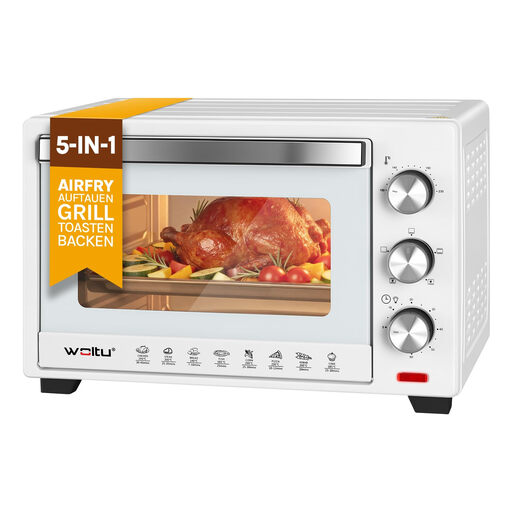
WOLTU mini convection oven, 28 l, white
For freestanding baking without a built-in housing unit; check in advance that your muffin tin will fit and that you have enough space for the oven.
28 l; temperature control and timer; white.
The product description doesn’t specify the dimensions of the muffin tin that will fit in the oven.
Joybuy
Frequently asked questions
Do I always need to preheat the oven and bake carrot muffins at exactly the same temperature?
No. Follow your chosen recipe and the instructions for your oven. The REWE recipe for its 12 muffins says to preheat the oven to 150 °C on the fan setting and bake for 25–30 minutes; these instructions won’t necessarily apply to every mixture or oven.
How should I prepare muffins for a lunchbox?
Leave the muffins to cool first; the REWE recipe recommends storing them in an airtight container or freezing them in individual freezer bags. If you add perishable ingredients or a topping that needs to be kept cool, the German Federal Institute for Risk Assessment recommends keeping them chilled while you’re out, too.
Are a guarantee and statutory rights the same thing?
No. Statutory rights cover claims against the seller for faulty goods, while a guarantee is a voluntary offer with its own terms and conditions. The Verbraucherzentrale recommends considering guarantee terms and statutory rights separately.
Does every mini oven in Germany need the same EU energy label as a built-in oven?
No. The European Commission excludes small and portable ovens from the scope of this oven energy label. For an oven with the relevant label, you can compare energy consumption per standard baking cycle and heating function.
Can I put an old oven in my household rubbish when I buy a new one?
No. The German Environment Agency states that old electrical appliances must not be put in household rubbish. Before buying, check whether and how the old appliance can be taken back when your replacement is delivered.


