What to look for when buying
Start with the quantity you want to bake and the oven’s actual tray capacity, then consider where it will go. If you’ll use it often, energy consumption and cleaning effort may also matter. And if children are baking with you, make sure you plan how to keep them safe around the hot door.
| What matters |
What to check before buying |
Who is it important to? |
| Several trays |
Fan or fan-assisted setting and the shelf positions permitted in the manual; the number and dimensions of the trays supplied. |
When we prepare lots of dough for a baking session together, we want to avoid long waits. For around 36% of consumers, baking several trays at once is the top priority. |
| Installation and space |
For a built-in oven, check the cavity and installation dimensions; for a freestanding model, check the floor space, oven capacity and usable tray dimensions. |
If your kitchen doesn’t have a suitable built-in space or room is limited, the oven needs to sit safely and offer enough baking space. Around 29% of consumers prioritise a suitable position and usable space. |
| Running and cleaning |
Compare energy consumption figures per standard cycle within the same heating type; choose a cleaning method to suit your needs. |
If we bake often, we want to take energy consumption and the effort involved in cleaning into account, rather than focusing on extra features alone. This is a decisive consideration for around 21% of consumers. |
| Safety with children |
Check the door and any safety features on the specific model; plan how to keep children away from hot surfaces and trays. |
When young children are joining in, we need a routine that keeps them at a safe distance when the oven is opened and trays are taken out. Around 14% of consumers put this consideration first. |
Joybuy product selection
This selection includes built-in and countertop ovens for baking sessions with different space and capacity requirements.
 No image available
Bosch HBA571BB4 Series 2 built-in oven, 71 l
For a kitchen with a suitable built-in space and for anyone looking to use several shelf levels.
71 l capacity; 3D hot air for up to three shelf levels; pyrolytic self-cleaning; AutoPilot 10; LED touch display; black.
View at Joybuy
 No image available
Comfee built-in oven, 60 cm, 70 l
For a kitchen with a suitable built-in space; the product name specifies a 70 l model.
60 cm; 70 l; 3 kW; grill and pizza functions; AquaClean steam cleaning; LED display with timer; energy class A.
View at Joybuy
 No image available
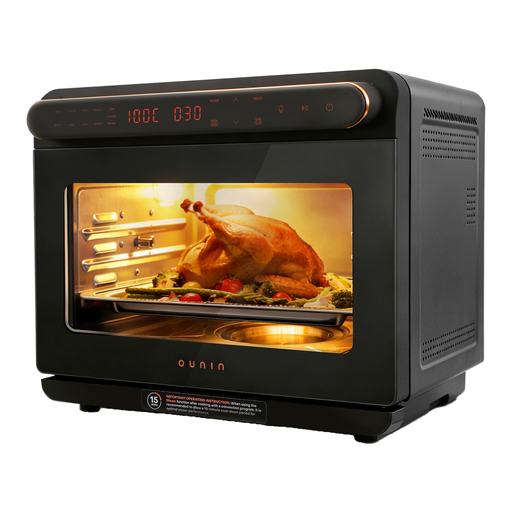
OUNIN 24 l steam combination oven, 10-in-1
A countertop option for a kitchen without a built-in oven.
24 l; baking and steam-baking functions; 1 l water tank; stainless steel interior; baking tray listed as an accessory.
View at Joybuy
 No image available
Woltu BF12sz mini oven, 32 l
A compact baking option without a built-in space; check the actual tray dimensions for the quantity of biscuits you plan to bake.
32 l; 1,600 W; temperature range 100 to 250 °C; timer; crumb tray; described as suitable for baking and grilling.
View at Joybuy
 No image available
Haier H6 ID23T3HTB built-in oven, 78 l
For a kitchen with a suitable cavity; before buying, check that the dimensions and included accessories suit your planned baking session.
78 l; nine cooking functions; energy class A+.
View at Joybuy
Frequently asked questions
Do I need a fan oven to bake two trays of biscuits at once?
Not necessarily – it depends on the recipe and the oven. For one biscuit recipe from the Verbraucherzentrale, two trays can be baked at once using the fan setting; with conventional top and bottom heat, the instructions recommend baking them one after the other. Check your oven’s manual and keep an eye on the first batch.
How can I check whether a built-in oven will fit my kitchen?
Compare the cavity dimensions and installation requirements for the specific oven with your kitchen. For the Bosch HBA571BB4, for example, the manufacturer specifies a cavity height of 585–595 mm, a cavity width of 560–568 mm and a cavity depth of 550 mm. These dimensions don’t apply to all models.
What should I bear in mind when baking with young children?
Keep young children away from hot oven surfaces and trays, and make sure they’re supervised. The Bundeszentrale für gesundheitliche Aufklärung specifically warns of the risk posed by the oven door glass. A door lock can provide extra protection, but it doesn’t replace safe practices.
Does the energy label show how much electricity it takes to bake a batch of jam biscuits?
No. For household ovens covered by the rules, energy use is given per standardised cycle for conventional or fan-assisted heating, not for your specific recipe. According to the European Commission, small ovens fall outside the scope described here for household ovens, so don’t compare their label figures as if they were equivalent.
Are all small countertop ovens required to have an energy label?
There’s no single answer that applies to every model. The European Commission specifically lists small ovens as being outside the scope described for household ovens. It depends on the type of appliance in question.


