Loaf cake for several lunchboxes
If you want to divide the cake into portions for several lunchboxes, check that your loaf tin fits, including its handles and the necessary clearance. Dr. Oetker’s lemon loaf cake recipe calls for a 25 × 11 cm tin.


A countertop oven may be enough for a lemon loaf cake, provided the tin fits with the necessary clearance. A whole baking tray or larger batches call for more usable space. A built-in oven is only an option if the housing unit fits the specific model. Check the internal dimensions and heating functions rather than comparing capacity alone.
If you want to divide the cake into portions for several lunchboxes, check that your loaf tin fits, including its handles and the necessary clearance. Dr. Oetker’s lemon loaf cake recipe calls for a 25 × 11 cm tin.
If you want to make plenty of portions in one batch, the usable area and baking tray dimensions matter. Dr. Oetker’s lemon traybake recipe uses a 40 × 30 cm tray; compare these dimensions with the oven and its accessories.
If you don’t have a suitable housing unit, a freestanding oven may be an option. As well as its external dimensions, allow for the clearances specified for that model. With a built-in oven, the housing unit and appliance must be compatible.
Dr. Oetker’s loaf cake recipe calls for a 25 × 11 cm tin, while its traybake recipe uses a 40 × 30 cm tray. The percentages below give a rough idea of how buyers’ priorities relate to baking these cakes.
| Priority | What to check | Who is this important to? |
|---|---|---|
| Tin size and number of portions | Compare the internal dimensions with your tin, including its handles; for traybakes, check the usable tray dimensions too. | If I’m baking a cake for several lunchboxes, my tin needs to fit, handles and all, so I can make the planned quantity in one batch. Around 36% of consumers put tin size and number of portions first. |
| Heating function and recipe settings | Check the specific model to see whether top/bottom heat and, where relevant, fan-assisted cooking are available. Don’t assume recipe settings will transfer directly. | If I want to follow a recipe’s settings, I need to be able to select a suitable heating function on the oven. Around 29% of consumers say the heating function is their main buying priority. |
| Space and positioning | Check the external dimensions, door opening and safety clearances specified in the instructions. For a built-in oven, also compare the model’s housing unit dimensions. | If the oven needs to sit on a worktop with limited space or fit into an existing housing unit, the appliance and its location need to be compatible. Around 21% of consumers prioritise positioning and connection. |
| Energy use and cleaning | For labelled appliances, compare consumption per standardised baking cycle; weigh up cleaning functions according to your actual needs. | If I bake regularly, I want to weigh up energy use against the effort involved in additional cleaning functions. Around 14% of consumers put running costs and cleaning first. |
The oven’s capacity alone doesn’t tell you whether a loaf tin or a particular baking tray will fit. A smaller tray may also mean you need to adjust the recipe quantities.
Compare the usable internal dimensions with your tin, including its handles, and check which tray comes with the specific appliance.
Depending on the fit, you may need a different tin or an extra baking batch.
The required clearances vary by model. The instructions for the Steba KB M19 require a 10 cm gap between the back of the appliance and the kitchen wall, and state that it must not be used as a built-in oven.
Position the oven in line with the instructions for the specific model and don’t assume the clearances for another appliance will apply.
Wattage describes power consumption, not the energy used for a specific baking session. The Verbraucherzentrale also points out that pyrolysis uses energy.
Where the information is available, compare consumption per standardised baking cycle and choose cleaning functions based on your actual needs.
The KB M19 is a compact countertop oven. According to the manufacturer, it has a 19 l capacity, separately selectable top and bottom heat, and optional fan-assisted cooking.
The freestanding BG 1805/E has a 42 l capacity and offers combinations of top/bottom heat and fan-assisted cooking, according to the manufacturer.
The TO 2068 is described as a small baking and toast oven, with a capacity of around 20 l, top/bottom heat and fan-assisted cooking.
According to the manufacturer, the HBA571BB4 built-in oven has a 71 l capacity, top/bottom heat, fan-assisted cooking and pyrolysis.
The BP7200T built-in oven is listed with a 71 l capacity, pyrolysis and assisted cooking functions.
Here you’ll find freestanding ovens with listed baking functions or heating settings. Before buying, check that your chosen cake tin will actually fit.
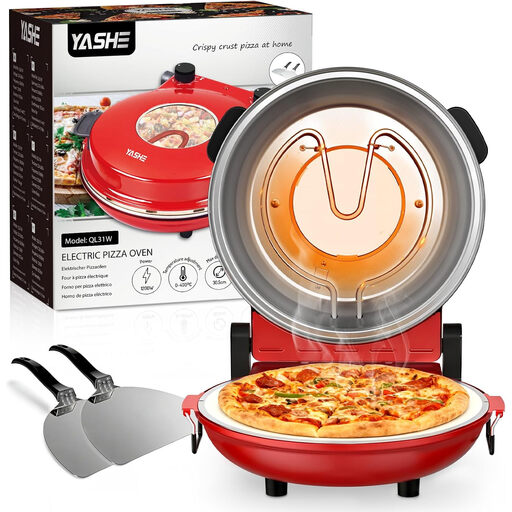 No image available
Described as a compact pizza oven for home use. If you’re planning to bake a lemon cake, check whether your loaf tin will fit.
30 cm ceramic stone, top and bottom heat, built-in timer and viewing window.
 No image available
This freestanding mini oven is described as suitable for baking and grilling. Check the usable space against your tin.
32 l, 1600 W, timer, crumb tray and adjustable temperature range of 100 to 250 °C.
 No image available
This compact model is described as suitable for the kitchen or office. Check the internal dimensions before choosing it for a particular cake tin.
10 l, programmable timer and adjustable temperature range of 100 to 230 °C.
 No image available
This freestanding mini oven is described as suitable for baking. Whether it fits your cake tin depends on the usable internal dimensions.
28 l, temperature control and timer.
For Dr. Oetker’s lemon loaf cake recipe, made in a 25 × 11 cm tin, the recommended settings are around 170 °C with top/bottom heat or around 150 °C fan, with a baking time of about 60 minutes. These settings are for that recipe and won’t necessarily suit every oven or tin.
Only if the tray and usable oven space are suitable for the recipe. Dr. Oetker’s lemon traybake recipe calls for a 40 × 30 cm tray. If your tray is smaller, you’ll need to take the recipe quantities and baking time into account.
Follow the instructions for the specific appliance. For example, the Steba KB M19 requires a 10 cm gap between the back of the oven and the kitchen wall. Its instructions also state that it must not be used as a built-in oven. These requirements don’t automatically apply to other appliances.
For ovens with the relevant energy label, consumption per standardised baking cycle can provide a basis for comparison. It isn’t the same as the measured energy used to bake your individual lemon cake, and wattage alone doesn’t tell you the cost of a baking session.
Leave the cake to cool completely before portioning and packing it. If it contains perishable ingredients, the Federal Institute for Risk Assessment recommends keeping it chilled during transport too. This doesn’t mean that a simple sugar icing always needs to be refrigerated.