Batch bakers
If you portion a cake out for several working days, first check that your tin fits in the oven and that baking it works well with your routine.


A countertop oven could be right for you if your cake tin fits inside with enough room around it, and one batch is enough for the lunchbox portions you have in mind. A built-in oven is an option if you have a suitable space for it and regularly want more cooking space or several shelves that are explicitly supported. Then compare heating modes, controls, model-specific energy information and cleaning. More capacity or extra programmes alone don’t make an oven a better choice for this cake.
If you portion a cake out for several working days, first check that your tin fits in the oven and that baking it works well with your routine.
If you don’t have a suitable space for a built-in oven or your worktop is limited, the appliance’s dimensions and required clearances are important factors to consider.
If you regularly plan to bake other things as well as lunchbox cake, you can also consider the cooking space, explicitly supported shelves, energy information and cleaning.
A good fit if: You don’t have a suitable built-in space and your smaller tin fits inside with enough room around it.
Consider: The cooking space limits the size of the tin and the quantity you can bake. Severin states that the TO 2068 has a capacity of 20 l, but this doesn’t tell you the maximum cake tin size it can take.
A good fit if: You want to use a larger tin you already own but aren’t planning to get a built-in oven. Rommelsbacher lists tins up to 29 cm for the BG 1550 and up to 31.5 cm in diameter for the BG 1805/E.
Consider: A larger countertop oven needs more space; according to Rommelsbacher, the BG 1805/E is 55 cm wide, including its feet.
A good fit if: You have a suitable space for it and regularly want more cooking space or several shelves for baking, as well as room for your cake.
Consider: The appliance dimensions and installation requirements must be suitable. Bosch lists a capacity of 71 l and 3D hot air for up to three shelves on the HBG578EB7; this is a manufacturer specification, not an independent baking test.
| What matters | What to check before buying | Who should pay particular attention |
|---|---|---|
| Cake tin and quantity | Compare your actual tin, including its rim, with the stated tin size limits or internal dimensions for the specific model. For square tins, check the width and depth as well. | If I’m baking a cake for several lunchboxes, my tin must fit in the oven, including its rim. Around 33% of consumers put this at the top of their list when choosing an oven. |
| Space and positioning | Measure the intended worktop space or recess and check the positioning or installation requirements for the model you’ve chosen. Rommelsbacher lists the BG 1805/E as 55 cm wide overall, including its feet. | If you’re baking in a small kitchen, you need to be able to position the appliance safely in the intended spot. Around 25% of consumers prioritise having a suitable place for their oven. |
| Heating mode and controls | Check which heating modes can be selected separately and whether the temperature range and timer suit your recipe. Severin lists top/bottom heat and hot air for the TO 2068; Bosch describes 3D hot air for up to three shelves on the HBG578EB7. | If I want to select the heating mode specified in the recipe without any hassle, I look for suitable controls. Around 25% of consumers prioritise heating mode and controls. |
| Energy use and cleaning | The Verbraucherzentrale explains that energy figures are given in kWh per standardised baking cycle for specified operating modes. Compare figures on a like-for-like basis and check cleaning functions against your actual needs. | If you bake regularly, you’ll want to consider the ongoing effort involved in electricity use and cleaning. Around 17% of consumers put these factors at the top of their list when choosing. |
The oven’s capacity alone doesn’t tell you whether a round or square tin will fit, or whether there will be enough space between it and the heating elements.
Measure your actual tin and compare it with the size limits and internal dimensions of the specific model.
Depending on the cooking space, you may need a smaller tin or another baking session.
Figures on an energy label relate to standardised baking cycles, not necessarily the cake you bake. The wattage alone also doesn’t tell you how much electricity one baking session will use.
Only compare kWh figures per specified standard cycle on a like-for-like basis. Don’t assume a countertop oven will use less energy unless you’ve measured it.
Even if an oven has enough capacity, that doesn’t mean it will fit on the worktop you have in mind. Rommelsbacher lists the BG 1805/E as 55 cm wide overall, including its feet.
Before buying, check the appliance’s footprint and the positioning instructions for the specific model.
There’s no evidence that steam assistance, connectivity or self-cleaning is necessary for the single baking task described here.
Consider these features only if you also plan to use them for other tasks on a regular basis.
According to Rommelsbacher, the BG 1550 and BG 1805/E countertop ovens are designed for different sizes of cake tin.
According to Severin, the TO 2068 countertop oven has a capacity of 20 l and selectable top/bottom heat and hot air.
The HBG578EB7 built-in oven is an option if you have a suitable installation space and plan to bake with a larger capacity.
According to the German manufacturer’s product sheet, the BPE53516AB built-in oven has a capacity of 65 l, hot air and pyrolytic cleaning.
According to Siemens, the HR776G1B1 built-in oven combines oven functions with a steam boost and pyrolytic-hydrolytic cleaning.
The selection below includes built-in ovens and countertop appliances with baking functions listed in their product details. For a countertop appliance, first check whether your specific cake tin will fit. For built-in ovens, make sure the installation dimensions match your recess.
 No image available
An option if you have a suitable installation space and want to bake a cake using hot air.
It has a capacity of 71 l; features listed include 3D hot air for up to three shelves and top/bottom heat.
Also listed are a temperature range of 30–275 °C, a timer and pyrolytic cleaning. Check the dimensions of your recess.
 No image available
This built-in oven could be right for you if it fits your recess and you want to use a specifically listed fan-assisted function for baking cakes.
The product details list a capacity of 70 l, hot air convection and baking on several shelves.
AquaClean is described as a steam-cleaning function. Before buying, check that the installation dimensions suit your intended space.
 No image available
The product details say this countertop appliance is designed for baking; first compare its actual internal dimensions with your cake tin.
Features listed include a capacity of 32 l, a temperature range of 100–250 °C, a 60-minute timer and a removable crumb tray.
 No image available
A countertop option for baking cakes, provided your tin fits inside and you can select the heating mode you want on the appliance.
The product details list a capacity of 28 l, three heating modes, three shelf positions, a temperature range of 100–230 °C and a 60-minute timer.
The pizza size example doesn’t specify a maximum cake tin size, so compare your tin with the appliance’s internal dimensions.
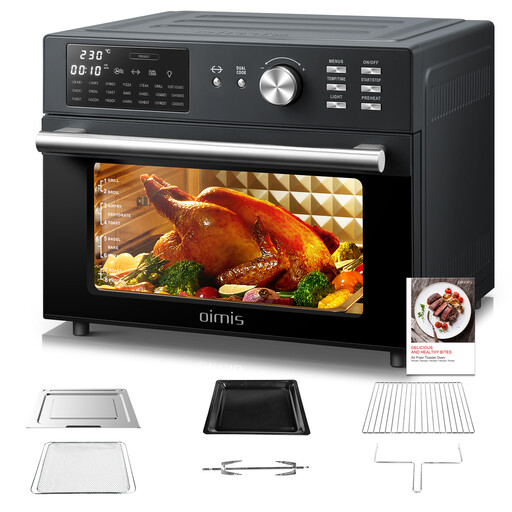 No image available
This countertop appliance could be worth considering for a coffee cake if its internal dimensions suit your chosen tin and you want to use the described fan function.
The product details list a capacity of 30 l, a baking function, 360° air circulation heating and 21 presets.
Check the dimensions of your cake tin separately; a pizza size example doesn’t prove that every cake tin will fit.
No. Start by following the recipe and the oven’s instructions. Top/bottom heat and hot air are different operating modes. A fan is particularly relevant if you want to use several shelves that are explicitly supported. This alone doesn’t tell you what result you’ll get with your cake.
A countertop appliance may suit you for a single cake if your tin, its height and the space you have for the oven are right for the specific model. Rommelsbacher lists tins up to 29 cm for the BG 1550 and up to 31.5 cm in diameter for the BG 1805/E; don’t assume these limits apply to loaf tins or square baking tins. The stated pizza stone size for the Severin TO 2068 doesn’t tell you what size cake tin it can take.
The Verbraucherzentrale describes kWh figures per standardised baking cycle for specified operating modes; they don’t automatically reflect the energy used to bake your particular cake. Only compare figures on a like-for-like basis. Choose an extra cleaning function according to whether you’re likely to use it in everyday life.
Follow the recipe and consider how the cake needs to be stored. If it contains ingredients or toppings that need refrigeration, keep the portions suitably cool during transport too; baking the cake doesn’t make perishable ingredients safe to store unrefrigerated. The Bundeszentrum für Ernährung lists freezing as an option for cake portions, provided they’re packaged appropriately.
Not necessarily: the European Commission lists small ovens as being outside the scope of EU energy labelling for domestic ovens. So check how the specific type of appliance is classified rather than assuming every countertop oven has a label.