What should you look for when buying an oven for a sausage bake?
Built-in oven
A good fit if: You have a suitable housing and need space for a large casserole dish or additional dishes.
Things to consider: The housing dimensions and installation must be suitable for the specific model and your kitchen.
Freestanding mini oven
A good fit if: You don’t have a suitable housing for a built-in oven, and the dish and portions you want to cook will fit in the countertop appliance.
Things to consider: A smaller usable area may mean cooking in batches. You’ll also need to consider where to position the appliance and follow its safety instructions.
When planning a meal for guests, first check that your dish will fit and decide where the oven will go. Then compare cleaning options and energy consumption.
| What to consider |
What to check before buying |
Who it matters most to |
| Dish size and portions |
Compare the external dimensions of your dish, including its handles, with the usable area and shelf positions of the specific model. |
If you want your sausage bake ready in one go for guests, getting the right fit is essential. This is the main consideration for around 36% of consumers. |
| Positioning and oven type |
For a built-in oven, check the housing dimensions and connection details. For a countertop model, check its external dimensions and safety instructions. |
If you don’t have a suitable space for a built-in oven, you’ll need to weigh up the available worktop space against the size of the appliance. Around 29% of consumers say positioning is their top priority. |
| Cleaning and ease of use |
Compare the cleaning method, accessories and instructions for each model. Pyrolytic cleaning requires preparation and a separate cleaning cycle. |
If you cook casseroles often, cleaning requirements may have more of an impact on your daily routine than an extra feature. Around 21% of consumers put this first. |
| Energy use and running costs |
When comparing similar appliances, check the kWh per standard cycle for the relevant heating mode and oven capacity. Consider installation and any accessories you need separately. |
If you use your oven regularly, it’s worth considering energy consumption alongside the other purchase costs. Around 14% of consumers say running costs are their main concern. |
The Consumer Advice Centre explains that energy consumption figures are given for standard cycles by heating mode. The German Environment Agency describes the energy label as showing the efficiency class and oven capacity.
Joybuy ovens for sausage bakes
The Joybuy models below include built-in ovens and a freestanding mini oven. Before choosing, check that the appliance and your casserole dish will fit your kitchen and suit the meal you’re planning.
 No image available
Bosch HBA571BB4 Series 2 built-in oven
Could suit a sausage bake for guests if the housing fits your kitchen and the dish fits inside the oven.
This model is listed with a 71 l capacity, 3D hot air, five shelf positions and pyrolytic cleaning.
The product description specifies professional installation.
View at Joybuy
 No image available
Comfee built-in oven, 60 cm, 70 l
Could suit a casserole for guests if the installation requirements and external dimensions work for your kitchen.
This model is listed with a 70 l capacity, hot air and a grill.
The product title lists AquaClean steam cleaning, a timer and energy class A.
View at Joybuy
 No image available
Bosch Series 6 HBG578ES3 built-in oven
Could suit cooking several dishes or using multiple shelves, provided the housing, installation and dish are right for the appliance.
This model is listed with a 71 l capacity, 3D hot air and conventional top and bottom heat.
The description mentions baking on up to three shelves and pyrolytic cleaning. Installation requires suitable housing dimensions and professional fitting.
View at Joybuy
 No image available
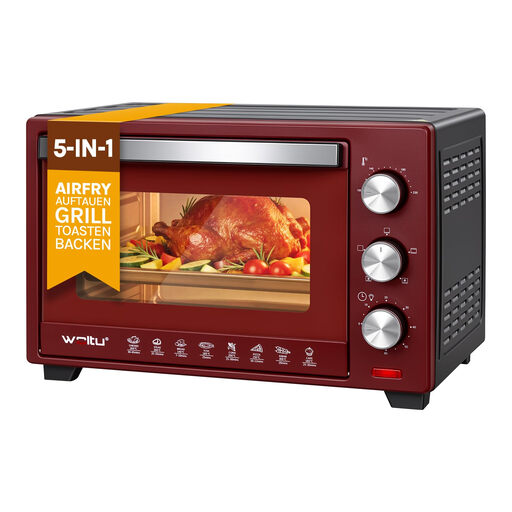
Woltu freestanding mini convection oven, 28 l
Could be an alternative if you don’t want a built-in oven, provided your casserole dish and portions fit in the countertop appliance.
This model is listed with a 28 l capacity, temperature control, a timer, and top, bottom and combined heat.
The title lists a baking tray and wire rack as included.
View at Joybuy
 No image available
Siemens HB978GMB1 studioLine iQ700 built-in oven
Could suit a sausage bake for guests and cooking on several shelves, provided the built-in dimensions and installation work for your kitchen.
This model is listed with a 71 l capacity, 4D hot air, pyrolytic cleaning and a keep-warm function.
The description lists 4D hot air for up to four shelves and specifies professional installation.
View at Joybuy
Frequently asked questions about ovens for sausage bakes
How can I check whether my casserole dish will fit in a mini oven?
Measure the dish’s external dimensions, including its handles, and compare them with the usable area. For the BG 1805/E, Rommelsbacher gives a usable internal area of 34 × 28 cm and recommends using a slightly smaller dish. The capacity in litres alone won’t confirm that it fits.
How can I cook the casserole and keep it warm safely for guests?
The German Federal Institute for Risk Assessment recommends heating food to at least 70 °C throughout for at least 2 minutes, and keeping food at 60 °C or above throughout when holding it hot. The oven temperature setting alone doesn’t show what temperature the food itself reaches.
What should I check before installing or positioning an oven?
For a built-in oven, check the housing dimensions and connection details against your kitchen. For a countertop model, check its external dimensions, where you’ll position it and the safety instructions in the manual. A capacity in litres alone won’t confirm that installation is suitable or that your dish will fit.
What are the running costs, and who can help if the oven develops a fault?
For ovens covered by the energy label, it shows energy use in kWh per standard cycle for the specified heating modes. It doesn’t guarantee how much energy a particular recipe will use. The Consumer Advice Centre says that the retailer is responsible for putting faults right. Your statutory rights are separate from any voluntary guarantee.
Does every type of oven need an EU energy label?
No, not every type of appliance compared here is covered. The European Commission lists small ovens as outside the scope of the ecodesign regulation mentioned. For new household ovens that are covered, it describes an energy label showing the efficiency class, oven capacity and energy use per cycle.


