Cooking for a group with your own baking dish
If you’d like to bake several aubergine rolls at once, check that your dish, including its rim and handles, fits inside the usable oven cavity.


First, check that your baking dish, including its handles, fits inside the usable oven cavity and that the oven can be positioned safely with the required clearances. The oven already in your holiday cottage may be suitable if it fits your dish and offers the heating function you need. If you’re considering an additional countertop oven, usable dimensions matter more than the litre capacity alone. Recipe temperatures and timings won’t guarantee the same results in every mini oven.
If you’d like to bake several aubergine rolls at once, check that your dish, including its rim and handles, fits inside the usable oven cavity.
Compare the space available with the appliance’s external dimensions and required safety clearances. Also check that the available power socket is suitable.
If you’d like to cook other oven dishes as well as the rolls, check which heating functions can actually be selected, rather than looking only at the size of the casing.
First, use a suitable oven that’s already provided in your accommodation and can be positioned safely. If you need an additional appliance, check that your dish will fit and that you have room for it before choosing the heating functions you need.
| Buying priority | What to check | Who is this important for? |
|---|---|---|
| Dish size and portions | Compare the dish, including its handles, with the usable internal and tray dimensions; allow space above the dish. | If I want to bake several rolls at once, my dish needs to fit and there must be enough room for the portions. Around 31% of consumers therefore prioritise dish fit and portion capacity. |
| Space and power connection | Check the external dimensions, door opening, space available and model-specific clearances; follow the connection instructions in the manual. | With limited worktop space in a holiday cottage, I want to position the appliance safely and use it with the available socket in accordance with the instructions. Around 31% of consumers prioritise space and the power connection. |
| Heating functions | Check whether top and bottom heat and, where needed, fan-assisted cooking are available and selectable; take the recipe’s settings into account. | If I want to cook other oven dishes too, I need to be able to select the heating function specified in the recipe. Around 23% of consumers prioritise the heating functions available. |
| Cleaning and other uses | Check what’s included, such as a baking tray and crumb tray, and read the cleaning instructions for the exact model. | If I want to use the oven for more than one dish, I look for suitable accessories and straightforward cleaning. Around 15% of consumers make this their priority. |
A capacity in litres or a stated fit for round dishes doesn’t tell you whether a rectangular baking dish, including its handles, will fit.
Measure the entire dish and compare its external dimensions with the usable internal dimensions and the manufacturer’s specifications.
If your dish doesn’t fit, you may need a different one or have to bake in several batches.
A countertop oven can get hot on the outside. Just because the casing fits on the worktop doesn’t mean the oven can be used there safely with the required clearances.
Check the positioning and connection requirements for the exact model you’ve chosen before deciding that the space in your holiday cottage is suitable.
The European Commission excludes small and portable ovens from the scope of EU rules on energy labelling for ovens. For an appliance classified in this category, the absence of a label alone is therefore no evidence of a breach of the rules.
Check the appliance category and compare the relevant manufacturer’s information, rather than assuming it must have a label that doesn’t apply to that category.
Mini ovens in a range of cavity sizes; the BG 1550 is an example of a model with a larger cavity.
Freestanding designer ovens; the TO 20 is an example of a model with several heating functions.
Mini ovens and toaster ovens in a range of sizes and specifications.
Compact ovens, including the KB 238 Black Steel, which has a larger cavity.
The products below range from compact to larger countertop ovens and also include an air fryer oven. For a specific mains-powered appliance, check whether it falls under the Low Voltage Directive; where the 50–1.000 V AC range applies, the relevant safety and conformity requirements, including CE marking, are important. The Bundesnetzagentur describes CE marking as a declaration by the manufacturer, not an independent quality seal. Also look for the required operating and safety instructions in German.
 No image available
With a 32 l capacity, this model is an option if you’re looking for a countertop oven for baking and grilling; check first that your baking dish will fit.
The product title lists 1.600 W, a timer, a crumb tray and a temperature range of 100 to 250 °C.
 No image available
The compact 10-litre cavity could suit smaller baking jobs, provided your dish’s dimensions are a good fit.
Features listed include top and bottom heat, a temperature range of 100 to 230 °C, a 60-minute timer and external dimensions of 37 × 26,5 × 21 cm.
 No image available
With a 28 l capacity, this model is an option if you’re looking for a larger mini oven for a variety of dishes; compare your dish’s dimensions with the usable oven cavity.
The description lists top heat, bottom heat and combined heat, as well as three adjustable shelf positions. The product title lists temperature controls and a timer.
 No image available
This 35-litre countertop oven could be a good option if you’d like more capacity and several shelf positions; you’ll still need to check the dimensions of your baking dish separately.
The description lists a four-level rack, a thermometer function, an LED display and 360-degree convection heating.
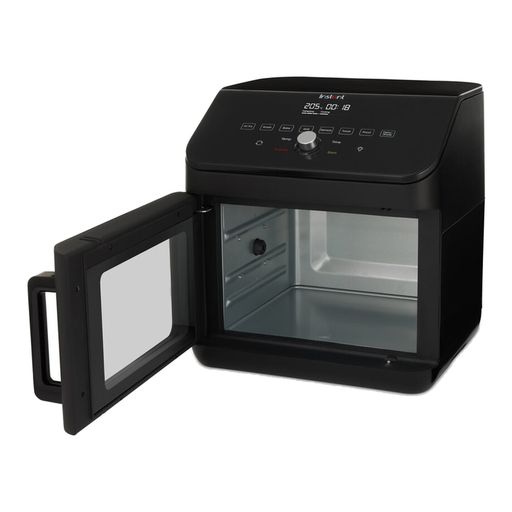 No image available
This 13-litre model could suit you if you’d like to try cooking methods beyond baking; check that the cooking trays are suitable for your dish.
The description lists two cooking trays, several cooking programmes and 360-degree hot-air circulation.
No, you can’t be sure the dish will turn out the same in every appliance. Recipe instructions apply to the specific cooking method. Choose the right heating function, follow the appliance manual and check that the food is cooked through. DasKochrezept.de provides separate settings for top and bottom heat and fan-assisted cooking in its recipe.
Follow the instructions for the specific appliance when positioning it and connecting it to the power supply, and check that you’re allowed to use your own appliance in the accommodation. For example, a Steba manual warns that surfaces can get hot, prohibits using the appliance as a built-in oven and requires a suitable earthed socket. Let the oven cool down before cleaning it.
No. If you buy from a retailer in Germany, your statutory consumer rights are generally claims against the seller; any additional guarantee is voluntary and comes with its own terms. The Verbraucherzentrale states that the statutory period is generally two years.
No. The European Commission lists small and portable ovens as excluded from the scope of oven energy labelling rules. For an appliance classified in this category, the absence of a label alone is no evidence of a breach of the rules; what matters is the category of the specific appliance.
For a mains-powered appliance covered by the Low Voltage Directive, the relevant conformity requirements, including CE marking, are important. The Bundesnetzagentur describes CE marking as a declaration made by the manufacturer on its own responsibility, not an independent quality seal. Also check that the required operating and safety instructions are available in German.