Loaf cake bakers
If you mainly want to bake a lemon cake in a tin you already own, first check the tin’s dimensions, the shelf height and the heating function specified in the recipe.


A mini oven may be enough for individual lemon loaf cakes, provided your tin fits and the oven offers the heating function specified in the recipe. If you’re baking several cakes or doing multiple batches, usable space, suitable heating functions and whether the appliance can be freestanding or built in matter more. A freestanding cooker is mainly worth considering if you also need a hob. Dr. Oetker Deutschland’s recipe is for a lemon loaf cake, not specifically every lemon drizzle cake, and gives different settings for conventional and fan cooking.
If you mainly want to bake a lemon cake in a tin you already own, first check the tin’s dimensions, the shelf height and the heating function specified in the recipe.
If you’re planning several cakes or batches, compare the usable shelf and tray space, as well as the heating functions you need. The stated capacity in litres alone doesn’t tell you how many tins will fit at once.
If you don’t have a suitable space for a built-in oven, a freestanding appliance could be an option. Before buying, check the available surface area, the appliance’s external dimensions and whether your tin will fit.
A good fit if: you have a suitable cavity and regularly bake larger quantities.
Bear in mind: the installation dimensions and plans need to suit the space you have.
A good fit if: you also need a hob and have a suitable space for the appliance.
Bear in mind: you’re buying the hob and oven together. The Verbraucherzentrale notes that the oven’s energy rating does not include the hob’s energy consumption.
A good fit if: you bake individual cakes or don’t have space for a built-in oven, and your tin and shelf will actually fit inside.
Bear in mind: the stated oven capacity doesn’t guarantee that your loaf tin will fit.
As a practical reference, Dr. Oetker Deutschland’s lemon loaf cake recipe uses a 25 × 11 cm loaf tin and takes around 60 minutes to bake. The recipe’s timings and settings won’t necessarily apply to other lemon cakes.
| What matters to you | What to check when buying | Who this matters most to |
|---|---|---|
| Recipe and tin | Compare the tin, including its rim and handles, with the internal, shelf and rack dimensions; check that the required heating function is available. | If I want to use a loaf tin I already own, the tin and shelf need to fit and the recipe’s heating function must be available; around 36% of consumers prioritise this fit. |
| Quantity to bake | Check how many cakes you need, the usable shelf and tray dimensions, and the heating functions for your planned batches. | If I’m preparing cakes for sale in several batches, I need suitable capacity and baking schedules I can plan around; around 29% of consumers put baking capacity first. |
| Space and appliance type | Compare the appliance’s external dimensions with the built-in cavity or available surface area; only factor in a hob if you need one too. | Anyone without space for a built-in oven, or who also needs a hob, will need to find an appliance type that works for them; around 21% of consumers prioritise the space available. |
| Running costs and ongoing expenses | For appliances with an energy label, compare kWh per standard cycle. If you’re looking at a cooker, don’t apply the oven’s figure to the hob. | If I bake repeatedly and want to consider running costs, the stated standard figures are relevant; around 14% of consumers look at running costs and ongoing expenses first. |
A tray’s capacity and external dimensions don’t tell you whether a particular loaf tin will fit on the shelf and inside the oven.
Measure the tin, including its rim and handles, and compare its dimensions with the usable interior, shelf and rack positions of the specific appliance.
Dr. Oetker Deutschland’s recipe gives conventional and fan cooking as alternatives, with different temperature settings. According to its technical specifications, the Severin TO 2067 does not have a fan function.
First check which heating function your recipe calls for, then consider any additional programmes.
The Verbraucherzentrale explains that energy figures are based on standardised baking cycles; your recipe’s actual energy consumption may differ.
For appliances with an energy label, compare the kWh per standard cycle, but don’t use this to calculate the exact electricity cost of baking one cake.
The BG 1805/E mini oven is worth considering as a freestanding option if you want to check whether a larger baking tin will fit and don’t have a built-in cavity.
The TO 2067 is worth considering as a compact, freestanding oven for individual cakes and smaller spaces.
The FSM67320DXT freestanding cooker is worth considering if you also need a hob.
The Joybuy models below include built-in ovens for planned baking batches, as well as freestanding mini ovens. Whichever type you choose, check that your tin fits, compare the usable internal dimensions and make sure the oven offers the heating function specified in your recipe.
 No image available
This built-in oven could suit planned baking batches if you have a suitable cavity. The product name lists a 71 l capacity and 3D Hotair.
 No image available
This built-in model requires a suitable cavity. The product name lists a 70 l capacity and 3 kW; check the appliance and cavity dimensions before buying.
 No image available
This built-in model is an option if you have a suitable cavity. The product name lists a 60 cm width, AirFry and 3D Hotair; check that the heating function suits your recipe.
 No image available
This freestanding mini oven could suit you if you’re not looking for a built-in option. The product name lists a 32 l capacity, 1,600 W, a timer and a temperature range of 100–250 °C; check the usable dimensions to make sure your tin fits.
 No image available
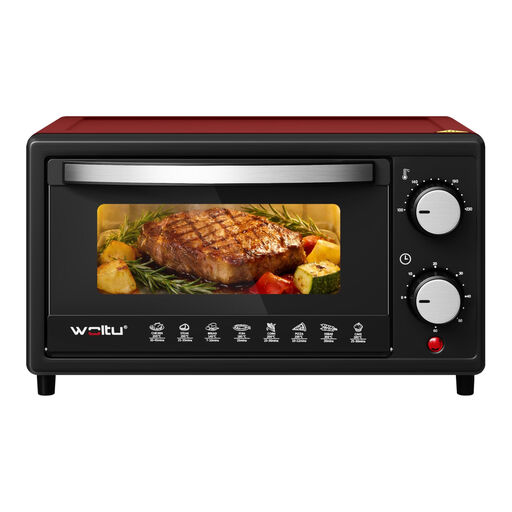
Described as a compact, freestanding option, this model could be worth considering for a single baking batch. The product name lists a 10 l capacity, a temperature range of 100–230 °C and a pizza function; check that your tin will fit before buying.
Follow your recipe and choose a heating function your oven actually offers. Dr. Oetker Deutschland’s lemon loaf cake recipe specifies around 170 °C on conventional heat or around 150 °C on fan heat for its 25 × 11 cm tin, with the oven preheated and a baking time of around 60 minutes. Other recipes may differ.
No. The oven capacity alone doesn’t tell you whether a particular tin will fit. Check the tin’s external dimensions, the shelf, the usable internal dimensions and the shelf positions. For example, Rommelsbacher lists a 42 l capacity for the BG 1805/E and external dimensions of 38.5 × 31.5 cm for its original baking tray; that doesn’t mean every tin will fit.
Energy data for ovens with the relevant energy label is based on standard cycles and doesn’t tell you exactly how much energy your particular cake will use. In Germany, the statutory warranty you have against the seller is separate from a voluntary guarantee, as the Verbraucherzentrale explains. Also check the terms of any service plans on offer.
There isn’t a blanket answer. The Federal Office of Consumer Protection and Food Safety lists activities without sufficient continuity and organisation, such as those at club events, as potential exceptions to registration, and says the decision depends on the individual case. The Verbraucherzentrale distinguishes occasional private charity sales from regular sales when it comes to allergen labelling. If you’re selling regularly or in an organised way, or you’re unsure how the event is classified, check the specific requirements with your local food safety authority and the event organiser.