Batch bakers
If you’re preparing lots of parcels together, look for fan cooking that’s explicitly designed for multiple shelves, suitable baking trays and enough space between the pastries.


If you want to bake lots of puff pastry parcels at once, a built-in oven with fan cooking explicitly designed for use on multiple shelves could be a good option. Check how many suitable baking trays are included, too. For small batches baked one after another, a countertop oven may be enough. What matters is the usable tray area, a safe place to position the appliance and the heating method specified in the recipe – not just the oven capacity. Dr. Oetker recommends about 200 °C using conventional top and bottom heat, or 180 °C with fan cooking, for its puff pastry parcel recipe.
If you’re preparing lots of parcels together, look for fan cooking that’s explicitly designed for multiple shelves, suitable baking trays and enough space between the pastries.
A countertop oven could work well for modest batches baked one after another. Check the usable tray area and make sure there’s enough room for the specific appliance where you plan to put it.
If you’re replacing or adding an oven, consider the installation dimensions, controls and comparable energy consumption figures, rather than comparing the number of extra features alone.
First decide whether you want to bake the whole batch at once or prefer to bake smaller batches one after another. Then compare the space required, heating type and cleaning options.
| What matters | What to check when buying | Who it matters most to |
|---|---|---|
| Several trays at once | Check which shelf positions are suitable for fan cooking, as well as the number and dimensions of the trays. For its recipe, Dr. Oetker recommends about 200 °C using conventional top and bottom heat, and 180 °C with fan cooking. | When we’re preparing lots of parcels for everyone to enjoy together, we want to know how many can actually be baked at once. Around 36% of consumers put the number of trays that can be used at the same time first. |
| Batch size and space | Compare the usable tray area and external dimensions with the space available, and check the model-specific installation instructions. For the Steba KB M19, the manufacturer gives internal dimensions of 23,5 × 31 × 25,5 cm (H × W × D); the Rommelsbacher BG 1805/E has an overall width of 55 cm, according to the manufacturer. | When space is limited and we’re baking smaller batches one after another, we want to know whether the appliance can be positioned safely and whether the parcels will fit on the tray. Around 29% of consumers prioritise a suitable batch size when space is limited. |
| Energy consumption | For household ovens with the relevant label, compare figures only for the same heating type and measurement basis. The German Environment Agency explains that the energy label shows consumption per standard cycle. | When we bake often, we want to compare energy figures in a meaningful way, without assuming they’re the same as the actual consumption for a single batch. Around 21% of consumers prioritise comparable information on energy use and running costs. |
| Ease of use and cleaning | Check the door opening, trays and removable parts, and find out which cleaning function is actually included with the model you’re considering. | After baking, when we’re handling trays and clearing away crumbs, we want an oven that’s easy to access and straightforward to clean. Around 14% of consumers put ease of use and cleaning ahead of tray capacity, space and energy consumption. |
The manufacturer lists four shelf positions for the Rommelsbacher BG 1805/E, but only one baking tray is included. So the number of shelf positions doesn’t mean you can use four trays at the same time.
Check the contents and instructions for the specific model against the batch size you have in mind.
Installation requirements vary by model. The Steba KB M19 manual explicitly states that the appliance is not a built-in oven.
Before buying, check the external dimensions, including the appliance feet, and follow the installation instructions for the oven you choose.
The consumption figures shown relate to standard cycles and don’t automatically reflect the load, baking time or your electricity tariff.
Compare figures only for the same heating type and measurement basis. To estimate your own costs, you’ll also need to make suitable assumptions about how you use the oven and your tariff.
Built-in ovens; the B54CR71N0 is worth considering if you want to use several shelf positions.
Countertop ovens; the BG 1805/E could be a larger countertop option for one bigger batch.
Compact countertop ovens; the KB M19 may suit small batches baked one after another.
Built-in ovens; the HR776G1B1 offers fan cooking and extra features for more versatile use.
Built-in ovens; the BBIM12300X is an option if you’re looking for a 60 cm built-in model with fan heat distribution.
The Joybuy products below range from countertop appliances to built-in and freestanding cookers, and are relevant for baking puff pastry parcels. Compare the usable tray area, heating type, space or installation dimensions and what’s included to find the right option for you.
 No image available
Could suit a batch baked for everyone to enjoy together if you’re looking for a countertop appliance with a baking tray.
32 l; temperature range 100–250 °C; 60-minute timer; one baking tray and one wire rack listed as accessories; removable crumb tray.
 No image available
The description says several baking trays can be used at the same time; check which trays are included before buying.
28 l; three heating modes; temperature range 100–230 °C; 60-minute timer.
 No image available
This countertop appliance could be worth considering for baking on several levels; check which trays are suitable for the batch size you have in mind.
35 l; convection heating; four-level baking rack; built-in thermometer and LED display.
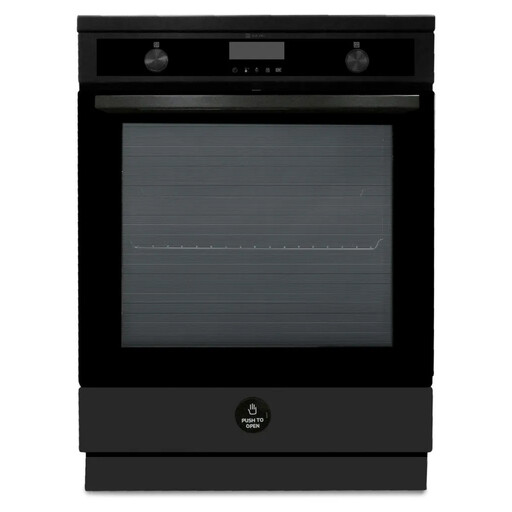 No image available
A combined cooking and baking appliance to consider if you’re looking for an induction hob as well as an oven.
73 l oven; fan cooking; one enamelled baking tray; nine heating functions; temperature range 30–300 °C; pyrolytic cleaning. According to the product description, it should be connected by a qualified electrician; 230 V and 16 A are specified.
 No image available
The description specifies 3D hot air for up to three levels; the trays actually included are also important for the batch size you have in mind.
71 l; ten heating functions; temperature range 30–275 °C; pyrolytic cleaning; one baking tray and one Air-Fry tray listed. For installation, the description specifies a niche width of 56–56,8 cm, a niche height of 58,5–59,5 cm and a depth of 55 cm, and says installation should be carried out by a qualified professional.
For its specific recipe, Dr. Oetker recommends about 200 °C using conventional top and bottom heat, or about 180 °C with fan cooking, after preheating. The baking time is around 20 minutes. Also check your recipe, oven instructions and how brown the parcels are getting; these settings aren’t guaranteed to suit other fillings or appliances.
Not necessarily. The Steba KB M19 manual explicitly says that the appliance isn’t a built-in oven and requires, among other things, a 10 cm gap between the back of the appliance and the kitchen wall. For any other model, follow its own installation instructions.
For household ovens with the relevant label, the EU energy label shows consumption per standard baking cycle for certain heating types and oven capacities. This isn’t a direct measurement of energy use for your batch of puff pastry parcels. To make a specific cost estimate, you’ll need comparable assumptions about how you use the oven and your electricity tariff.
The German Environment Agency explains information shown on oven labels, such as oven capacity and consumption per standard cycle. Changes to German ecodesign and energy labelling laws also apply from 1 November 2026. If goods are faulty, you have statutory rights against the seller; a guarantee is separate and voluntary.
If you’re using raw meat filling, don’t rely on the pastry’s colour alone. The German Federal Institute for Risk Assessment recommends heating food to at least 70 °C throughout for two minutes, and handling raw and ready-to-eat foods separately to maintain good food hygiene.