Quark cheesecake bakers
You’re mainly looking to bake a recipe-led cake during a baking session with others, and want to select the right heat setting without any fuss.


For a quark cheesecake, look for an oven that lets you select the conventional heat setting specified in the recipe and has enough space for your tin. If you’d also like to bake other items at the same time, approved shelf levels and a fan setting may be useful too. However, a manufacturer’s claim that an oven can bake on several levels doesn’t mean your cheesecake recipe will work unchanged. NEFF describes conventional heat as a suitable setting for cakes with a moist topping.
You’re mainly looking to bake a recipe-led cake during a baking session with others, and want to select the right heat setting without any fuss.
You’re making extra bakes at the same time and want to know whether having several usable shelf levels could make things easier.
You’re replacing a built-in oven and need to take the niche dimensions, connection type and disposal of your old appliance into account.
| What matters | What to check before buying | Who should pay particular attention |
|---|---|---|
| The right heat setting | Check that the oven has conventional heat and the temperature range required by your recipe. Your cake tin must also fit inside the oven. | If I’m following a recipe, I want to be able to select the specified heat setting easily. Around 36% of consumers would put the right heat setting first. |
| Space and baking at the same time | Check your tin and baking trays against the oven’s interior dimensions. Consult the manual to see which shelf levels are approved for the heat setting you want to use. | If you’re baking other items during the same session, you’ll need enough space and clear guidance on using multiple shelf levels. Around 29% of consumers would prioritise baking several items at once. |
| Fit and connection | Check the niche height, width and depth, as well as the connection details for the specific model, against your kitchen. | When replacing a built-in appliance, I want to make sure the new model will fit the existing niche and installation. Around 21% of consumers would consider fit and connection first. |
| Energy use and cleaning | Consider energy use per standard cycle alongside the oven’s capacity, and check the cleaning system for the model you’re considering. | If I use my oven regularly, energy use and the effort involved in cleaning it matter to me. Around 14% of consumers would focus on these factors. |
A manufacturer’s claim that an oven can bake on several levels doesn’t tell you whether a quark cheesecake recipe will work equally well on every level or with a fan setting. One published recipe for quark tart uses conventional heat.
Check the heat setting for your specific recipe separately from your plans for baking other trays and dishes.
Oven capacity isn’t the same as its interior dimensions or the dimensions of the built-in niche. So, a capacity that sounds generous doesn’t confirm that your springform tin will fit or that the oven will fit your existing kitchen.
Check your tin and niche dimensions against the specifications for the exact model.
The European Commission and consumer advice organisation Verbraucherzentrale explain that energy-label figures show consumption per standard cycle for different modes. These standardised figures don’t calculate the energy use or cost of baking an individual recipe.
When comparing energy labels, look at the kWh figures for each listed operating mode and the oven capacity, rather than focusing only on the energy rating.
The Siemens HB314G0S3 is an example of a built-in oven with conventional heat and a fan setting.
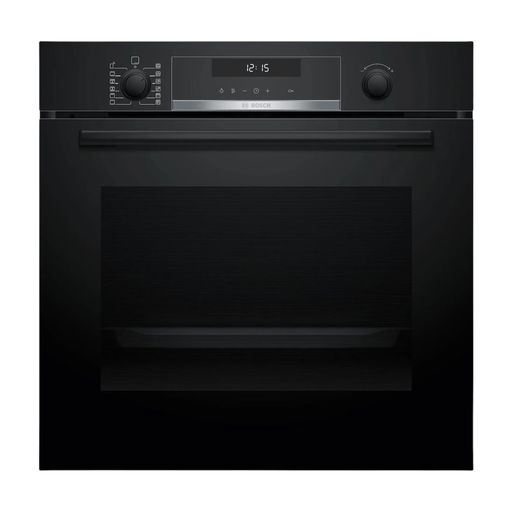
The Bosch HBA572BB4 is an example of a built-in oven with several heat settings and pyrolytic cleaning.
The AEG BE1100B is an example of a model with a 72 l capacity and an Aqua cleaning function.
The Miele H 2455 BP ACTIVE is an example of a model with a timer and pyrolytic cleaning.
The product options below include built-in ovens for recipe-led baking, as well as models with extra features for baking several items at once or meeting different cleaning preferences.
 No image available
If you’re choosing based on oven capacity and extra features, this model may be worth considering. Check the product details to make sure it has the heat setting your recipe requires.
71 l capacity, 3D fan cooking and pyrolytic cleaning.
 No image available
If you’d like to cook other dishes at the same time, check whether the information on multi-level cooking suits your plans.
The product name lists a 70 l capacity, 3 kW, AquaClean, an LED timer display and several heat and cooking functions.
 No image available
This model may suit buyers who want to consider pyrolytic cleaning alongside their choice of oven.
The product name lists a width of 60 cm, Home Connect, AirFry and a black finish.
 No image available
For a baking session with others, the product name’s AirFry and 3D fan cooking features are a good reason to check whether it suits the dishes you plan to make and the shelf levels you’ll use.
The product name lists a width of 60 cm and a steel finish.
 No image available
If you’re considering this compact option for a baking session, check beforehand that your cake tin will actually fit inside.
The product name lists a 23 l capacity, two cooking zones and 15 programmes.
No. A recipe for a quark tart in a 26-cm springform tin specifies 175 °C conventional heat. Follow your specific recipe rather than changing the heat setting just because your oven has a multi-level function.
Check the niche dimensions and connection details for the exact model against your kitchen, and follow its installation instructions. For example, Siemens specifies an earthed Schuko/Gardy plug for the HB314G0S3; this doesn’t apply to all ovens.
The EU oven label shows energy use in kWh per standard cycle for conventional and fan cooking, as well as the oven capacity. The European Commission describes these standardised figures as a way to compare appliances; they don’t calculate the energy use of your individual cake recipe.
Old electrical appliances mustn’t go in household rubbish. Local recycling centres are one option; the German Federal Government also describes designated take-back points at retailers. If your new oven is being delivered, check separately whether collection of the old appliance is available.