Which buying considerations matter most?
First, work out the size of your dish and how much space you have for a freestanding or built-in oven. Then check which timing and alert features will support your routine without replacing checks on the food itself.
| What matters |
What to check before buying |
Who is it important for? |
| Coordinating cooking and serving times |
Check the cooking-time settings, alert and, where available, keep-warm function on the specific model. Rommelsbacher lists a timer with an audible signal for the BG 1805/E. Remote start and connected features on the Siemens HR776G1B1 depend on requirements such as an internet connection and activation. |
When we’re planning the casserole together, I need a clear alert for the agreed check-in time, not necessarily an app. Around 26% of consumers say coordinating timings is their main concern. |
| Safe cooking and keeping food warm |
Plan to check the temperature inside the food, and keep perishable ingredients chilled until you’re ready to prepare them. The German Federal Institute for Risk Assessment (BfR) recommends heating food to at least 70 °C throughout for two minutes, and keeping cooked food at a minimum of 60 °C throughout when holding it hot. |
When there’s sausage in the casserole, I don’t want to rely on the timer alone. I need to make sure it’s cooked through and handle any waiting time safely. Around 26% of consumers prioritise safe preparation. |
| Space for the casserole and other dishes |
Measure your dish, including its handles, and compare it with the usable shelf or tray area and shelf positions. Bosch Hausgeräte lists a 71 l capacity and 3D hot air for up to three levels on the HBA571BB4; Rommelsbacher lists dishes up to 31.5 cm in diameter for the BG 1805/E. |
When I’m cooking several portions, I want to know whether my dish will fit with its handles and whether there’s room for side dishes. Around 21% of consumers put space for a casserole and other dishes first. |
| A suitable built-in or freestanding space |
For a built-in oven, compare the cavity dimensions; for a worktop model, check its external dimensions and installation requirements. Bosch Hausgeräte lists a cavity width of 560–568 mm and a cavity depth of 550 mm for the HBA571BB4; Rommelsbacher gives dimensions of 54,50 × 43,00 × 36,00 cm (W × D × H) for the BG 1805/E. |
If your kitchen doesn’t have a suitable cavity or you have very little worktop space, the oven needs to fit the space you have. Around 16% of consumers choose an oven based first on where it will be installed or positioned. |
| Energy use and cleaning |
Compare kWh per cycle for ovens of a suitable size using the same heating method, and check the cleaning system on the specific model. The data sheet from SEG Hausgeräte GmbH / Siemens dated 16 September 2026 lists 0.87 kWh per cycle for conventional heating and 0.69 kWh for fan heating on the HR776G1B1. These are standard-cycle figures, not a prediction of how much energy your casserole will use. |
If I use the oven often, I want to consider energy use per cycle and cleaning, rather than relying on the energy rating alone. Around 11% of consumers prioritise electricity use and cleaning effort. |
Ovens at Joybuy for your dish, timings and available space
This selection includes built-in ovens for a suitable cavity and a mini convection oven for the worktop. Above all, compare the size of your dish, the timer features and the space you have available.
 No image available
Bosch HBA571BB4 Series 2 built-in oven
An option if you have a suitable built-in cavity and need space for a casserole or additional dishes.
71 l capacity; 3D hot air for up to three levels; electronic clock and AutoPilot programmes. Your dish and cavity dimensions must be suitable for the model.
Joybuy
 No image available
Comfee built-in oven, 60 cm, 70 l
An option for a kitchen with a suitable built-in cavity and a cooking routine where a timer can mark the time to check the food.
70 l; hot-air cooking on multiple levels; LED display with timer. The timer doesn’t confirm that the casserole is cooked through.
Joybuy
 No image available
Bosch HBG578ES3 built-in oven
Could suit you if you have a built-in cavity and want to plan regular cooking routines using automatic programmes.
71 l; 3D hot air for up to three levels; 30 AutoPilot programmes. The programme doesn’t replace checking that the casserole has been heated sufficiently throughout.
Joybuy
 No image available
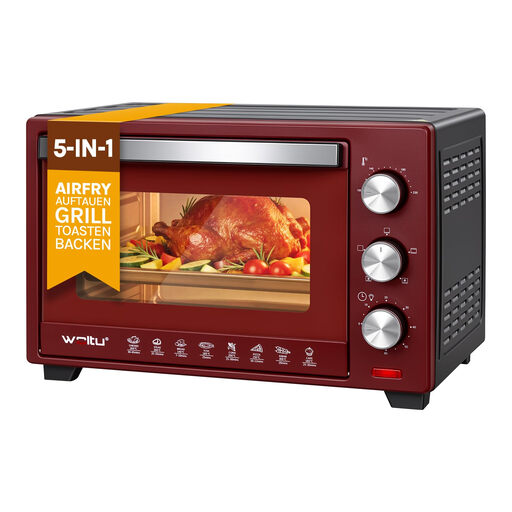
WOLTU mini convection oven, 28 l
An option without a built-in cavity if you have enough worktop space and your casserole dish will fit inside.
28 l; temperature control and 60-minute timer with alert. The product description gives a pizza up to 26 cm across as an example of size, but doesn’t confirm that every casserole dish will fit.
Joybuy
Frequently asked questions about ovens and sausage casserole
Can I put sausage casserole in the oven unrefrigerated and use remote start later?
No. Remote start is no substitute for refrigeration. Keep perishable ingredients chilled according to the storage instructions until you’re ready to prepare them, and plan your shared routine around safe storage. Home Connect also says that remote start depends on the appliance and activation.
Is the oven timer’s alert enough to show that the sausage is cooked?
No. A timer alert shows how much time has passed, not the temperature inside the food. The BfR recommends heating food to at least 70 °C throughout for two minutes. Check the casserole accordingly, especially if you’re using raw sausage.
What can I do if our mealtime is delayed?
Check the temperature inside the cooked casserole rather than relying only on the oven temperature you’ve set. The BfR recommends keeping food hot at a minimum of 60 °C throughout; for longer storage, it recommends cooling food quickly to below 7 °C.
What should I check before ordering, installing or positioning an oven?
For the specific built-in model, compare the cavity dimensions and connection requirements with your kitchen. For a worktop oven, check its external dimensions, the space needed to open the door and the installation requirements in the instructions. Make sure any work on a fixed electrical connection is carried out by a qualified professional.
Does every oven in Germany need an EU energy label?
Energy labelling is required for household ovens covered by the relevant EU rules. The European Commission lists exemptions and cases that need to be checked separately, including small ovens and appliances with a microwave heating function. So, a mini oven without a label isn’t automatically non-compliant.


